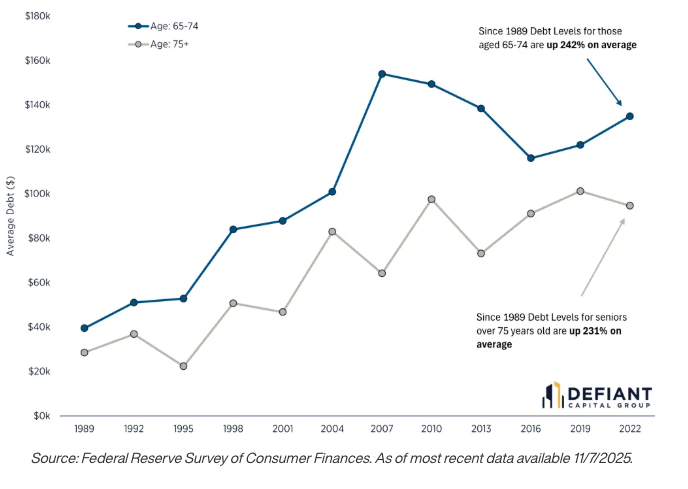
Warren Buffett has raised a red flag about a segment of the housing market that deserves more attention – senior homeowners (i.e. homeowners over sixty years old). He has noted that Americans over 60 have been taking on increasing amounts of debt, a trend that could pose broader risks to the economy. Rising property taxes, insurance costs, and an increase in home equity loans and cash-out refinances (“cash out” strategies) have left many seniors more financially stretched than in decades past.
While the Federal Reserve doesn’t break out its regularly updated household borrowing by age group, it’s Survey of Consumer Finances does. The below graph is a little old but remains accurate given the trend has accelerated.

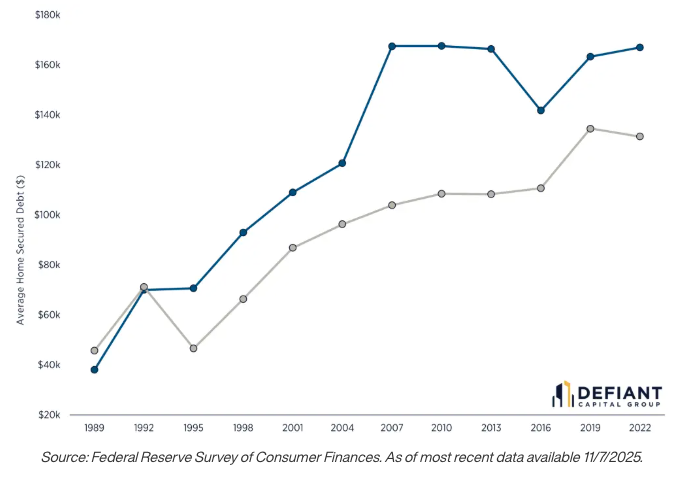
Even more troubling is the Home Secured debt by Seniors, which again has been steadily increasing.
These cash out strategies might provide short-term relief or spending flexibility, but they also erode a homeowner’s financial cushion. When unexpected expenses or market downturns hit, those without sufficient liquidity may be forced to sell their homes, often under unfavorable conditions.
In fact, while the broader housing market still has momentum, we are starting to see home values softening in several regions. This could indicate an approaching a point where involuntary home sales by older homeowners put additional downward pressure on housing markets.
Economic Cycles and Forgotten Lessons
History shows that financial behavior tends to repeat itself as collective memory fades. Once the last generation that experienced a major downturn is gone, the hard-learned lessons of restraint and caution often disappear too. Buffett’s concern isn’t just about housing debt; it’s about how human behavior drives cycles of risk and excess.
A century ago, Charles E. Mitchell, chairman of National City Bank (now Citigroup), played a role in fueling the stock market bubble of the 1920s by promoting heavy use of margin loans, borrowing to invest. That ended disastrously in the Great Depression.
The parallels today, with leverage rising in both the consumer and corporate sectors, are striking. As market strategist Ed Yardeni recently observed, this decade has its own echoes of the “Roaring Twenties,” where optimism and easy access to credit can lead to painful reversals.
What Buffett’s Cash Position Signals
Perhaps most telling, Buffett himself has been a net seller of stocks in recent years. Berkshire Hathaway now holds nearly $400 billion in cash and Treasury securities – one of its largest cash positions in its history. That kind of patience reflects caution about valuations and broader market risk. For investors, it’s a reminder that sometimes the best opportunity isn’t chasing yield or returns, but waiting for the right moment to deploy capital.
Key Takeaway
Buffett’s warning isn’t just about seniors or real estate – it’s about financial discipline. Whether you’re managing a portfolio or a household balance sheet, the principle is the same: leverage magnifies both gains and losses. Maintaining liquidity, avoiding unnecessary debt, and remembering the lessons of past cycles can help investors and families alike weather what comes next.
Please read important disclosures here.
A message from Advisor Perspectives and VettaFi: Discover something new! Click here to register for our upcoming webcasts.
© Defiant Capital Group
Read more commentaries by Defiant Capital Group