Running Hot
Membership required
Membership is now required to use this feature. To learn more:
View Membership BenefitsIn the last few years, we who remember the 1970’s inflation got to watch new generations learn how it feels. They haven’t enjoyed it, to say the least. I’d like to reassure them the worst is behind us. Unfortunately, I’m not sure it is.
The inflation of my youth wasn’t just a few years in the 1970s. It was an era that started in the 1960s and extended into the early 1980s. It waxed and waned within those years but gradually worsened until Paul Volcker “ended” the worst of it. The solution was quite painful, too: two recessions and high unemployment - but by that point we had run out of better options.
Now we’re roughly four years into a period of post-COVID inflationary pressure, largely the result of the Federal Reserve being too timid to slowly raise rates as inflation went over 4%. It peaked in 2022 but remains stuck above the pre-pandemic rate. I see little reason to think it will fall much from here, at least in the next few quarters – and quite a few reasons to suspect it could rise.
Let’s also note, the inflation rate is a rate, not a level. If you have a year of, say 5% inflation followed by a year of 1% inflation then yes, the inflation rate is lower. But prices are still 6% higher than they were two years earlier. They have slowed their rate of ascent but have not descended. Absent outright deflation, which has its own different but painful problems, inflation is a permanent increase in the price level.
As happened in the previous era, several forces are combining to keep inflation alive. Today I want to review what’s happening. This won’t be a fun letter to read, but it’s important. You need to prepare for what could be coming.
Third Wave
Let’s start by looking closer at the last era of inflation, in its entirety. The blue line in the chart below shows CPI inflation’s annual rates by month from 1967 to 1983. I added red arrows to highlight the three separate upward legs.
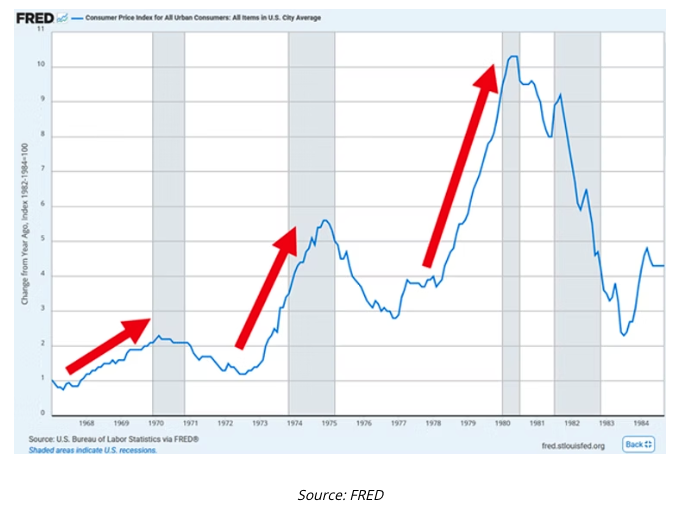
As the chart begins, inflation was quite low, just 0.75% for the year ending May 1967. By early 1970 the rate had more than tripled to 2.3% - still very low but proportionally a giant leap from where it had been. Inflation was not really a pressing topic when I was taking economics at Rice University. Many of the professors still personally remembered the Great Depression and deflation, and inflation under 2% wasn’t on their list of concerns.
This phase gave way to a two-year downtrend. Inflation improved but remained higher than before. It turned out to be a temporary break, giving way to a much worse streak from 1972-1975. Then inflation fell again before beginning the near-vertical rise that we now think of when we say, “1970s inflation.”
Notice also the gray bars, signifying recessions. Inflation accelerated during the deep and lengthy 1974-75 recession. This is what we mean by “stagflation.”
Finally, observe how bringing inflation down from the 1980 peak at just over 10% down to a “mere” 5% took two full years. Volcker did this by raising interest rates to a level that made most private borrowing practically impossible, forcibly deleveraging the economy. It was extremely painful, but he had no other options. As we’ll see below, even that option is unavailable to us now.
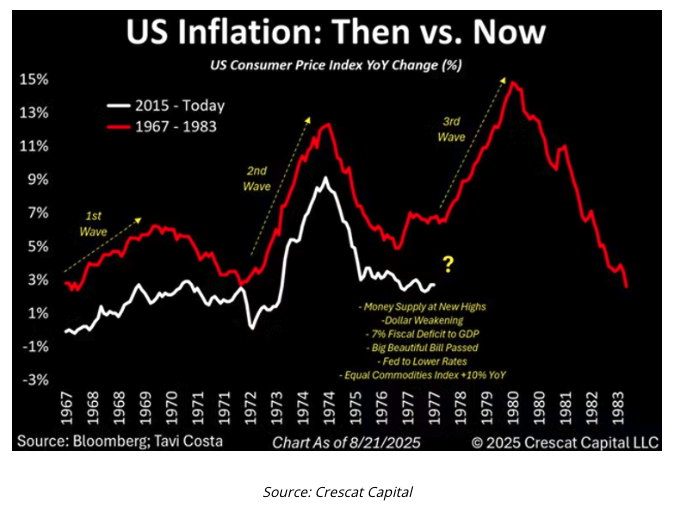
This next chart (from a recent report by hedge fund firm Crescat Capital) compares that earlier era with today. The red line shows core CPI inflation from 1967-1983. (My chart above looks a little different because it’s headline CPI.) The white line is core CPI from 2015 through August 2025. The overall shape is similar to that earlier era, though not quite as high.
The two initial waves are visible in both lines. If the similarity continues, a third wave is coming soon.
Is inflation pressure building again? This Torsten Slok chart shows the percentage of items in the CPI showing 3% or greater annualized price increases. It settled back from the 2022 peak but began rising again late last year.
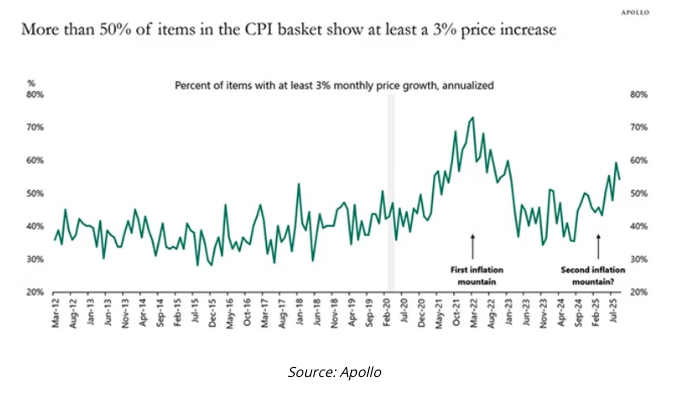
This is a little bit misleading because the CPI items aren’t equally weighted. Some things count far more than others. Housing prices have the largest weight, and their growth rate has been falling, although slowly. The CPI shelter sub-index rose 3.6% in the last 12 months through September.
If housing keeps getting more expensive at something like that rate, and then other things that had been flat or declining turn higher too, another inflation wave becomes very likely. The question then becomes how high it will go.
Fiscal Dominance
One of this year’s little mysteries has been the way GDP keeps growing even though many consumers don’t feel it.
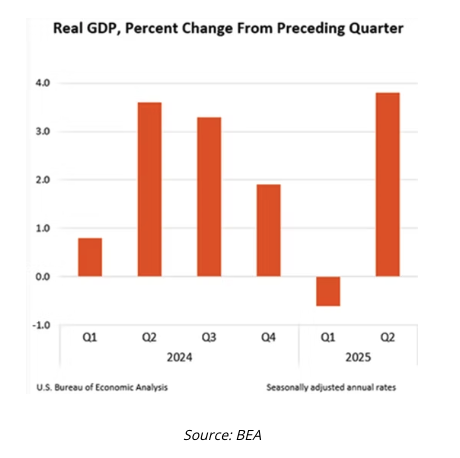
While GDP has flaws in its construction, which I have written about at length, it’s the best growth measure we have. It showed a good year in 2024 and, if you average Q1 and Q2, another good one in 2025 despite tariffs and other issues. Forecasters expect more growth in Q3.
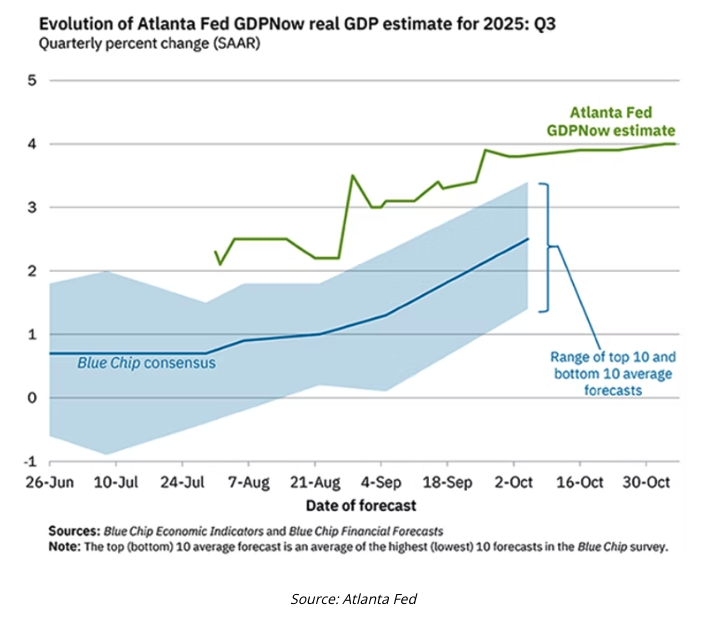
Note that the Atlanta Fed estimate currently calls for exactly 4% GDP for the third quarter. The blue-chip economists consensus is over 2%, although you can find some blue-chip economists surveys that will be in the 1.5% range. So why the grumpiness?
One probable explanation: furious growth in a relatively small segment pulls up the total but its benefits stay mostly within that segment.
That is exactly what’s happening with the AI boom. Everyone hears about it, but the tangible, perceptible gains are concentrated in a small slice of the population – technology investors, data center developers and workers, and white-collar professionals who are using the systems to be more productive. Most people aren’t feeling it, except for the higher consumer prices that often trace back to the smaller group’s rising demand.
The Crescat report I cited above – which is well worth reading, by the way – talks about an age of “Spenders vs. Earners.” In the AI race we have a handful of giant companies spending vast sums on chips and infrastructure. Their spending goes to a different group of “earners” like energy, industrial, utilities and materials firms.
Yet there’s another big spender: the US government. Its spending is (for now) directed not toward AI infrastructure but to defense, public works, healthcare, and assorted entitlement programs. This money flows through the economy and sustains large parts of it. And $2 trillion of it is borrowed money, which introduces a whole new dynamic.
That $2 trillion represents roughly 7% of GDP. It is a stimulus just as much as quantitative easing would be.
This is why the Federal Reserve and the Trump administration are so at odds. Each is responding to different incentives. Jerome Powell wants to control inflation and avoid going down in history as another Arthur Burns. Donald Trump wants to keep voters happy, so he needs to sustain the programs people want without further exploding the debt. He thinks lower interest rates would help. So far the 150 basis points of interest rate cuts have really not produced all that much in terms of lower rates on mortgages and other consumer debt.
This is called “fiscal dominance,” a situation where monetary policy is directed toward helping the government pay its bills. Crescat outlines how this might look. (Emphasis mine. Read the second paragraph three times.)
“One could argue that both sides have a case. Powell is right to worry about inflation, while Trump has reason to seek relief from soaring interest costs.
“However, the reality is that fiscal dominance is becoming unavoidable. The US is approaching a point where rate suppression will be the only option, even if it means tolerating higher inflation.
“Even without interest payments, the US is still running a deficit of around 4% of GDP — an extraordinary imbalance. Cutting rates may buy time, but unless spending is reined in, the fiscal math only gets worse. Mandatory outlays are difficult to reduce without radical reform, so the adjustment is likely to come at the expense of growth-oriented initiatives.
“From Powell’s perspective, the picture is equally challenging. The Taylor Rule, which offers a guide for setting interest rates based on inflation and output, suggests that rates should be roughly 150 basis points higher than where they stand today.
“Yet Treasury Secretary Scott Bessent recently argued that rates should be 150 basis points lower than they are — a gap of 300 basis points from the Taylor Rule.
“Trump, for his part, wants rates at 1%. If that happened, it could be nirvana for hard-asset investors, but it would also all but guarantee that inflation continues to pulse through the system.
“The recent narrative has been dominated by the re-emergence of inflationary pressures. The central question at present is whether the latest data represents a transitory outlier or the early indication of a sustained resurgence in consumer prices.”
The problem with fiscal dominance is that rate cuts, while helpful for the budget, won’t be enough. Unless we put major tax increases and/or major spending cuts on the table – which isn’t in the cards right now – the sheer size of the debt will force the Fed to more unconventional policies like quantitative easing or (later) even outright monetization. I am reading discussions among knowledgeable people about why the Fed may need to do small amounts of quantitative easing next year. Seriously?
“Bold and Dangerous”
Ray Dalio described in a recent paper how the financial mechanics will work if the Fed does what Trump wants, which depending on who he nominates is quite possible once Powell and a few others are gone.
He notes how this time is different (which he acknowledges are dangerous words) from the last QE era because the Fed will be “easing into a bubble.” Instead of weak GDP and low inflation, we have solidly growing GDP and moderate but persistent inflation. Unemployment is rising but still historically low. This is not the kind of environment in which the Fed normally pulls out the big guns. Yet it is now not just cutting rates but ending efforts to reduce its balance sheet and actively injecting more liquidity. Here’s Dalio:
“When the Fed and/or other central banks buy bonds, it creates liquidity and pushes real interest rates down as you see in the chart below. What happens next depends on where the liquidity goes.
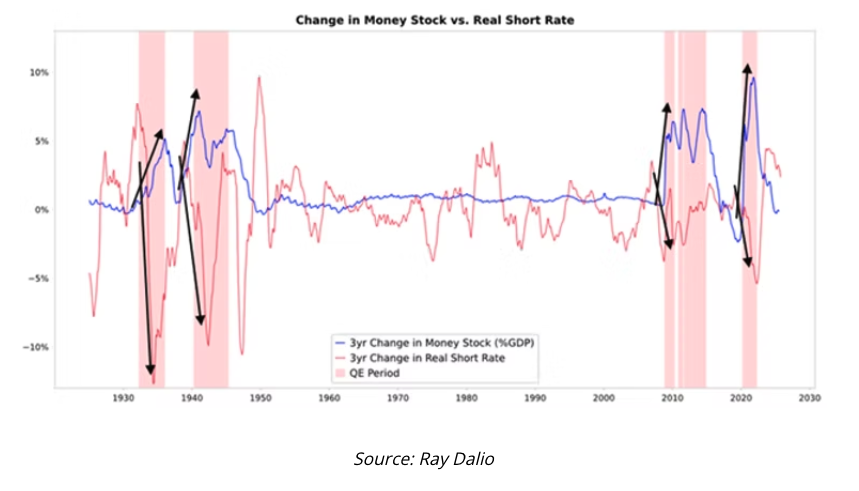
“If it stays in financial assets, it bids up financial asset prices and lowers real yields so multiples expand, risk spreads compress, and gold rises so there is ‘financial asset inflation.’ That benefits holders of financial assets relative to non-holders so it widens the wealth gap.
“It typically passes to some degree into goods, services, and labor markets raising inflation. In this case, with automation replacing labor, the extent to which this will happen would seem to be less than typical. If it stimulates inflation enough, that can lead nominal interest rates to rise to more than offset the decline in real interest which then hurts bonds and stocks in nominal terms as well as in real terms.”
Historically, it’s not unusual for highly indebted regimes to try to bail themselves out with inflation. If they have to bend a few rules to produce sufficient inflation, they usually don’t mind. In theory, some moderate inflation combined with spending cuts and tax increases might be enough.
The problem is keeping the inflation part under control. It tends to take on a life of its own. Dalio sounds as much or more skeptical than I am about this.
“Because the fiscal side of government policy is now highly stimulative (due to huge existing debt outstanding and huge deficits financed with huge Treasury issuance especially in relatively short maturities) QE would effectively monetize government debt rather than simply re-liquify the private system. That’s what makes what is happening different in ways that seem to make it more dangerous and more inflationary.
“This looks like a bold and dangerous big bet on growth, especially AI growth, financed through very liberal looseness in fiscal policies, monetary policies, and regulatory policies that we will have to monitor closely to navigate well.”
What could prevent this kind of outcome, or at least cushion the pain? I can think of a few things. One would be if AI systems work as the optimists think, raising productivity and unleashing more growth. This might boost tax revenue enough to help avoid QE.
Another would be a big reduction in healthcare costs, which represent a giant part of government spending. The kind of longevity breakthroughs I expect should help. We need to not just extend lifespans but “healthspans” too. The GLP-1 weight loss drugs are already making a noticeable dent in obesity rates. I think we’ll see more such developments, and they’ll help not just our health but our fiscal outlook, too.
The problem is timing. Increasing productivity through AI and lower healthcare costs because of new technologies will take time – at least a decade. Can the positive influences have an effect soon enough to avoid a debt-driven economic crisis? I don’t think so. We will first have our sovereign debt crisis which will force changes in our healthcare, Social Security, and tax structures, along with many other areas of life.
What Should the Federal Reserve Do?
The next Federal Reserve meeting is December 9-10. A few days ago, odds for a rate cut were fairly high. According to CME Fedwatch, the odds of a December rate cut fell to 51.9% today from 62.9% yesterday and 95.5% a month ago. The market also took a deep dive on Thursday, after a speech by Susan Collins, president of the Federal Reserve of Boston. She simply said:
“Absent evidence of a notable labor market deterioration, I would be hesitant to ease policy further, especially given the limited information on inflation due to the government shutdown.”
She is correct in that by the December meeting it is doubtful that the “data” on inflation and unemployment will be available to the Fed in any meaningful manner. Peter Boockvar adds this:
“So now we have three voting Fed presidents (Musalem, Collins and Schmid) that do not want to cut rates next month. I’d say Goolsbee is also leaning towards a pause. On the flip side, we know Miran is the uber dove while Waller and Bowman would be supportive of another 25 bps lower. I’d call the balance of Powell, Williams, Barr, Jefferson and Cook more around 50/50 which is where the rate cut odds currently stand, just about.
“Either way, 150 bps of rate cuts so far have done almost nothing to lower longer term interest rates so the beneficiary of more cuts really depends where on the curve one borrows. Can you borrow SOFR+? Is your loan priced off the 5 yr? Or the 10 yr? Certainly, the latter if one wants a fixed rate mortgage.”
To that point, my friend Brent (@blacklionCTA) posted on X:
“We are hearing from regional presidents, several who are not voters this year. There is a widening gap between the hawkish presidents and dovish governors. The Fed is cutting next month.”
The Fed is between a giant rock and a very hard place. Inflation is about 3% with the potential to rise somewhat. Unemployment is still relatively low at 4.3%. The economy is doing well. The regional Fed presidents are listening to their constituents tell them inflation is a major problem in their districts. The Federal Reserve governors listen to other politicians, who are worried about softening economy and higher unemployment.
Ironically, both sides are right to be concerned. I have talked about the K-shaped economy in the past. The term describes the uneven recovery of different segments of the economy following a recession, particularly highlighting the growing divide between wealthier and lower-income individuals.
We have a significant percentage of the economy doing quite well in terms of their spending, wealth, and lifestyles. A larger group are struggling paycheck to paycheck. Rising costs are hitting them hard.
The problem is that it is not clear how Fed cuts will reduce mortgages and borrowing costs for the lower and middle classes but certainly could unleash more inflation. Powell was right to be cautious in his comments at the last Fed meeting.
The Fed is gradually losing the narrative in the sense that they are losing control to the fiscal dominance of the US government’s out-of-control spending. The choice of the next Fed chair is going to be critical. If Trump appoints someone that seems remotely dovish, or at least dovish adjacent, I think the bond market will not react happily. We need someone with the inflation-fighting credentials of Kevin Warsh. God forbid it is somebody in the same camp with Stephen Miran.
US debt is now over $38 trillion and interest on the debt is close to $1 trillion. Unless Congress gets deficit cutting religion, the debt will easily reach $50 trillion by the end of the decade. That type of debt growth is not deflationary, to put it mildly. We will be addressing this more and more in the future.
Doctors and Alzheimer’s
We are looking for an additional doctor for our Dallas longevity clinic. If you have a passion for longevity and are looking to move into that field, drop me a resume at [email protected]. Real quick, our clinic in Dallas is filling up. We primarily do Therapeutic Plasma Exchange which is where you should start your longevity journey. You can read about the procedure here. If someone close to you has Alzheimer’s or dementia, I can’t emphasize enough that you should read that paper. Our website is here: Home—Lifespan Edge. Schedule a discovery call if you like.
Tulsa, Dallas and Cleveland
After a hectic but immensely satisfying week in New York, I am back in Puerto Rico. It was the first meeting of the Inner Circle. My partners and I had a large vision for what the Inner Circle could be, but the results were even better. The new members are ecstatic and it was just a soul affirming process for everyone.
I will fly to Tulsa for Thanksgiving. Shane will stay in the Dallas area waiting on our new grandchild, Stetson, then I will return to Puerto Rico where we will open the Dorado Lifespan Edge clinic December 1. I will fly back at some point to see my new grandson and visit with others. I am still trying to figure out my schedule to get to Cleveland to do my annual checkup. There is a small chance I might fly to New York later this year.
I start thinking about topics for the letter often weeks in advance and gathering research and materials. I also read your letters to get inspiration. Let’s be more direct this week: drop me a note and tell me what topics that you would like to see in the future.
And with that, I will hit the send button and wish you a great week. Enjoy your family and friends and don’t forget to follow me on X!
Your watching “The Fourth Turning” happen in real time analyst,
John Mauldin
A message from Advisor Perspectives and VettaFi: Discover something new! Click here to register for our upcoming webcasts.
Membership required
Membership is now required to use this feature. To learn more:
View Membership Benefits