Global Debt Addiction
Membership required
Membership is now required to use this feature. To learn more:
View Membership BenefitsI often describe debt as “future spending pulled forward in time.” It can be good if you’re using the debt productively. All too often, people don’t. Nor do governments.
Note I said “governments” in the plural. I write often about the giant and growing US federal debt, much of which is not being used productively. But this is more than an American problem. Politicians everywhere have learned what should be obvious: people hate taxes but love having the things government can provide. So whenever possible they pay for their spending with borrowed money. Repaying it will be someone else’s problem, they assume.
This method can work really well for a long time, years or even decades. It works especially well in the US because we have the “exorbitant privilege” of borrowing in our own currency. But even here, it won’t work indefinitely. There are limits – and I fear we are approaching them at an uncomfortable rate.
Today we’ll look at government debt as a global problem because that’s what it is. Some governments are somewhat less profligate, but very few have clean hands on this. All of us are in the mud.
A Problem Too Big for AI
In starting research for this letter, I began by looking for a comprehensive chart to illustrate the problem. This turned out to be surprisingly difficult.
Most data sources track government debt as a percentage of GDP. That’s good for some purposes, but I wanted to show the scale of accumulated debt in real-money terms. That’s hard because both GDP and currency values are moving targets. I even asked ChatGPT and it said sorry, no can do. That’s how bad this problem is, apparently.
The best comparison I found was on a site called World Population Review. They have a table listing 2024 national debt by country. Here are the top 16:
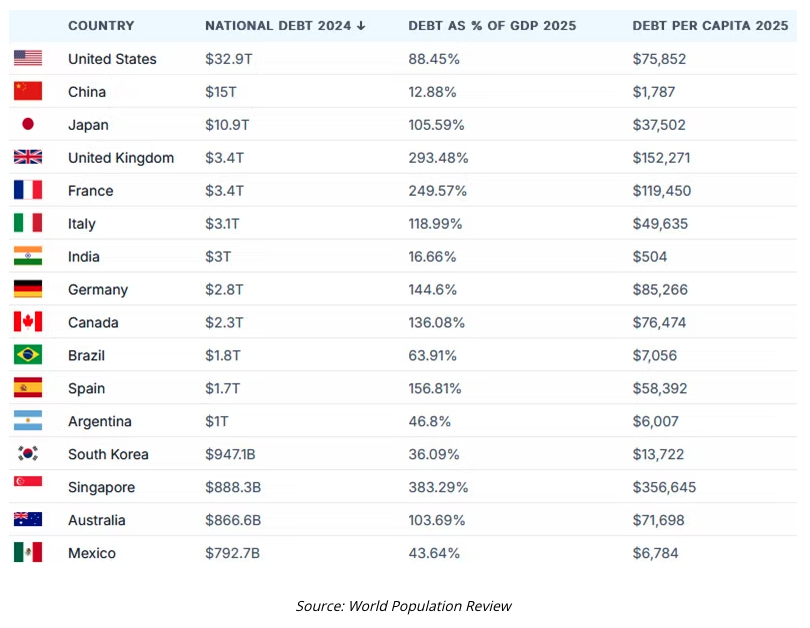
You can see the US leads this ignoble race by several country miles. Our $32.9 trillion debt listed above is more than double runner-up China’s $15T (though, to be fair, there’s reason to doubt China’s official data). Not all of it is dollar-denominated so this is the USD equivalent where applicable.
Worldwide total government debt as of 2024, at least according to this source, was $97.5T. That means the US accounts for roughly one-third of global government debt. The US + China + Japan are almost 60% of it.
What if we sort it by percentage of GDP? This also gets complicated. Both GDP and debt totals are illusory in some tax-haven and other countries which have more banks than people. But excluding those, the biggest problems are concentrated in Europe: Netherlands, the UK, France, Belgium, Greece, Switzerland, Finland, Sweden, Spain, Norway, Germany, Portugal, Denmark, Austria, Italy and Hungary all have debt-to-GDP ratios above 100%.
One reason for this is demographic. These countries generally have low birth rates and long life expectancies. This combination produces a high “dependency ratio” as a shrinking number of workers have to support a growing number of retirees. Tax rates are pretty high, too, but governments still have to borrow to meet the demand for benefits. Raising taxes in countries in Europe which are already taking well more than 50% of GDP is problematic for GDP growth.
While the others are not a great deal better, the problem is increasingly evident in France. The Wall Street Journal Editorial Board ran a good piece on it this week (emphasis mine).
“France’s working-age population is shrinking while the ranks of retirees swell. That will have a ‘profound effect on public finances,’ warns the Court of Auditors, the government body that examines the use of public funds. Its report last week offers a profile of the broader Western entitlement state problem.
“Pensions are France’s biggest entitlement, currently devouring about 14% of GDP. In 2023 the cost exceeded $411 billion, the report says. Add other age-related benefits, and the French government now spends more than $47,500 a year on each senior. Age-related items account for more than 40% of French expenditures.
“Those costs will rise as France ages into dentures and canes. The report projects that in 2070 nearly 30% of the population will be 65 or older, up from 21.8% in 2024 and 16.3% in 2005. Life expectancy has also increased, which means retirees will draw benefits for longer.
“Someone’s got to pay as papa becomes grand-père, but the forecast is bleak. Today there are 39 seniors for every 100 working-age people in France. But by 2070 working-age French will account for only 50% of the population, down from more than 55% in 2023.
“Oh, and many of France’s working-age ranks aren’t actually working. The French unemployment rate was 7.7% in October 2025, compared to a 6% European Union average. Some four in 10 collecting unemployment are under age 35, as France rewards joblessness with lengthy and generous payments.”
Interestingly, French President Emmanuel Macron and others are belatedly trying to reform their pension, unemployment and other unsustainable systems, but finding it politically impossible. Voters simply won’t tolerate change. Macron’s 2024 snap elections produced a dysfunctional government where protecting benefits is one of the few areas of left-right agreement.
The US and many others are in the same situation, just a few years behind. A point will come when it is a) economically impossible to raise taxes, b) politically impossible to cut benefits and c) financially impossible to borrow more money on manageable terms.
Then what? Some kind of giant crisis. We’ll be forced to choose the “least bad” options. I call it the Great Reset. It won’t be fun, but our years of delay have made it inevitable.
“New and Pernicious Ways”
You may have seen news about the growing “buy now, pay later” consumer lending business. Critics say this kind of easy credit encourages lower-income consumers to take on more debt than they can handle. This is a problem I may discuss in a future letter. But something along the same lines is also happening in developing country government debt.
The World Bank issued its annual International Debt Report this week, which I find ironic since it is one of the international institutions most responsible for these debt problems. But we’ll set that aside for now since they do publish some excellent research.
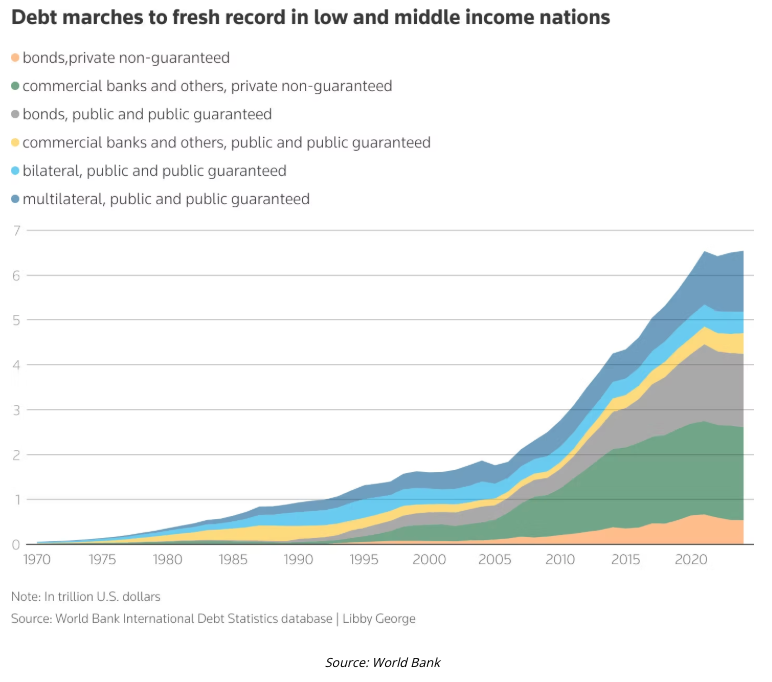
The report focuses on the “debt gap,” the difference between what these governments owe and the amount of new money they can raise. This gap has widened sharply since 2022. That, you may recall, was the year when the post-2008 regime of low (and sometimes negative) interest rates abruptly ended amid post-COVID demand spikes and the Russia-Ukraine war.
Over more than a decade of easy money, some countries accumulated far more debt than they could handle. They agreed to lender-friendly terms that are now coming back to haunt them as existing debt resets at higher rates. Worse, the new debt they need to stay current on the old debt carries even more onerous terms.
I’ve talked before about the way rising interest payments are a growing share of US government payments – to the point they now outstrip previously larger categories like defense. Something far worse is happening in many developing countries. Simply servicing their old debt is forcing hard trade-offs. Low- and middle-income nations now have over $6 trillion worth of debt.
World Bank chief economist Indermit Gill used the report to urge more such trade-offs.
“Global financial conditions might be improving, but developing countries should not deceive themselves: they are not out of danger. Their debt build-up is continuing, sometimes in new and pernicious ways. Policymakers everywhere should make the most of the breathing room that exists today to put their fiscal houses in order—instead of rushing back into external debt markets.”
That’s not bad advice in itself. It would have been more useful 10-15 years ago. Some fiscal reform back then might have put those countries on a better path. But it’s not just their problem; it has systemic consequences, too. Here’s how one news story put it.
“From the Bank's perspective, the danger is that a series of country level problems could interact, amplifying each other through trade, financial markets, and migration. If several large borrowers are forced into restructuring or severe austerity at the same time, the result could be weaker global demand, higher risk premiums for all emerging issuers, and renewed pressure on multilateral lenders. That is why the institution has paired its warning with calls for more predictable restructuring frameworks and greater use of concessional finance, even as it acknowledges that the political appetite for large scale relief is limited.”
“Weaker global demand” is a polite way of saying “possible worldwide recession.” Obviously not what anyone wants. But that’s what excess debt does; it comes back to bite everyone in unexpected but painful ways. Innocent bystanders aren’t exempt.
Piling It On
The fact other countries have their own debt problem in no way diminishes the impact of US debt. If anything, it should embarrass us. We’re supposed to lead but not like this.
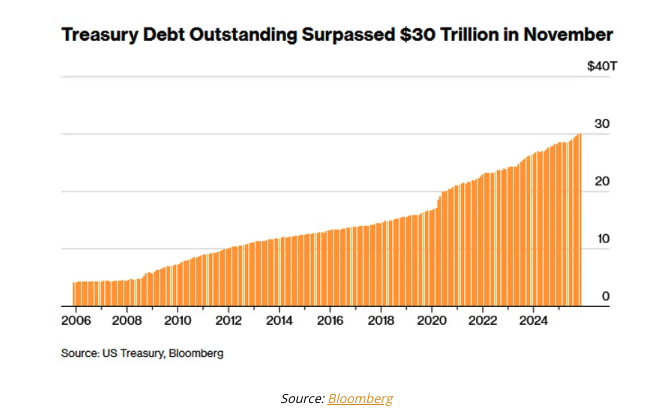
Below is an interesting look at our debt growth. I would quibble with the headline since a proper accounting would show our debt surpassed $30 trillion long ago. But in any case, it is huge and growing. To me, the remarkable part is how smooth this series of monthly bars looks. No matter what else was going on, we piled on a little more debt almost every month. It added up.
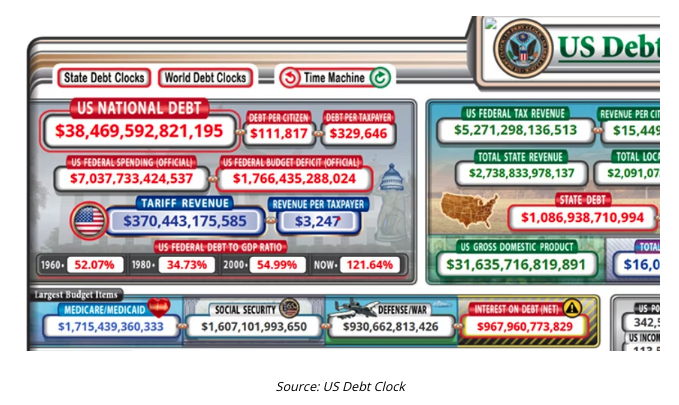
Below are the numbers from US Debt Clock which shows that US debt is 121% of GDP and interest on the debt is almost $1 trillion annually.
Growth of the debt by year? Note only one year in the past 60 has the debt gone down. When then-VP Dick Cheney said that deficits don’t matter, it was when the deficit was below the growth rate of nominal GDP. And you can make a case for that. But we have gone way past growing our debt relative to nominal GDP.
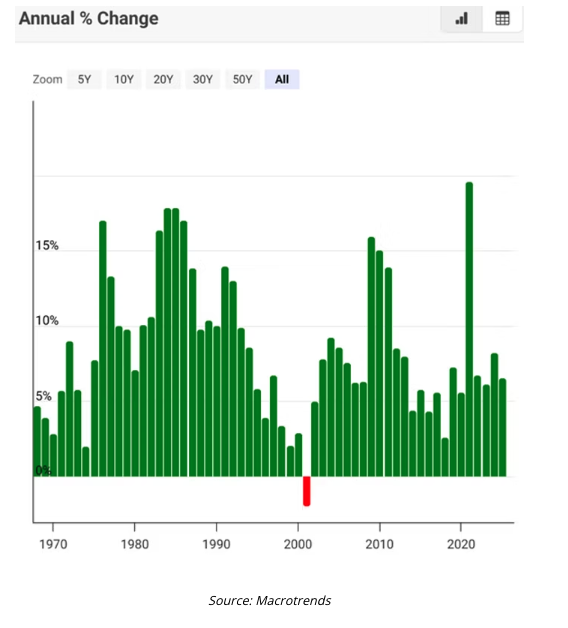
I’ve noted this before but it’s worth saying again. In the early 2000s we were on the way to actually reducing or at least stabilizing this debt growth. The post-Cold War “peace dividend” and higher tax revenue from the 1990s tech boom, along with some small but helpful fiscal reforms, had us on the right path. But in short order we strayed from that path and fell off the cliff.
Let’s also note this is a bipartisan problem. In the period shown here, we had both Republican and Democratic presidents. Both parties controlled the House and Senate at various times. Both parties had “trifecta” periods of full control when they could have forced change. Neither did so.
The reason neither did so, in my view, is they are responding to voters and donors who, even if they say the right words about “fiscal responsibility,” don’t really want fiscal responsibility. They want their share of the action, whether it be defense contracts, welfare benefits, agricultural subsidies, free healthcare, loan guarantees or whatever. There is no significant constituency for actually making the kind of changes that would alter our debt trajectory. Just a few old curmudgeons like me.
Unfortunately, this won’t stop the changes from coming. They will come. They’ll cause a lot of pain we could have avoided. Then eventually, we’ll come out better on the other side. But getting there will be tough.
The Real Problem with Growing Global Debt
The world’s debt capacity is staggeringly high. But the cost of that debt has been rising. Negative interest rates allowed countries to load up on debt that now has much higher costs, not just in the developed world but down to the smallest countries.
At some point it’s not going to just be developing countries that will have to find debt forgiveness or suffer severe austerity or inflation. Inflation is a pernicious destroyer of wealth and creator of poverty.
The European Central Bank can continue to finance European debt, but at what price? Interest rates at the longer end of the bond market are rising. Central banks everywhere, including the Federal Reserve, are losing their ability to influence long-term interest rates. Long-term rates are finally rising even in Japan.
The Cayman Islands (read: large hedge funds) now hold $1.4 trillion worth of US treasuries, making that country the largest external holder of US debt, far more than China, Taiwan and Japan. Not a problem until it is a problem. This was brought to global attention by paper from the Federal Reserve researchers Daniel Barth and Daniel Beltran. It’s basically interest rate arbitrage.
The problem is that those same hedge funds are a major source of international liquidity. And no one knows how interconnected everything is. A Chinese focused paper highlights the risk to global markets. A spillover effect into non-sovereign debt markets is a real possibility. Or maybe not. We simply have no idea.
The second problem is that “investors” in sovereign debt in less developed markets and then eventually in Europe and Canada are going to start demanding higher rates for what they perceive to be higher risks. In a normal world, the United States should be able to borrow a great deal more money than we already have. But what I believe will happen is that as investors of all sizes eventually see risk in Europe, they will begin to wonder just how the US markets are positioned? Given that our debt is an inflationary problem, that means the Federal Reserve is going to have to respond eventually with either higher rates or allowing inflation. Allowing inflation will of course mean higher rates at the long end, no matter what Trump and a future Federal Reserve chair would want. Someone in 2030 is going to inherit that problem and it will be even more intractable.
What would normally take a lot longer is going to end up happening much faster than we imagine today. When? No real idea but sometime within the next five years? But not much longer. And it’s going to happen at a time when social cohesion is less than it is today, when voters are going to want to continue to get their benefits and subsidies, but the ability to finance them is going to be at best problematic, at worst causing a significant upheaval in all global markets, not just bond markets. And it is going to happen around the world. There is no way to understand today who voters will want to be in charge when the problem is forced upon us.
Global debt is a real issue. Pay attention…
Home for the Holidays, Cancer, Texas Chili and More
I have no planned trips in the next year, and even then, the schedule is up in the air. Shane and I will be hosting our annual Texas chili and black-eyed pea afternoon brunch on New Year’s Day. Last year I made 20 gallons of chili and we had 300 people show up. A few readers will be there, and you are welcome to come.
This has been a brutal few weeks for me personally, but even worse for several of my friends. It seems like almost every day for the past week I find another friend who has some kind of terrible terminal cancer. Life and health are so precious.
That’s the main reason that Dr. Mike Roizen and I are launching the Lifespan Edge. We start with the basic premise that the start of your longevity journey should be to get rid of mis-folded proteins, senescent cells, micro-plastics and other junk in your blood that create inflammation and a host of aging issues. Mike Roizen says TPE is the only true therapy for Alzheimer’s disease if you catch it early enough. I know I keep mentioning it, but the continuing loss of friends reminds me that I want all of you to stay healthy.
You can learn more at Lifespan-Edge.com (note the dash). If you have not, you really need to read the main research report we have. Our clinic in Dallas is getting busier and busier, and we hope to have Puerto Rico open soon. Then we will begin adding other clinics around the country but frankly, you shouldn’t wait until it’s “convenient.” This is your health and a trip to Dallas is not that unpleasant. I know it is not cheap, but we are THE low-cost provider. Schedule a discovery call with Dr. Allen Green.
And with that I will hit the send button. You have a great week and holidays and thank you so much for being with me over the years. It means more to me than you know.
Your really thinking about health analyst,
John Mauldin
A message from Advisor Perspectives and VettaFi: Discover something new! Click here to register for our upcoming webcasts.
Membership required
Membership is now required to use this feature. To learn more:
View Membership BenefitsSponsored Content
Upcoming Virtual Events View All













