In our view, investors should prepare for a market where interest rate swings are more frequent, reinforcing the need for active management across fixed income portfolios.
Strong 2025 despite persistent headwinds
Markets once again demonstrated their resilience in 2025. Supportive monetary and fiscal conditions, steady consumer spending and robust AI-driven business investment underpinned broad strength across risk assets—even as investors navigated inconsistent economic data, policy uncertainty and ongoing geopolitical disruption.
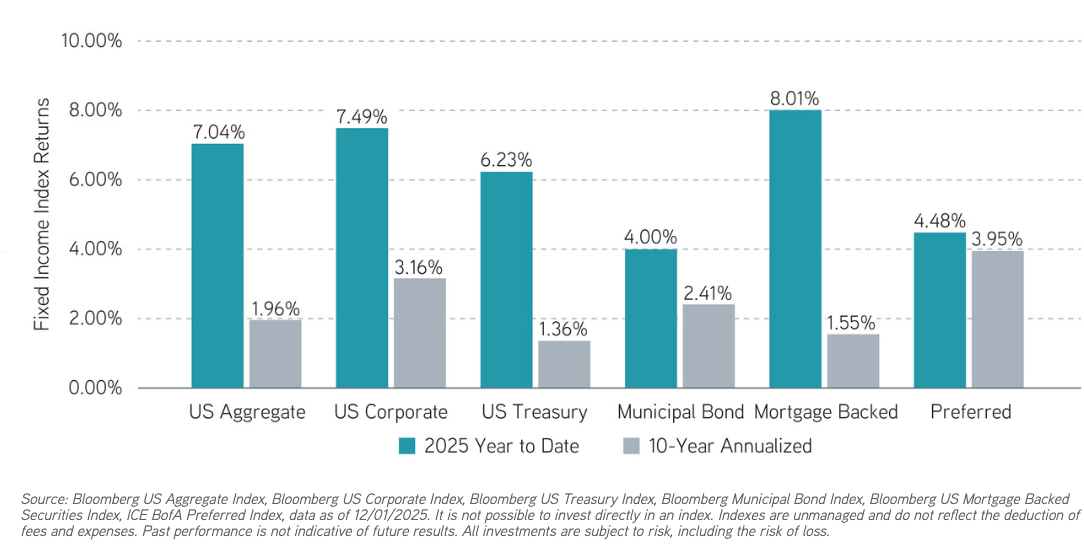
Equities reached new all-time highs and delivered another year of double-digit returns. Yet fixed income also posted meaningfully positive performance. Elevated starting yields and continued progress toward rate normalization helped most fixed income sectors outperform their long-term averages. For many fixed income investors, 2025 highlighted the benefits of maintaining strategic duration exposure—even amid uncertainty.
Fixed income index sector performance through December 1, 2025

The US Federal Reserve heads into 2026 with a cautious, data-dependent stance. Labor market momentum has weakened: After averaging 167,000 new jobs per month in 2024, job growth has slowed sharply to just 38,000 per month since May, with the unemployment rate reaching 4.4%—its highest level in nearly four years.
Yet inflation remains stubborn: Year-over-year readings hover near 3% as tariffs feed into price levels, while progress toward the Fed’s 2% target has stalled. Even as policymakers maintain that current policy is restrictive, the strong consumer and ongoing AI-related capital expenditures have kept GDP near 3% for several consecutive quarters, leaving the Fed in an uncomfortable position. Supporting employment risks fueling inflation, while maintaining restrictive policy risks slowing the economy too sharply.
Policy division and market expectations
With inflation still running about 1% above target, and without clear signs of labor market deterioration, divided policymakers have been hesitant to cut rates meaningfully. Both sides of the debate carry strong conviction, and uncertainty surrounding the path of rate cuts may persist throughout 2026.
A sustained decline in inflation or a more significant rise in unemployment might be required to move the federal funds rate toward 3%. While the Fed may tolerate some inflation risk to support employment, more rate cuts amid cyclically reaccelerating growth could reignite the upward price pressures that voters are so sensitive to.
Complicating matters further, a fiscal deficit projected to exceed $1.7 trillion in 2026 (over 6% of GDP), concerns over central bank independence and an upcoming Supreme Court decision on tariff authority under the International Emergency Economic Powers Act (IEEPA) all appear poised to keep the term premium elevated and the yield curve steep. These forces suggest that even if the Fed eases, long-end yields may not fall in a straight line.
Here are some possibilities to consider for fixed income portfolio positioning in 2026:
Add duration thoughtfully. Even after a wave of inflows, many investors remain underweight duration and bonds overall. With yields still near decade highs, fixed income may warrant a more prominent role in diversified portfolios. Higher starting yields have historically correlated with stronger forward return potential, and high-quality municipals and corporate credit could offer valuable downside risk mitigation should equity markets experience volatility.
Reassess cash allocations. If the Fed proceeds with additional rate cuts, yields may decline on cash instruments—cash sweeps, CDs and T-bills. Extending modestly along the curve could allow investors to lock in today’s elevated yields, while introducing duration exposure with the potential to stabilize the portfolio if growth slows.
Prioritize professional credit oversight. AI-related capital spending has been extraordinary in scale, yet the payoff path remains uncertain. As investment accelerates and supply picks up, strains may emerge unevenly across issuers. Credit fundamentals look solid today, but spreads are tight, leaving little cushion for surprises. These dynamics point to greater credit dispersion in 2026, which could make disciplined, professional oversight more critical than ever.
Use tax loss harvesting opportunistically. With potential volatility on the horizon, systematic tax loss harvesting within fixed income SMAs could enhance after-tax outcomes and provide valuable flexibility and tax savings when rebalancing. Providers with year-round harvesting capabilities may offer meaningful value.
Embrace active management. With several plausible macro paths ahead, active management provides the tools to help turn volatility into opportunity. Dynamic decision-making around duration, curve positioning, credit exposure and security selection may allow investors to capture opportunities that passive strategies could overlook, while managing emerging risks better. In an environment defined by policy uncertainty and shifting rate dynamics, active fixed income management can become a strategic differentiator.
Here are our outlooks for munis, corporates and preferreds in 2026:
Municipals
- Bloomberg’s BVAL AAA Muni Yields remain near decade highs and above long-term averages, up 20–60 basis points (bps) since the Fed started rate cuts in September 2024. Over the past decade, the yield on the Bloomberg Municipal Index has exceeded current levels only 20% of the time.
- Tax-exempt yields of 3% to 4% are likely to attract buyers. For high-income investors in states with high taxes, this can mean tax-adjusted yields of 6% or more—offering competitive value compared to other fixed income and equity options.
- The municipal curve has been significantly steeper than the Treasury curve, offering buyers attractive compensation for extending maturities. For investors transitioning out of cash and preparing for the next stage of the interest rate cycle, extending moderately along the curve may provide an opportunity to increase income while mitigating reinvestment risk.
- Muni fund inflows reached $47 billion in 2025, surpassing 2024 totals. This trend may continue into 2026, as rate cuts have historically driven positive net inflows during easing cycles.
- Muni issuance hit a record $535 billion in 2025, up 30% from the five-year average. High supply has sometimes led to underperformance and higher ratios, but also created attractive entry points. We expect another record year in 2026, potentially offering similar opportunities when net supply rises.
- Municipal credit remains strong, with rainy day funds averaging 15% of state spending in 2025. Solid reserves could help states offset Medicaid cuts with limited effect on their credit ratings. With muni spreads holding steady or tightening, upgrade-to-downgrade ratios may slow but stay at or above parity.
- We believe the muni market could see stable to improving returns depending on yield curve positioning, with better performance possible at the long end of the curve.
Preferreds
- Preferreds may benefit from strong issuer fundamentals and renewed investor demand, as the Fed’s expected rate cutting cycle tends to increase interest in high-quality fixed income and improve the relative value of preferred securities versus cash and short-duration instruments.
- Financial preferreds have outperformed again in 2025, supported by resilient credit quality, improving capital markets activity and robust net interest income. We expect these positive earnings trends to continue into 2026, reinforcing the sector’s role as a core anchor of the preferred market.
- Limited net supply remains a key technical tailwind: Updated US regulatory requirements have created incentives for banks to reduce Additional Tier 1 (AT1) capital, which may point to modest preferred issuance in 2026, while the scarcity of new paper could support pricing and compress spreads for high-quality issuers.
- Fundamental strength across banks has enhanced the credit profile of preferreds, helping to keep Common Equity Tier 1 (CET1) ratios elevated, liquidity robust and credit costs contained across consumer and commercial portfolios. Deregulation and improved capital markets throughput have added to the constructive backdrop.
- Utility hybrids may continue to grow as a share of the preferred and hybrid universe, with increased issuance to cover their rising capital spending for grid modernization, as well as higher power demand from data centers. Despite higher supply, valuations have remained attractive relative to senior utilities debt.
-
In our view, preferreds may offer high, tax-advantaged income, with starting yields well above their 10-year averages—providing attractive carry and the potential for solid total returns in 2026, driven primarily by coupon income and supported by an improving rate environment.
A message from Advisor Perspectives and VettaFi: Discover something new! Click here to register for our upcoming webcasts
Past performance is no guarantee of future results. The returns referred to in the blog are those of representative indexes and are not meant to depict the performance of a specific investment
Parametric and Morgan Stanley do not provide legal, tax, or accounting advice or services. Clients should consult with their own tax or legal advisor prior to entering into any transaction or strategy described herein.
The views expressed in these posts are those of the authors and are current only through the date stated. These views are subject to change at any time based upon market or other conditions, and Parametric and its affiliates disclaim any responsibility to update such views. These views may not be relied upon as investment advice and, because investment decisions for Parametric are based on many factors, may not be relied upon as an indication of trading intent on behalf of any Parametric strategy. The discussion herein is general in nature and is provided for informational purposes only. There is no guarantee as to its accuracy or completeness. All investments are subject to the risk of loss. Prospective investors should consult with a tax or legal advisor before making any investment decision. Please refer to the Disclosure page on our website for important information about investments and risks.
The views expressed in these posts are those of the authors and are current only through the date stated. These views are subject to change at any time based upon market or other conditions, and Parametric and its affiliates disclaim any responsibility to update such views. These views may not be relied upon as investment advice and, because investment decisions for Parametric are based on many factors, may not be relied upon as an indication of trading intent on behalf of any Parametric strategy. The discussion herein is general in nature and is provided for informational purposes only. There is no guarantee as to its accuracy or completeness. Past performance is no guarantee of future results. All investments are subject to the risk of loss. Prospective investors should consult with a tax or legal advisor before making any investment decision. Please refer to the Disclosure page on our website for important information about investments and risks.
Investment advisory services offered through Parametric Portfolio Associates LLC ("Parametric"), an investment advisor registered with the US Securities and Exchange Commission (CRD #114310). Parametric is also registered as a portfolio manager with the securities regulatory authorities in certain provinces of Canada (National Registration Database No. 42850) with regard to specific products and strategies. Parametric provides advisory services directly to institutional investors and indirectly to individual investors through financial intermediaries. The information on this website does not constitute an offer to sell, or a solicitation of an offer to purchase, securities in any jurisdiction to any person to whom it is not lawful to make such an offer. Investing entails risks, and there can be no assurance that Parametric (and its affiliates) will achieve profits or avoid incurring losses. All investments are subject to potential loss of principal. Parametric does not provide tax or legal advice. Prospective investors should consult with a tax or legal advisor before making any investment decision. Please refer to the disclosure page for important information about investments and risks.
S&P Dow Jones Indices are a product of S&P Dow Jones Indices LLC (“S&P DJI”) and have been licensed for use. S&P® indexes are registered trademarks of S&P DJI; Dow Jones® is a registered trademark of Dow Jones Trademark Holdings LLC (“Dow Jones”); S&P DJI, Dow Jones, and their respective affiliates do not sponsor, endorse, sell, or promote Parametric and its strategies, will not have any liability with respect thereto, and do not have any liability for any errors, omissions, or interruptions of the S&P Dow Jones Indices.©2025 Parametric Portfolio Associates LLC. All rights reserved. 800 Fifth Avenue, Suite 2800, Seattle, WA 98104.
© Parametric
Read more commentaries by Parametric