Coming into 2025, amid a debate about concentration and lofty valuations in the largest of large-cap stocks, as well as concerns about macro uncertainty and economic conditions, we collectively called for diversification. That diversification, among other things, singled out the opportunity in small-caps.
I, myself, when reading the crystal ball back in January, said 2025 might be the year for small-caps to “finally have their moment.” The valuation gap to their large-cap counterparts sat at a wide 44% based on trailing P/Es for the iShares Russell 2000 ETF (IWM) vs. the iShares Russell 1000 ETF (IWB). Their period of underperformance vs. large-caps was stretching out to a decade at that point.
The Russell 2000’s notorious slice of unprofitable names remained large, between 30%–40% of the index. However, active managers in the small-cap space stood strong to deliver carefully considered exposures (which many have, I should note). It seemed like a great set up for small-caps, in a broad sense, to deliver value in meeting the call for diversification, to lead portfolio rotation, and to possibly outperform their large-cap peers.
But looking back at their performance so far this year, small-caps have delivered a lot of false starts. They’ve lagged the market by about 200 basis points (as measured by IWM vs. IWB and vs. IVV) through November. Meanwhile, demand remained lackluster at best. Their results have them (again) in that dreaded “always the bridesmaid, never the bride” territory.
Now, here we are, counting down to a new calendar year. Calls for attention to small-caps are beginning to ring loud again as we navigate portfolio concentration, valuation woes and macro uncertainty.
To be clear, there’s no consensus call here. There’s no unanimous voice calling for small-caps to “finally have their moment.” Even my fellow pundits disagree — Todd Rosenbluth and Bloomberg’s Eric Balchunas have a going bet on whether small-caps break out. Their opposing views on this category of stocks is so persistent, they are betting a steak dinner on it.
It’s interesting to see that Q4 seems to have breathed some fresh air into this segment of the market. The broadest benchmark as captured by IWM is up some 14% since October 1, breaking above the 50-day moving average. The iShares Core S&P Small-Cap ETF (IJR), which captures the S&P 600, is up 7%. Yes, they are still both lagging their large-cap peers by a significant margin, but investors are suddenly buying in. And that’s relatively new.
To take a step back, when we look year-to-date, our data shows that overall demand for some of the largest small-cap ETFs remains in the red. For example, IWM has bled some $5 billion in assets in 2025. IJR has lost some $2.7 billion. But in the first two weeks of November (through November 15), the tide changed. We are seeing a pick up in investor appetite.
IWM has now welcomed $1.6 billion in net new flows in the past two weeks, landing it among the month’s 10 most popular ETFs. The Vanguard Small-Cap ETF (VB) and the Vanguard Small Cap Value ETF (VBR) have each snagged about $1.35 billion so far this month. IJR has taken in $640 million.
Are these new assets early signs of a recovery in small-caps, or at least, a recovery in investor sentiment regarding the opportunity in small caps? Or will this, too, be another false start?
Only time will tell. What we do know is that it may take more than sentiment to reignite small-caps. However, more may be exactly what we have here.
To quote Globalt Investments’ Kiimberly Woody, “A small cap catch-up is rarely the product of a single catalyst.”
“Rather, it emerges from a confluence of factors: strengthening economic growth, accommodative monetary policy, robust labor markets, compelling valuations, ample liquidity, and evolving investor perceptions of risk,” she said in a commentary earlier this year. “After long periods of underperformance, small caps can look especially cheap compared to large caps and historical averages. If the fundamentals start improving, value hunters might move in, drawn by low price-to-earnings or price-to-book ratios.”
There’s no question that this renewed appetite for small-caps is indeed young. For that, we should be cautious to read too much into it.
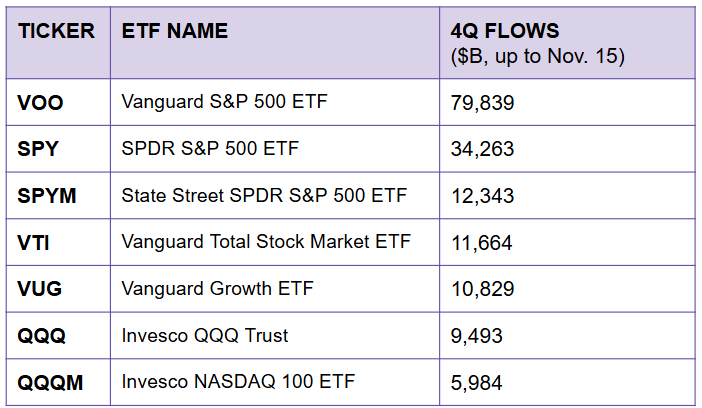
Zooming out from November to equity ETF flows throughout Q4, small-caps are nowhere among the quarters’ biggest asset gathering hits. On the contrary, top equity ETF asset gatherers are who’s who of large-cap funds, from S&P 500-tracking favorites to Nasdaq 100-darlings.

Source: VettaFi Data.
The 15 most popular ETFs this quarter together have attracted about $200 billion in net new assets. When we expand that top tier, we see investors have done two things with conviction in their equity allocation (at a top level):
- They’ve added an exclamation point to their U.S. large-cap exposure through a focus on large-cap and growth funds,
- They’ve diversified that position with some international stocks, including emerging markets, as well as some large-cap value ETFs.
Notably absent in these top asset flows trends in Q4 is small-cap ETFs. But the month of November specifically has been changing that story.
Whether small-caps build up from here and find renewed investor enthusiasm going into 2026 remains to be seen. But there are a lot of folks looking for some action in this category.
To quote one, Janus Henderson’s portfolio manager Nick Sheridan recently said small-caps globally are “primed to outgrow the giants in 2026.”
As he put it, there’s an alignment of multiple factors setting up the next move in small-caps. (It sounds a lot like the “confluence of factors” Globalt’s Woody spoke about earlier this year.) From economic recovery, to AI-driven efficiencies, to M&A activity to a de-escalation of global tensions, there’s a lot that could bode well for small-caps going forward.
“Overall, 2026 looks promising for small caps as macro tailwinds, technological adoption, and strategic activity converge to narrow the valuation gap with large caps,” Sheridan said.
“We are big believers over the long term that smaller companies can deliver strong operational performance,” he added. “This is not currently reflected in their valuations. Should conditions align favourably, the smaller cap space could deliver strong growth prospects for investors.”
Early 2026 market outlooks promise a lot of predictions about small-cap stocks. Can this young momentum perking up its head in November persist? We’ll be watching, and we’ll be looking to see whether it’s Todd or Eric who is buying a steak dinner for the other.
Originally published on ETF Trends
For more news, information, and strategy, visit ETF Trends.
A message from Advisor Perspectives and VettaFi: Discover something new! Click here to register for our upcoming webcasts.
Read more commentaries by VettaFi