Key takeaways
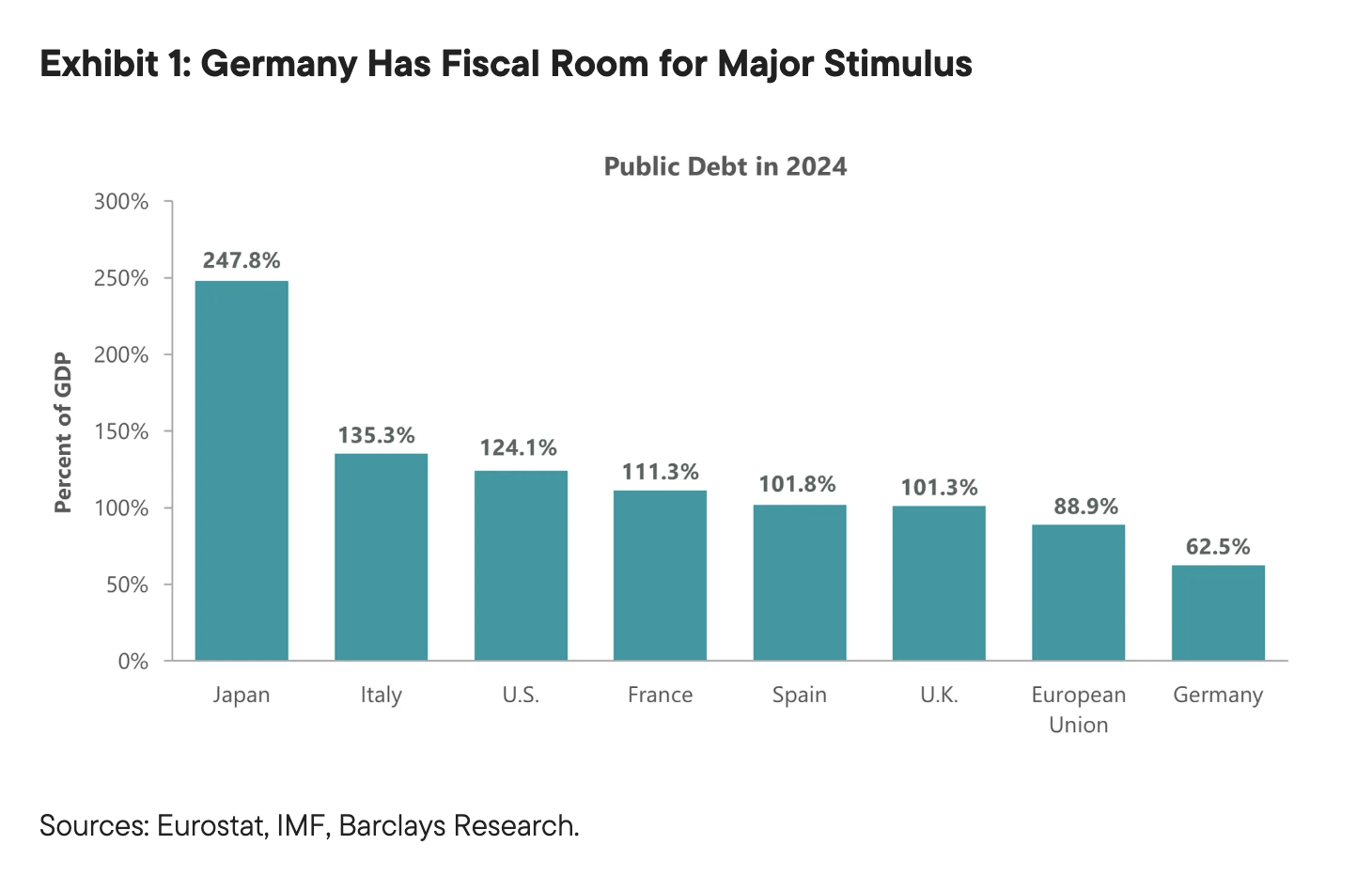
- Greater fiscal spending in Europe and Japan to gain self-sufficiency and generate growth is boosting both knowledge-based industries like artificial intelligence (AI) and manufacturing.
- We believe better earnings are key to improved performance for growth stocks compared to value and we are bullish on select growth opportunities in the consumer, industrial and health care sectors, as well as banks.
- Transformational innovation from China is helping the country gain share in areas such as biopharmaceuticals and battery storage. While Beijing’s expansionary vision could create friction globally, we believe this is a market that cannot be ignored.
Developed markets carry positive momentum into 2026
A long-awaited global equity leadership shift took hold in 2025 as policy uncertainty in the United States under the Trump administration spurred investors to look overseas for more predictable returns. With the United States pulling back from its traditional roles in global trade and security, Europe and Japan have committed to increased fiscal spending while China has doubled down on its desire to achieve economic independence from the West. These actions helped spur most international developed and emerging markets to outperform the United States. Whether this broad momentum will continue, or if non-US opportunities will become more selective, are key questions entering the new year. We recently spoke with Elisa Mazen, Head of Global Growth, about the landscape for international equities in 2026.
How are deglobalization and the need for reshoring industrial and research and development (R&D) capabilities supporting Europe and other markets where you invest?
Reshoring is crucial to strategic sovereignty—as was exposed by the supply chain weaknesses during the COVID-19 pandemic. What some may view as existential threats from China and the United States in terms of their reshoring initiatives and tariffs are really policymakers realizing they need to be more self-sufficient and be able to generate their own growth, both in knowledge-based industries, like AI, and in manufacturing.
Europe has been increasing spending as a result. Following the recommendations of the Draghi report that came out in 2024, the European Union has begun to streamline bureaucracy and harmonize its market of 27 different countries. If they can act as one unit, it will release a lot of investment capital. The critical German auto market, for example, is being disrupted by Chinese electric vehicles. This is changing how Europeans think about battery technology. Additionally, many European auto companies are also now working with European defense companies to use the auto companies’ excess capacity and leverage manufacturing efficiencies.
Beijing does not see Western economies supporting its growth, so it is also spending; part of China’s new five-year plan is to use cheap technology and its large population of PhDs and engineers to grow its pharmaceuticals and manufacturing capabilities.
Your team and most global investors pulled back from China for a few years. What has caused you to regain confidence in the world’s second-largest economy?
Many investors have shunned China since COVID-19, so much that indexes were being created ex-China. However, while China is a complicated market with many local players and several exchanges, the innovation there is breathtaking. It is transformational, and the Chinese government and private companies are trying to export it and take over industries like biopharmaceuticals and battery storage. These efforts will create friction globally, but we believe this is a market where we need to point our ship.
How are you approaching innovation such as AI as an international investor and what areas are you most excited about heading into 2026?
We see multiple opportunities around AI. It feels like the United States is dominating the headlines and everybody else is picking up the scraps, but that’s not exactly true. We are thinking of AI the same way we target three types of growth—structural, secular and emerging. Among structural change stories, which tend to be early cyclicals, we like the “picks and shovels” companies like semiconductor stocks. At some point, demand for GPUs and custom AI silicon that power large language models will be met, but we are not there yet. Additionally, industrial companies that supply power, connections and cooling equipment to data centers are also part of the early-stage buildup.
The next group is the AI adopters, which encompasses not just technology companies but all parts of the global economy. We are having conversations with consumer companies such as a global cosmetic maker, for example, which is deploying AI for R&D. By using AI to operate faster and more efficiently, secular growth companies should see cost savings. For supermarkets, which operate on skinny margins and high levels of headcount, the upswing from that cost savings could be meaningful. We are excited about the secular phase and expect adoption to broaden by the second half of 2026.
Finally, AI-native companies fall into our emerging growth bucket with high rates of revenue growth. There are not many of them today, but we are confident that there will be. We expect completely new businesses will emerge on the back of all this other foundational AI technology we are investing in.
Additionally, AI companies can be quite different by market. China has differentiated companies in AI relative to the United States. Access to technology has led them to scale differently and their advantage in power—and ultimately running costs—will be a key differentiator for the future.
Geopolitics has always had an influence on international equities, but that influence became amplified in 2025. How is that impacting your investment universe as an active growth manager?
Defense spending has been front and center in 2025. This began with questions around how much NATO was going to really support the Europeans and the Ukrainians. Supplies of munitions in the European Union had been extremely low, so we have seen a rebuilding of inventories and efforts to maintain a steady supply of defense infrastructure. Japan has also had to increase its defense spending and has a new prime minister interested in making sure its military is strong.

We believe increased defense spending is here to stay. Companies considered defense stocks within the industrials sector of the MSCI EAFE Growth Index benchmark were around 100 basis points (bps)a few years ago but today represent about 700 bps. That is a significant change over a very short period.
Unlike in the United States, value has outperformed growth in international markets in 2025. What will it take for growth stocks to reassert themselves?
Value has worked internationally because inexpensive stocks are the most direct beneficiaries of the kind of enormous stimulus measures being approved in Germany, other parts of Europe and Japan. Growth stocks, in contrast, have done okay, but they are a much smaller part of core benchmarks like the MSCI EAFE and MSCI ACWI Ex-USA. In Europe, which is roughly three-quarters of developed market indexes, technology is quite small and concentrated in cyclical areas.
Better earnings can drive growth stocks higher, and we see challenges to growth earnings falling into three categories: tariffs, technology and transition. These issues have created volatility around earnings and impacted more highly rated growth stocks. Many of them are in the secular AI growth bucket and should see a reassertion of growth as cost savings begin to come through and new ways of monetizing their businesses emerge. Lower interest rates will certainly help stocks, but we think that to reassert market leadership—specifically in technology—it will come down to improved earnings.
What other sectors look attractive heading into 2026?
Our approach across three buckets—structural, secular and emerging—allows us to own companies that are showing good earnings growth. Among structural growth ideas where we see a step change in earnings is European banks, which have been a good source of performance. We think banks can continue to work as we don’t believe inflation is going away and we expect to see higher interest rates than the market is discounting. This should be beneficial for certain other industries, such as supermarkets, with high fixed-cost structures.
Within industrials, areas tied to aerospace and defense have done well but anything related to real estate such as construction and engineering has underperformed. So, we are staying nimble in determining which industries have pricing power and where higher inflation can be a tailwind.
Health care has challenged by lower research spending and US policy adjustments. But these issues are moderating today as corporations adjust to the new regime. While stocks have been weak, health care is a compelling innovation source, notably in biotechnology. Some of these companies do not yet have commercial revenue but are developing new products (for example, China has been aggressively developing antibody drug conjugates that target diseased cells) that could be the next clinical breakthrough large cap pharmaceuticals companies are seeking.
Conclusion
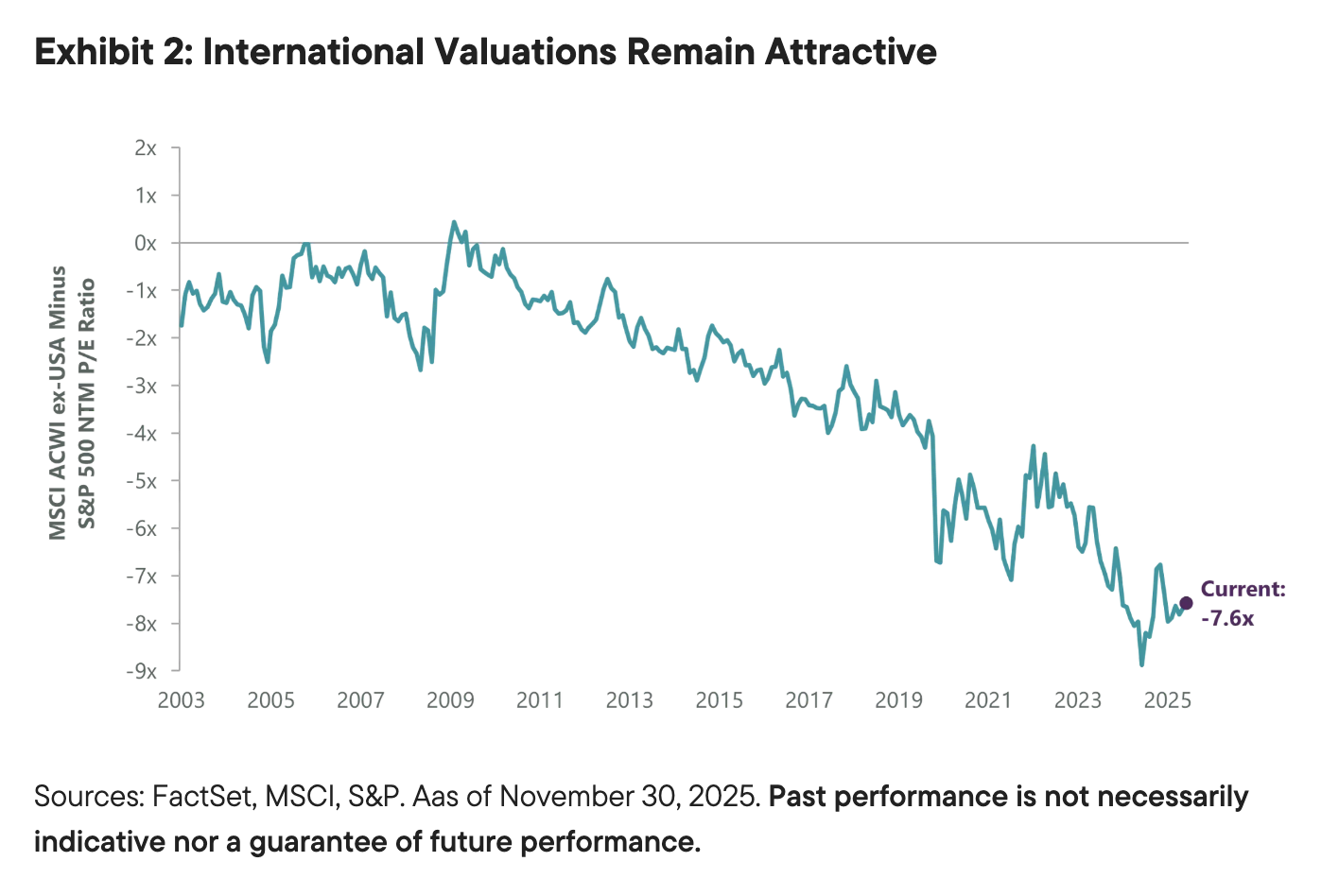
Despite a relative performance comeback for international equities in 2025, valuations remain historically attractive compared to their US peers. Overseas markets continue to offer growth franchises with best-in-class business models and innovation comparable to that available in the United States but at more reasonable multiples. International companies are clear leaders across industries such as semiconductor equipment, biopharmaceuticals, luxury goods and advanced manufacturing and are well-positioned amid the current secular trends of AI and increased defense spending. We believe an active approach grounded in fundamental research is well-suited to identifying compelling non-US growth opportunities in a rapidly changing global economy.
DEFINITIONS
The S&P 500 Index is an unmanaged index of 500 stocks that is generally representative of the performance of larger companies in the United States.
The MSCI All Country World (ACWI) ex USA Index is a market capitalization weighted equity index of stocks traded in 46 world markets. It does not include the stocks of companies that are based in the United States.
WHAT ARE THE RISKS?
All investments involve risks, including possible loss of principal. Past performance is no guarantee of future results. Please note that an investor cannot invest directly in an index. Unmanaged index returns do not reflect any fees, expenses or sales charges.
Equity securities are subject to price fluctuation and possible loss of principal. Large-capitalization companies may fall out of favor with investors based on market and economic conditions. Small- and mid-cap stocks involve greater risks and volatility than large-cap stocks.
The government’s participation in the economy is still high and, therefore, investments in China will be subject to larger regulatory risk levels compared to many other countries.
There are special risks associated with investments in China, Hong Kong and Taiwan, including less liquidity, expropriation, confiscatory taxation, international trade tensions, nationalization, and exchange control regulations and rapid inflation, all of which can negatively impact the fund. Investments in Taiwan could be adversely affected by its political and economic relationship with China.
WF: 7899058
A message from Advisor Perspectives and VettaFi: Discover something new! Click here to register for our upcoming webcasts.
IMPORTANT LEGAL INFORMATION
This material is intended to be of general interest only and should not be construed as individual investment advice or a recommendation or solicitation to buy, sell or hold any security or to adopt any investment strategy. It does not constitute legal or tax advice. This material may not be reproduced, distributed or published without prior written permission from Franklin Templeton.
The views expressed are those of the investment manager and the comments, opinions and analyses are rendered as at publication date and may change without notice. The underlying assumptions and these views are subject to change based on market and other conditions and may differ from other portfolio managers or of the firm as a whole. The information provided in this material is not intended as a complete analysis of every material fact regarding any country, region or market. There is no assurance that any prediction, projection or forecast on the economy, stock market, bond market or the economic trends of the markets will be realized. The value of investments and the income from them can go down as well as up and you may not get back the full amount that you invested. Past performance is not necessarily indicative nor a guarantee of future performance. All investments involve risks, including possible loss of principal.
Any research and analysis contained in this material has been procured by Franklin Templeton for its own purposes and may be acted upon in that connection and, as such, is provided to you incidentally. Data from third party sources may have been used in the preparation of this material and Franklin Templeton ("FT") has not independently verified, validated or audited such data. Although information has been obtained from sources that Franklin Templeton believes to be reliable, no guarantee can be given as to its accuracy and such information may be incomplete or condensed and may be subject to change at any time without notice. The mention of any individual securities should neither constitute nor be construed as a recommendation to purchase, hold or sell any securities, and the information provided regarding such individual securities (if any) is not a sufficient basis upon which to make an investment decision. FT accepts no liability whatsoever for any loss arising from use of this information and reliance upon the comments, opinions and analyses in the material is at the sole discretion of the user.
Franklin Templeton has environmental, social and governance (ESG) capabilities; however, not all strategies or products for a strategy consider “ESG” as part of their investment process.
Products, services and information may not be available in all jurisdictions and are offered outside the U.S. by other FT affiliates and/or their distributors as local laws and regulation permits. Please consult your own financial professional or Franklin Templeton institutional contact for further information on availability of products and services in your jurisdiction.
Issued in the U.S. by Franklin Templeton, One Franklin Parkway, San Mateo, California 94403-1906, (800) DIAL BEN/342-5236, franklintempleton.com. Investments are not FDIC insured; may lose value; and are not bank guaranteed.
You need Adobe Acrobat Reader to view and print PDF documents. Download a free version from Adobe's website.
CFA® and Chartered Financial Analyst® are trademarks owned by CFA Institute.
© ClearBridge Investments
Read more commentaries by ClearBridge Investments