There’s a lot of collective wisdom about the challenge of forecasting markets and the economy. Warren Buffet once famously said: “”Forecasts may tell you a great deal about the forecaster; they tell you nothing about the future.”
In an even more scathing take, courtesy of economist John Kenneth Galbraith, “The only function of economic forecasting is to make astrology look respectable.”
Early last year, I myself made some ETF predictions. Among my calls, I forecast a moderation in the ETF asset gathering pace; we went on to have a record year of inflows. I also expected small-caps to shine, given concentration and valuation concerns; small-cap ETFs struggled and faced outflows most of the year. So, I’ve personally helped give astrology a lot of credibility.
But it’s January, and making predictions for a new calendar year is one of our favorite sports.
My Prediction
Uncertainty remains a buzzword going into the fourth year of a bull market where many investors remain bullish but are also growing cautious. As an anecdote, in a late 2025 advisor survey we did at VettaFi, when asked about expectations for the S&P 500 in 2026, about 62% of advisors said they were bullish, looking for 10%-plus returns this year. But the remainder were calling for rangebound to lower price action.
Uncertainty, as in policy, trade, rate, growth and geopolitical uncertainty, continues to feed into caution as the market extends its bull run while remaining top-heavy and richly valued. With that backdrop, I’m going to make one single prediction this year: 2026 will be the year when all-weather investing makes its mark.
Consider that another advisor insight we took away from our surveys in late 2025 was that managing volatility and downside risk while maintaining stable returns (or better) ranked highest among advisor priorities going into the new calendar year. That pursuit, in the context of uncertainty, is prime territory for all-weather investing.
In the ETF space, there are different ways to think about all-weather investing. with solutions that can deliver broad diversification — aka: the secret to resilient portfolios — or laser focused exposures, tactically navigating the market’s ups and downs.
Consider 3 Ideas
We could say ALLW is a pureplay all-weather approach. It’s in the name, after all. We know regulators are sticklers about ETF naming conventions and the actual portfolios underlying the monikers.
ALLW is an actively managed, global multi-asset fund that accesses Ray Dalio’s expertise in navigating markets, without attempting to predict them.
State Street Investment Management described the fund’s key feature this way: “ALLW is designed to balance assets with various sensitivities to key economic environments without predicting which environment is ahead, which means risk is allocated equally to different growth and inflation environments.”
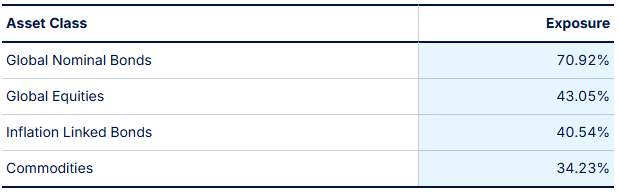
In 2025, growth-sensitive equities and allocations to commodities like gold boded well for the strategy. Since inception last March, ALLW returned about 16% to date. As of Jan. 5, the portfolio was allocated across four asset classes, led by fixed income.

Source: ALLW Portfolio as of Jan. 5, 2026, SSIM
“Is the equity bull market sustainable? No one knows for sure,” SSIM said about ALLW. “But investors don’t need to bet on knowing how the market will move to accumulate wealth over the long term if they are already prepared across a broad range of possibilities.”
ALLW is still relatively young, but it already boasts nearly $700 million in assets some 10 months since launch, and it has three unique nominations for best-in-class ETF in the ETF.com Awards this year.
There are many multi-asset ETFs looking to be core, well-diversified all-weather portfolio holdings. CGBL is a great example of a strategy that actively adjusts exposure between equities and fixed income in order to deliver consistent results while minimizing volatility.
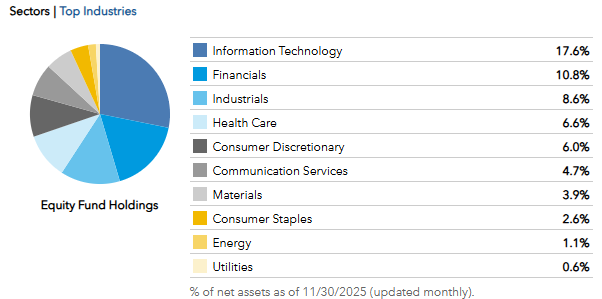
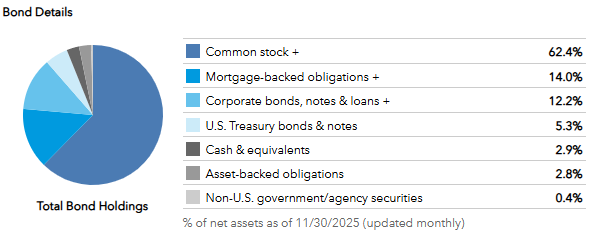
The fund invests in quality growth and income equities (dividends), which account for 50% to 75% of the portfolio, and diversifies that with a sleeve comprising fixed income ETFs.
Coming into the year, CGBL had equities snagging over 60% of the portfolio (55% in U.S. names) and 35% in fixed income, with the remainder in cash/cash equivalents. The composition of each of these asset class allocations look like this:
Source: Capital Group
In the past year, CGBL delivered over 15% in returns, besting a traditional 60/40 index.
Defined outcome ETFs offer a form of structural all-weather investing. They deliver stable returns and market participation without a lot of heartburn. They can also be seen as bond replacements. Thanks to their risk profile, they can deliver bond-like portfolio protection while also delivering upside returns that can exceed that of bond yields of similar risk.
That’s especially true when implemented on a quarterly basis — shorter reset period — or on a laddered basis, where timing-related concerns associated with the outcome period are minimized.
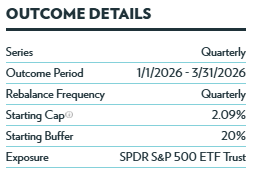
BALT is one of many interesting ETFs in this category. It captures S&P 500 returns to a cap (at 2.09% on initial date) while providing 20% downside protection over a three-month period (the S&P 500 rarely sees that kind of decline over a quarter.)
Source: Innovator ETFs
All-Weather for the Win
Coming into 2026, forecasts for S&P 500 and U.S. equity returns are moderating, with cautious optimism coloring ongoing bullish sentiment. Meanwhile, expectations are rising for a steepening yield curve, which may challenge bond investors.
These conditions could prove ideal for all-weather investing, be it of the multi-asset, active 60/40-like or Defined Outcome sort. As the call to manage risk and maintain results comes into sharper and sharper focus, these types of strategies could deliver a lot of value for investors. This could be their big year.
Now, let’s see how that prediction stacks up to astrology.
Originally published on ETF Trends
For more news, information, and strategy, visit ETF Trends.
A message from Advisor Perspectives and VettaFi: Discover something new! Click here to register for our upcoming webcasts.
Read more commentaries by VettaFi