Have you ever thought about the incredible number of assumptions you make every day, subconsciously?
Before you go out the door in the morning, you assume the sun is up, the air is safe to breathe, and there will be coffee. As you head out the door, you assume the people you’ll interact with will behave in a predictable manner.
This is not always the case, but in general, people obey traffic laws, wait their turn, and pay for their morning coffee and donut. They do this because it is rational. Otherwise, we’d be living on a studio set of Mad Max. Acting rationally at the individual level benefits society as a whole.
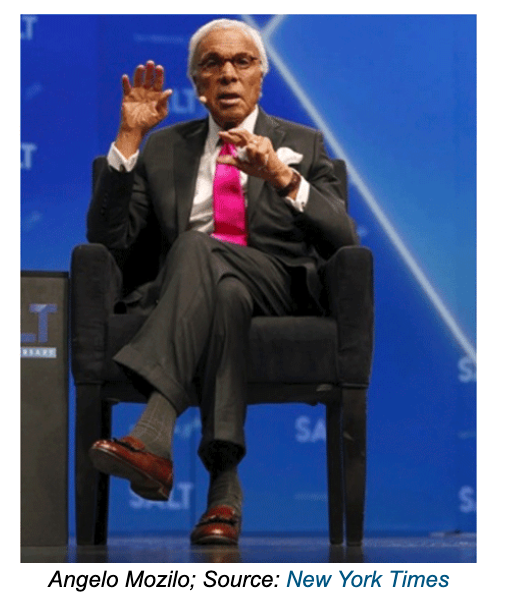
Except not always… Remember this guy?

So relaxed and tan. This is Angelo Mozilo, former CEO of Countrywide Financial. In the mid-2000s he implored his mortgage originators to act in their own self-interest. Take more applications! Don’t worry about qualifications—nobody cares! More loans mean more fees, and we don’t even have to hold the loans—Wall Street will slice them up, package them, and sell them to investors. No risk! Just lots of fees for all of us to share. What’s not to love?
And then… the economy collapsed, triggered by a sea of bad mortgages and loan defaults.
That is called a fallacy of composition, where rational actions at an individual level become dangerous and destructive in the aggregate.
This week, my friend Lyric Hughes Hale and special guest Eric Huang of Taiwan share with us the details of what could be another massive fallacy of composition.
Oddly, this time the risk lies with one of the US’s largest creditors.
Surprise! It’s not China. For years talking heads have fretted over China “weaponizing” their holdings of US Treasuries. If China dumped their holdings all at once, it would collapse the $1 trillion dollar per day treasury market and the value of the US dollar. But that would mean the People’s Bank of China had just shot itself in the foot (perhaps the head). Why destroy the value of an asset if you own A LOT of it? I suppose it could happen, but from China’s perspective, it would be self-destructive.
Just to play out the scenario, what would happen if a large holder of US treasuries sold their holdings quickly?
The value of the US dollar would collapse. The value of US treasuries—owned by nearly all global central banks, global financial institutions, multi-national corporations, and individual investors—would collapse, leading to a global financial crisis. World trade would grind to a halt. This would be the granddaddy of financial crises, leading to what John Mauldin calls the Great Reset... or worse.
Put in that light, it is highly unlikely any major US creditor would elect to sell all their holdings at once. It would trigger global financial destruction.
What Lyric and Eric share with us today is the story of a large US creditor that, in certain circumstances, could be forced to liquidate their treasuries.
That creditor is the friendly island of Taiwan. US Treasuries held in Taiwan are owned by a variety of entities and individuals. In total, their value is roughly $700 billion, nearly equal to the value of Treasuries held by China. A large subset of Taiwanese US treasury holders are insurance companies. They hold US treasuries as investments.
That’s perfectly rational. Most insurance companies do. The problem comes with how they hold them. Their holdings are hedged. Without getting too technical, this sets up a situation where, in certain instances, the insurance companies would be compelled, automatically, to sell their treasuries.
The trigger would be a swift change in the value of the Taiwan dollar. What would cause that?
An invasion, or even the hint of imminent military action by China, could trigger the equivalent of a bank run. Taiwan’s populace would race to raise cash in their local currency. That would force sales of US Treasuries at a massive scale, very quickly. In a matter of hours, the global treasury market could collapse.
This is not a fait accompli. Steps can be taken to avoid such a tragedy. Lyric Hughes Hale, editor-in-chief at EconVue, and Eric Huang recently co-authored an article on this topic and what must be done to avoid this fallacy of composition. They discussed the situation and their article with me on Global Macro Update. I encourage you to watch, listen, or read the transcript. Links to all options below.
Eric put the risk bluntly: “Even before a single missile or shot at Taiwan, the market will already react.” If Taiwanese citizens hear credible rumors of an invasion, their first instinct will be to call their insurance companies and demand their money back. The insurers, by law, would be forced to liquidate their US treasury holdings to meet those redemptions.
I encourage you to watch my full conversation with Lyric and Eric by clicking here.
A transcript of our conversation is available here.
Their EconVue article, "The Financial Ring of Fire," goes deeper into the mechanics and offers specific policy recommendations. Read it here.
With US focus turned to Latin America, Ukraine, and the Middle East, one has to wonder if China sees today as an opportunity to act against Taiwan. Today’s Global Macro Update should give them pause.
Until next time, thanks for reading.
Ed D’Agostino, Publisher & COO
A message from Advisor Perspectives and VettaFi: Discover something new! Click here to register for our upcoming webcasts.
© Mauldin Economics
Read more commentaries by Mauldin Economics