The Bipolar Economy
Membership required
Membership is now required to use this feature. To learn more:
View Membership BenefitsExtreme mood swings are characteristic of a psychiatric condition called bipolar disorder. Patients can cycle between euphoria and depression. This is difficult because we all need balance to live normal lives. We spend most of our time in the muddle-through zone between the extremes.
Living with a bipolar person is difficult. Living in a bipolar economy is hard, too. Last year saw wild swings in attitudes about the economy and financial markets. The year opened on a high note, quickly stumbled when the Chinese DeepSeek AI model questioned the Mag-7 prospects, recovered from that, then fell again with the Liberation Day tariff announcements, came back again, then went through several more cycles. Not a bad year overall, but it was a rough ride at times.
Last January I called for A Partly Cloudy Year with A Possible Storm. Thankfully, my worst concerns didn’t materialize but the risks I mentioned haven’t disappeared. Ironically, we are generally dealing with the same questions and concerns at the beginning of this year as we were last year. Today and next week we’ll look ahead to 2026, drawing on my expert network and my own ideas as well.
Before we begin, let me give you what has become a traditional reminder: the purpose of these forecasts isn’t pinpoint accuracy. Just getting the direction right is a challenge. I don’t have a crystal ball and neither does anyone else. But reviewing what might happen compels us to prepare for different scenarios – at least mentally. And often, mental preparation is half the battle.
Let me offer some general thoughts first. One of the lessons my many mentors taught me over the years is that when everybody is on the same side of the boat a correction is due. It’s that balance thing. And yet, everybody, if you think of everybody as Wall Street analysts, has been on the same side of the boat for several years and it is just as pronounced this year.
Essentially, every Wall Street analyst is projecting the S&P 500 to increase this year. The list below shows 21 out of 21 bullish analysts, with an average projection of a 10%+ increase.
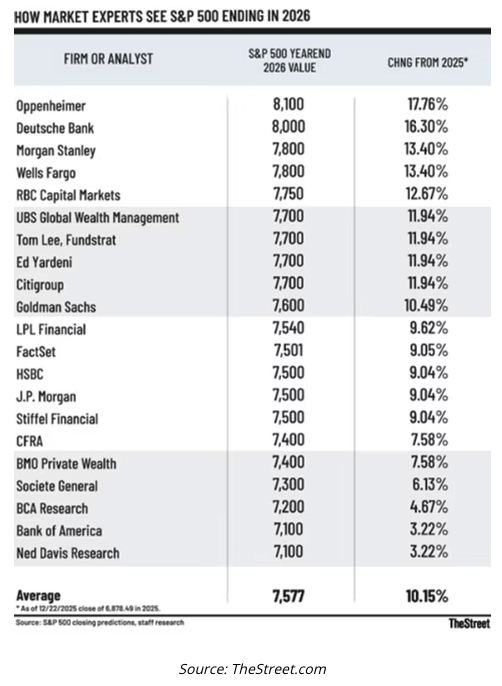
That’s all well and good, and since 1980, projecting a higher S&P 500 has been right approximately 75% of the time.
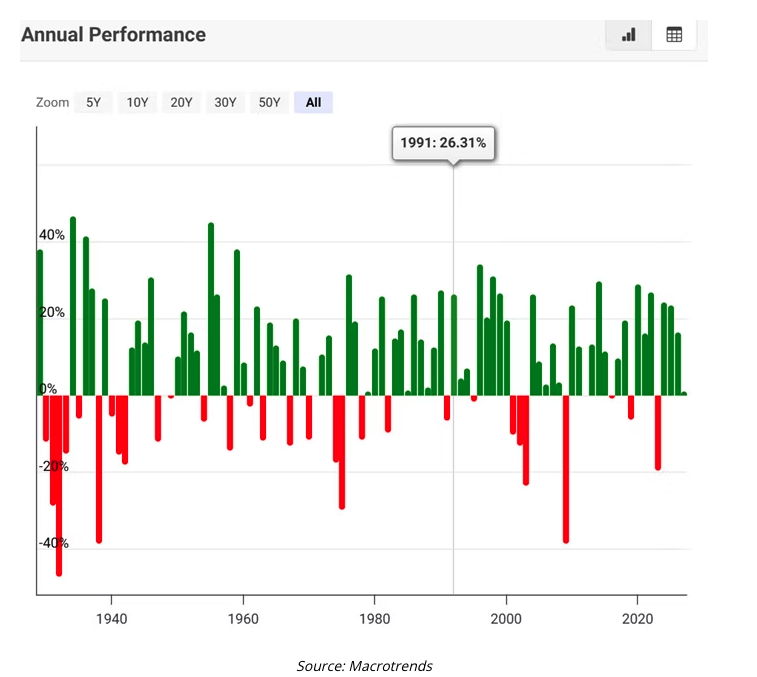
But the last time the S&P 500 rose four or more consecutive years was in 2003-07. That being said, as we will see, there are very good macro reasons to be bullish, and some headwinds that could be disruptive.
The best way to view market forecasts is as entertainment. Your investment portfolio shouldn’t change simply because analyst A is bullish or bearish. Investment portfolios should have a longer-term horizon than one year. My stock portfolio is generally positioned in dividend stocks (with some legacy exceptions) that in general won’t change unless something happens to that specific stock. And there, my manager (TBG) will make the decision and not me.
Also note that I make a big distinction between investments (long-term) and trading. Good traders take into account all sorts of things, including forecasts.
Certain forecasts can be quite useful depending on your circumstances. If your business depends on copper, having an in-depth view on copper could be important. Or energy or whatever is important for your business.
Different opinions can help balance your own life and emotions. Now let’s look at a few forecasts plus my comments.
Unsustainable Imbalances
We’ll start with Dave Rosenberg, who is accustomed to going first as my Strategic Investment Conference opening speaker. This week he wrote about balance as the major 2026 theme.
In Dave’s view, the US economy and stock market are both deeply unbalanced in unsustainable ways. He listed 20 specific imbalances. How these extremes get resolved will write the story of 2026.
Here’s the full list:
-
Top ten stocks in the S&P 500 representing 40% of the market cap.
-
Tech sector industrial production +11.8% YoY; +1.8% for ex. Tech manufacturing.
-
A real CAPE earnings yield of 2.5% and a 30-year real TIPS yield of 2.6% (as in, a negative equity risk premium).
-
Wage growth +3.5% year-over-year; S&P 500 (operating) earnings growth +23%.
-
Real consumer spending +2.6% year-over-year; real personal disposable income +1.5%.
-
AI and related business spending up +11.0% year-over-year; the rest of capital spending down -4.4%.
-
Real GDP growth +2.3%; Real Gross Output at +1.5%; and soft survey-based economic data consistent with 0% growth.
-
Hiring rates (3.2%) tied for a fifteen-year low; layoff rates (1.2%) tied for a five-year high.
-
Full-time employment +0.6% on a YoY basis; part-time +6.6%.
-
Unemployment rate for those 25 years and older at 3.7%; and at 8.3% for those in the 20-24 age cohort. [JM - making for a total of 4.4% unemployment as of Friday morning.]
-
Nonfarm payrolls growth at +0.6% YoY; excluding health/education +0.1%.
-
Large company employment +2.1% year-over-year; small business jobs down -0.2%.
-
Year-ahead income growth for those earning $100k and up, +3.2%; for those earning less than $50k, try +2.4%.
-
The labor share of national income is stuck at a historical low of 55%; down from 58% just before the pandemic hit in early 2020.
-
Consumer sentiment at its seventh-worst level on record; equity market sentiment at a twelve-month high and in the top 25% readings of all time.
-
Home sales -1.0% YoY; housing inventory +7.5%; median home price growth YoY down to +1.2% from +4.3% a year ago (and yet, inflation is on everyone’s brain).
-
Core “sticky” CPI inflation at +3.0%; core “flexible” inflation at a mere +0.7%.
-
Core inflation ex. shelter running at +2.3%; the nonfarm business sector price deflator down to +2.1% from +2.3% a year back and +3.4% two years ago, and yet most investors still think inflation is a top threat.
-
An unprecedented seventh straight year of the U.S. fiscal deficit/GDP ratio coming in at roughly 5% or higher (even with the tariff revenues); and coinciding with record portfolio bullish views on the economic outlook.
-
The Haver Analytics Fed-based recession model is at 74%, versus 71% a year ago. It got as high as 74% as well in late 2022 as investors priced in recession, but it never came; we are now at the same level, but no asset class is priced for the possibility of a downturn.
I agree with Dave that these discrepancies can’t persist forever. As always, timing is the hardest part. We see it especially in the stock market, where what looked like wild extremes became even more extreme.
Inflationary Boom?
My friends at Gavekal have long used a four-quadrant framework to guide their analysis. Different combinations of inflation and growth trends support four different investment strategies, as summarized in this diagram.
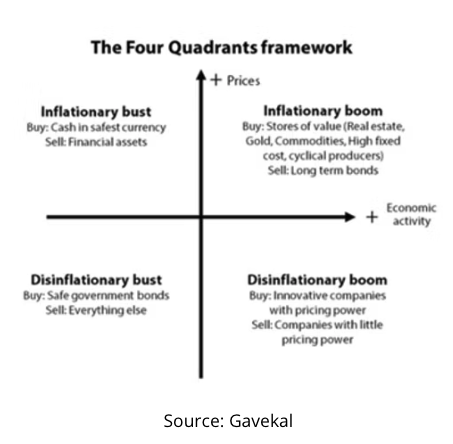
In a recent report, Gavekal analysts Will Denyer and Tan Kai Xian think 2026 will likely bring the US a continuation of “inflationary boom” conditions. They list five driving factors.
“Fiscal stimulus. In 2025, higher tariff rates led to a modest contraction in the US budget deficit relative to GDP. This was likely a marginal drag on growth and inflation. By contrast, 2026 is set to see a small widening of the fiscal deficit, as tax cuts from the One Big Beautiful Bill Act kick in. This is likely to be moderately positive for growth and inflation.
“Easier monetary policy. The Federal Reserve has cut rates by -175bp since September 2024. After CPI inflation softened in October and November, and November’s jobs report came in weak, the Fed may cut further in coming months. Today, the futures market is putting a probability of just 16% on a rate cut on January 28. But this could rise quickly if December’s jobs report, due for release Friday, is weak. On top of this, in December the Fed pivoted away from balance sheet contraction towards expansion to address a shortage of liquidity.
“Banking deregulation. Treasury Secretary Scott Bessent is overhauling the US bank regulation apparatus to focus on promoting growth. On December 11, he said economic growth and national security, including economic security, “are both essential to financial stability.” Alongside monetary easing, bank deregulation—including easier capital standards—is likely to give a boost to growth and inflation.
“Positive fundamentals for business investment. According to national accounts data released on December 23, US corporate profits grew strongly in the third quarter of 2025. Our estimate of returns on invested capital in the US corporate sector already looked fairly robust, but this boost pushed them up to a record high of 7%. With the return on capital high and the cost of capital relatively low, this positive “Wicksellian spread” is conducive to business investment, whether financed with earnings or debt.
“Meanwhile, corporate balance sheets also look robust. With debt-to-equity ratios low and rising, all this is likely to be positive for business investment, credit growth, and nominal GDP.
“Wealth effects remain positive for consumption. The rollover in cryptocurrencies has eroded the net wealth of some. But most US households are more affected by the performance of home prices and equity markets. US housing looks weak, but the dominant story—for now—remains the continued rise in US equity prices. All told, the average US consumer still benefits from a positive wealth effect.”
All these would support an environment of continued GDP growth along with inflation in the 2% to 3% range. Inflation above that zone, perhaps triggered by a spike in energy prices, might change the outlook, as would a severe drop in stock or real estate values. But inflationary boom remains their base case for this year.
(By the way, Over My Shoulder members can read the full Gavekal report here. If you’re not a member, you should be. Learn more here.)
The AI Unwinding
Good friend David Bahnsen always has one of the most fascinating annual forecast pieces. This year’s is no exception. Next week we will look at his forecast in closer detail but let’s first consider his comments on AI, since this boom is arguably the biggest single factor in maintaining economic growth.
David sees AI as a major technological breakthrough that could bring serious transformation to the global economy. That’s a different topic than the investment prospects over the next year or two. He is talking here about AI as an investment story, not a technology.
“I am asked often, ‘what do you think would catalyze a real unwinding of this story?’ My answer remains the same – some hyper-scaler blinking. I do not mean surrendering, exiting, or ceasing to invest. I merely mean ‘slowing the pace of investment.’ This not only strikes me as possible, but inevitable, and I do not see how valuations hold across the AI system ecosystem when that moment comes…
“Not only does this investment story depend on a friendly regulatory regime, a path to monetization that is not currently visible, and a sort of magical ending where everyone wins together, but it also seems extremely dependent on the assumption that this whole thing is something the public wants, period. I am not suggesting that the public does not want AI, but I am suggesting that people being impressed with what ChatGPT can tell them or what LLM’s can create has distorted what the cultural and political pushback is going to prove to be in 2026.”
“So with all that said, my list of things to watch in 2026 around the AI story:
-
-
-
Cultural and political pushback against the aggressive use of intellectual property being granted to LLM’s, the regulatory favors being granted to big tech companies, and greater scrutiny of the social cost from AI as various new narratives take hold
-
Whether or not capital expenditure assumptions are revised down as ROI realities are re-priced
-
China’s announcements in the space, both in terms of their own LLM development, and their own ability to generate sufficient computing power domestically
-
How much financing in this whole story (circular capex or otherwise) becomes debt-sourced versus equity
-
-
“Can the AI darling stocks be up, yet again, in 2026? Sure. Can some stocks be down while others are not (a more Darwinian interpretation)? Sure. Could it be a bit of a roller coaster along the way, but with a successful outcome in the end? Yes.
“But my 2026 theme is that there are more questions than answers, more risks than rewards, and more problems than solutions. And if I end up being early here, so be it. I have seen what happens when people are late.”
Roaring Productivity Versus AI Bubble
I generally agree with David, but my friend Dr. Ed Yardeni sees reasons to be more upbeat. This is from his latest letter (emphasis mine):
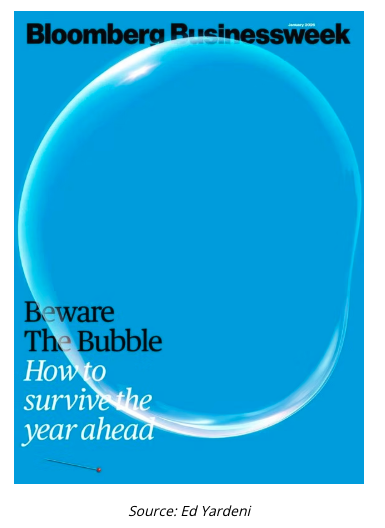
“Relax: The AI bubble is the cover story in the latest Bloomberg Businessweek. From a contrarian perspective, that's bullish because it signals that the bubble won't burst, if it even exists. We have AI Fatigue. We recently recommended underweighting the Magnificent-7 because their AI arms race is forcing them to spend heavily on AI infrastructure that could become obsolete quickly and that could be unprofitable as their competition squeezes their margins. We believe the air can be let out of the AI capital-spending bubble over time without it bursting and causing a recession.
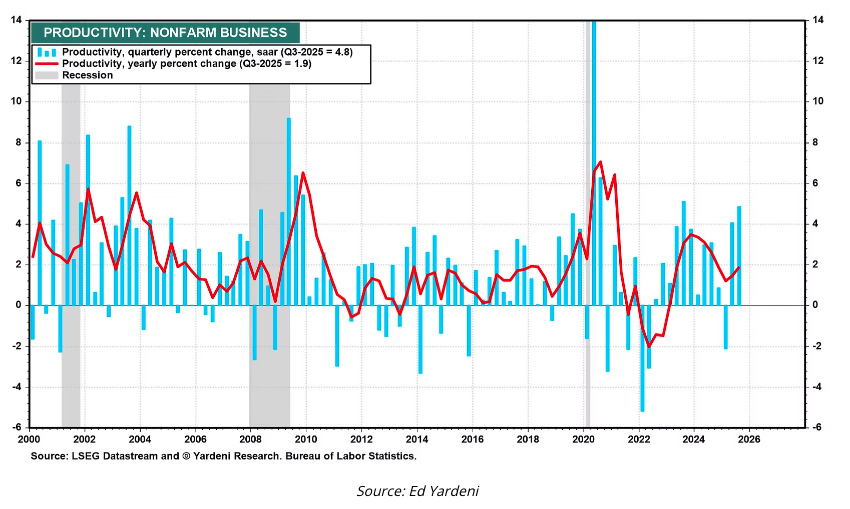
“Meanwhile, AI may be starting to boost the productivity of the users of this technology, especially the S&P 500's Impressive 493. Nonfarm business sector labor productivity increased 4.9% (saar) in Q3-2025, as output increased 5.4% and hours worked increased 0.5% (chart). Q2-2025 productivity was revised up from 3.3% to 4.1% as output increased 5.2%, while hours worked rose 1.0%. These are awesome numbers!
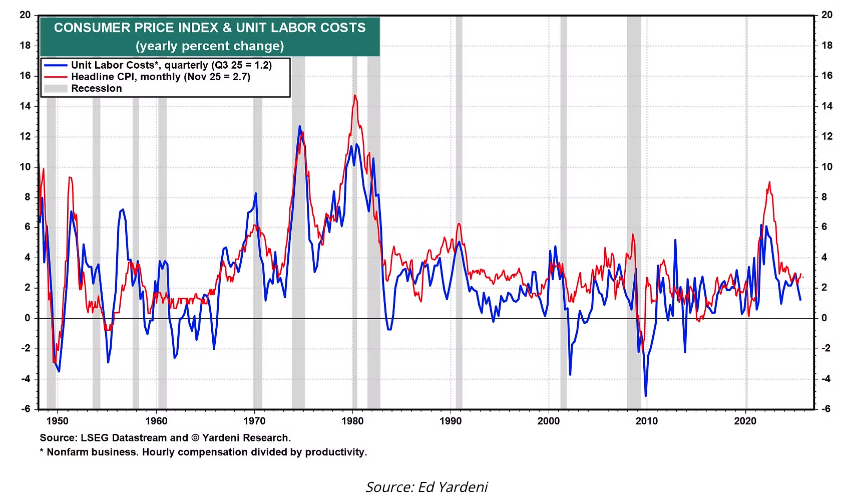
“Unit labor costs (ULC) in the nonfarm business sector decreased 1.9% in Q3-2025, reflecting a 2.9% increase in hourly compensation and a 4.9% increase in productivity. ULC during Q2-2025 was revised down from 1.0% to -2.9%. ULC increased only 1.2% (y/y) (chart). This confirms our view that CPI inflation should fall to 2.0% this year.
“Following today's advance report on October's merchandise trade, which showed a significant drop in imports, the Atlanta Fed's GDPNow estimate for Q4 real GDP was revised higher from 2.7% to 5.4% (chart). That estimate will probably decline as more data become available. But it suggests that productivity growth might have continued to boom during Q4-2025, consistent with our Roaring 2020s scenario.”
Let’s close with a look at the Atlanta Fed’s GDPNow estimate, which was revised sharply upward this week as the trade deficit came in lower. In accounting and GDP terms, exports are positive and imports are negative. Imports fell rather dramatically (can anyone say tariffs?). That drop fed into the fourth quarter 2025 GDP estimate increasing it from slightly below 3% to 5.4%. BOOM!
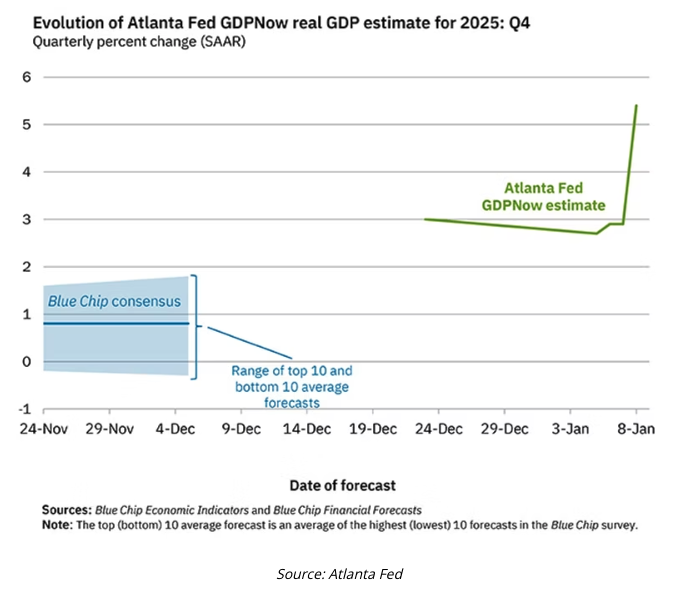
Notice that the Blue Chip Economist consensus is much closer to 1%, but that will probably increase when we see a new series of forecasts coming out over the next month. The Atlanta Fed is very good at showing overall direction. It is imprecise but still instructive in terms of magnitude. This suggests a stronger economy than most expect.
As we will see next week, tax cuts and deregulation are going to be a positive tailwind for the economy. Rising unemployment is worrisome, but is well within historical ranges. You can pick apart the individual details, such as boomers working longer because they need to and young people unable to find jobs, but overall, the economy seems to be doing well.
Going back to the beginning of the letter, there are years when the economy can do well but the stock market doesn’t. Typically, that’s when the stock market gets out “over its skis” in terms of valuation. But those aren’t deep bear markets, and they don’t last for long.
Pessimistically, you could say the labor market is already weakening while the tax cuts may need more than time to show their full benefit. Or you could argue along the lines of the Gavekal report I quoted earlier, that the boom was already underway even before the tax changes. We don’t know.
I suspect the answer will change several times as 2026 unfolds, as will the market’s reactions. But that’s OK to me because I’m not investing for a one-year time horizon. You shouldn’t be, either.
More next week.
West Palm Beach, Dallas, New York, and Rainforests
I fly into West Palm Beach on Sunday and back early Tuesday for business meetings. I think I will be there at least three to four more times this year. As a side benefit, I will get to be with my friend Barry Habib whose inflation and interest rate forecasts we will look at next week. I know I will have to be in Dallas and New York in the first quarter, just not sure when.
My sister Romaine is visiting us for two weeks from Victoria, British Columbia, Canada. I am going to play tourist with her today (Saturday) and visit the El Yunque National Rainforest on the east side of the island. It is the only rainforest in the US National Forest Service. I have lived in Puerto Rico going on eight years and have not yet made it. I’ve also not made it to Rincon on the west side of the island which I intend to visit later this month.
While she loves Canada, she is not a big fan of the national health system. She began having “flashes” in her eyes and tried to schedule a visit with an ophthalmologist. It took months and by the time she could see a doctor she had already lost the sight in her left eye. She now needs cataract surgery which is taking even longer.
Because of her experience with her eyes, when I began to see flashes, I immediately went to an ophthalmologist here in Puerto Rico and within 30 minutes was having laser surgery done to fix the tear. I was also able to schedule cataract surgery when I needed it, without any appreciable wait. Ironically, both procedures are covered by Medicare.
And with that, I will hit the send button and wish you a great week and even better 2026. I look forward to spending a few minutes with you every week sharing my thoughts and appreciate you giving me the attention and time to read them. You are why I write.
Your cautiously optimistic analyst,
John Mauldin
A message from Advisor Perspectives and VettaFi: Discover something new! Click here to register for our upcoming webcasts.
Membership required
Membership is now required to use this feature. To learn more:
View Membership BenefitsSponsored Content
Upcoming Virtual Events View All












