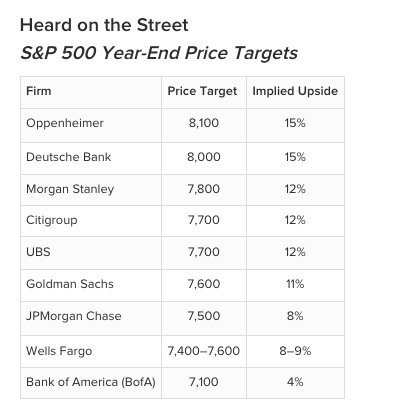
It’s historically rare to see a three-year winning streak of 20% or more for the S&P 500, but the index certainly came close last year. The benchmark racked up a roughly 18% return in 2025 — only the fifth time the index has seen three straight years of 16% gains or more in almost a century now. But after a near hat trick for the major indices, many on the Street are expecting a much more moderate bull market this year. A majority of year-end S&P 500 projections reflect more cautious optimism than in years past. The current average analyst consensus sits at approximately 7,555. This suggests an upside of 9–11% from recent levels.

Setting the Stage for Synthetic Income to Shine
Tariff fears have ebbed and flowed but faded (for the moment), as the trade détente holds for now. Continued Federal Reserve rate cuts, easing inflationary pressure and ongoing earnings growth should all support the bull case. The economy is back in fighting shape despite a murkier jobs market. But concentration risks remain at large, and many believe the market is in a mid-to-late cycle stage of its run.
In a year where moderation, not momentum, may define returns, options-enhanced ETFs offer an attractive way to stay invested while monetizing the more limited upside many expect. Simply put, the opportunity cost of foregone upside is reduced in a muted market. Yield-focused overlays have now taken on a less tactical, more strategic appeal. Plenty of products have stormed the scene that could help advisors gain that extra edge.
Weighing Your Options Overlay Strategies
The space is still dominated by the likes of JPMorgan, Global X and Amplify — with high-yield specialist NEOS quickly climbing the ranks as well.
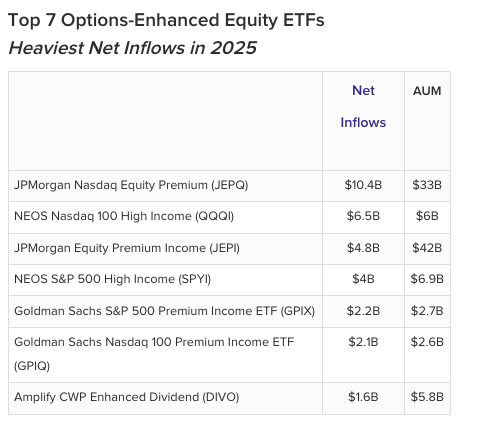
NEOS has disrupted the market by offering higher distribution rates and better tax efficiency with its flagship funds, the NEOS S&P 500 High Income ETF (SPYI) and the NEOS Nasdaq 100 High Income ETF (QQQI). Both use contracts taxed at a blended rate, making them popular for taxable accounts. And both were among the most popular ETFs last year — garnering $4 billion and $6.5 billion in net inflows, respectively.
Two funds from JPMorgan alone manage nearly 75% of total assets in this segment. The JPMorgan Equity Premium Income ETF (JEPI), which brought in nearly $5 billion in net inflows last year, has been favored for its enhanced broad-based equity selection. The JPMorgan Nasdaq Equity Premium ETF (JEPQ), which applies a similar overlay to the Nasdaq 100, has seen massive inflows, thanks to its ability to capture tech-driven growth while dishing out double-digit yields. The $33 billion fund saw roughly a third of those flows pour in last year alone.
Similarly, Goldman Sachs has seen success with two of its newer covered call ETFs, the Goldman Sachs S&P 500 Premium Income ETF (GPIX) and the Goldman Sachs Nasdaq 100 Premium Income ETF (GPIQ). GPIX offers even broader S&P 500 exposure than JEPI. Both launched just over two years ago and have more than doubled their asset bases in 2025 – bringing in over $2 billion in net inflows each. GPIX also spouted an impressive 16% total return last year, outperforming some of its largest peers. Both funds boast net expense ratios of just 0.29%.
Ultimately, 2026 will likely be less about chasing another blockbuster year and more about positioning for a market that rewards discipline, income and risk management. With consensus pointing to steady but capped equity upside, elevated valuations and a maturing cycle, strategies that trade a portion of potential gains for consistent cash flow may well win the day. Options-enhanced equity ETFs sit squarely at that intersection.
Originally published on ETF Trends
For more news, information, and analysis, visit VettaFi | ETF Trends.
A message from Advisor Perspectives and VettaFi: Discover something new! Click here to register for our upcoming webcasts.
Read more commentaries by VettaFi