Despite a fair amount of news and histrionics in the fourth quarter, stock and bond returns were relatively modest. The S&P 500 posted a moderate rise of about 2.5% and the TLT bond ETF lost about 1%. Unspectacular returns contrasted notably with political rhetoric around the government shutdown, the Epstein files, and countless other items. In short, headline volatility was high; market volatility wasn’t.
This year is starting off with the Trump administration's guns a-blazing in pushing its activist agenda. The bull case is straightforward: fiscal and monetary stimulus will provide consistent tailwinds for financial assets. The bear case is also strong, however: the net policy impact is neutral to negative for consumer demand, the global rate cutting regime is over, and the elimination of institutional guardrails increases tail risk. The challenge for investors is figuring out what all of it means for financial assets.
Hot, hot, hot
There is an easy case to make that the Trump administration is going to "run it hot" and that investors should prepare for further market appreciation this year. The signature legislative act last year, the budget bill, extended tax cuts for many, will produce refunds for many this year, and creates new investment incentives for businesses.
In addition, the administration continues to press for lower rates. While markets are currently pricing in only one or two more rate cuts in 2026, the three cuts from last year are still working their way through and easing financial conditions. In addition, bond volatility (i.e., the MOVE index) has crashed to lows not seen since the pandemic era of ultra-low interest rates.
Finally, the Trump administration is also pushing ahead with efforts to reduce regulation. Various initiatives have focused on energy, permitting and approvals, bank capital requirements (lower), and enforcement (lower) among others. One of the clear effects has been to ease the way for corporate consolidation.
By this telling, stocks are in a "Goldilocks" environment with significant upside potential. It's pretty clear a lot of retail investors are taking the message at face value and buying stocks hand over fist. Almost Daily Grant's (January 6, 2026) reported:

Devil's advocate
That kind of aggressive buying is hard to square with the disconfirming evidence. It doesn't take much of an adversarial review to expose significant weaknesses along each dimension of the Goldilocks view.
For one, it's not at all clear tax refunds will provide such a big boost. Bob Elliott ($) dissects the refund mechanics and finds them less than compelling:
As a result, we should expect only a fraction of that $50B and it should be expected to be spaced out through the year. In addition, those more modest benefits are going to be offset by the rollback in ACA (Affordable Care Act) premiums and cuts in SNAP (Supplemental Nutrition Assistance Program) benefits. The net result, Elliott concludes, is "Hardly the mix that would create a surge in demand to kick off the year".
Nor are rates likely to provide a big incremental boost. Markets currently price only one to two more cuts in the US in 2026 and most other major central banks are already on pause or are raising rates. Vitor Constancio highlighted the divergent trajectories of major central banks and also showed how European central bankers have become incrementally more hawkish in recent months. He reported:
Finally, not all regulatory action is uniformly positive either. Brandon Greeley ($) points out rules and regulations don't just pop out of nowhere:
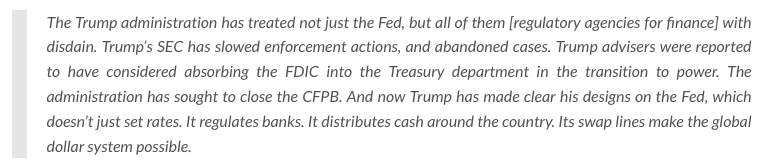
This isn't to say that each rule or regulation was perfectly drafted and has perfectly withstood the test of time. It is to say, though, that there was a reason for drafting virtually all of them. Some crisis or some major failure served as the impetus. As a result, the wholesale elimination of such regulations invites repeats of all the original crises. This appears to be what the Trump administration is doing:
Rules exist at least partly to ensure fair play. When people sense there isn't a level playing field, they withdraw. That's the big risk - consumers and investors pull back for fear of having adequate protection.
Right size the exposure
So, an objective analysis of the investment landscape alone reveals there are several good reasons for investors to be cautious in the new year. There are others.
One reason is the risk of loss. Of course, the perception of risk of loss has been significantly attenuated by the enormous quantity of fiscal and monetary stimulus the last few years, but that doesn't change the actual risk of severe losses. Misperception makes it easy to become undisciplined. Oftentimes, the time to worry most is when confidence is highest.
The potential consequences are the key here and investors often underestimate the damage losses can cause. Part of the reason for this is a technical concept called ergodicity. It means that return averages can be misleading because individuals don’t get the average outcome — they get the one path they actually experience. While that one path can seem like so much bad luck at the time, it can also be a life-changing experience.
The reality that investment losses can be devastating and extremely hard to recover from is captured by Warren Buffett’s two rules:
- Rule No. 1: Never lose money.
- Rule No. 2: Never forget Rule No. 1.
The primacy of loss avoidance highlights the importance of diversification, the avoidance of leverage, maintenance of a cash cushion, and emphasis of risk management over return chasing. These activities aren't always as much fun, but they do help insulate investors from the worst possible outcomes.
Unicorns and rainbows
Another reason to be cautious about markets in the new year is the possibility that bullish market narratives are being designed at least in part to recruit incremental retail buying so as to provide exit liquidity for others. Clearly the private equity industry has been working hard to increase retail investment to provide capital backfill after a few years of below average exits (sales) of portfolio companies.
The characterization of retail investors as gullible sources of capital can also explain the effusive praise of stocks by Wall Street: Someone is needed to keep buying stocks at record highs to keep the financial machine going. In more colloquial terms, someone needs to be left holding the bag.
Conclusion
There is an awful lot of enthusiasm for stocks in the new year. However, there is also a lot of political and economic disruption. Investors would do well to consider both perspectives as well as the downside risk if things turn south. The potential for tail risk, and the durable harm it can cause investment portfolios, is quite high.
A message from Advisor Perspectives and VettaFi: Discover something new! Click here to register for our upcoming webcasts.
© Arete Asset Management
Read more commentaries by Arete Asset Management