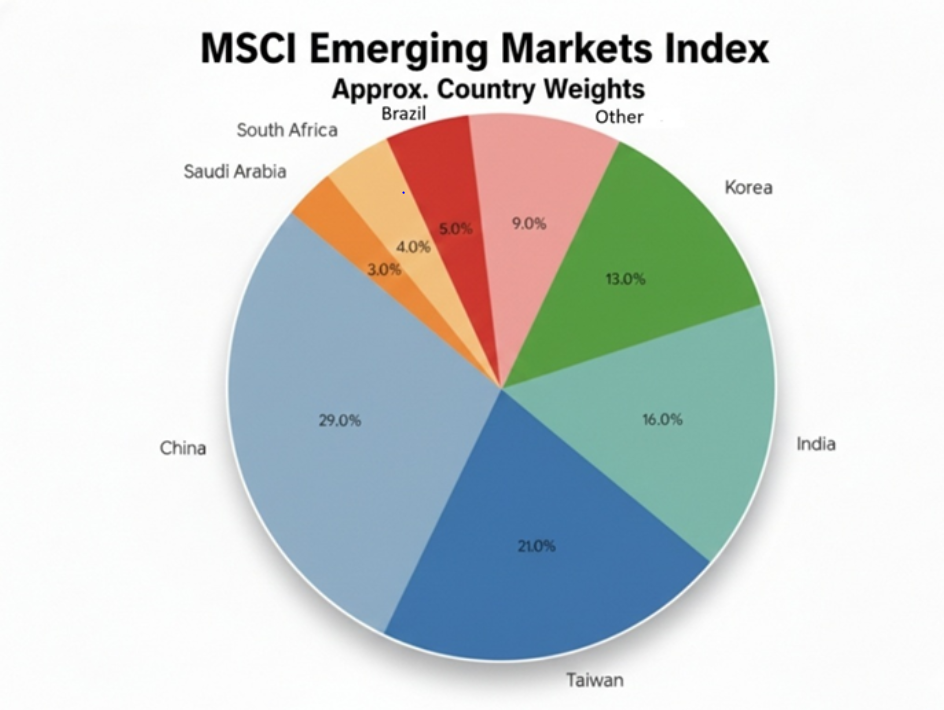
Even the tidal wave of tariffs wasn’t enough to hold back the rally in global equities last year. As it turns out, emerging markets were the single best-performing major regional indices in 2025. The MSCI Emerging Markets index rallied more than 30% in U.S. dollar terms, easily outpacing the S&P 500 and other developed market benchmarks. And many are expecting that broader outperformance to continue in 2026 – thanks to a combination of macro developments, valuations and AI exposure.
Here are four of the biggest reasons investors are finding EMs so appealing right now…
-
Growth Drivers in Asia. Some of the most heavily weighted components in the MSCI Emerging Markets Index happen to be some of the fastest growing economies and best-performing markets out there. China was a key driver of EM returns (with roughly a 30% weighting across most EM indices) – seen rising strongly amid tech-led AI optimism. Countries like South Korea and Taiwan have also fueled the success of the EM market. After a string of record highs, Taiwanese stocks rose 26% in local currency terms and 40% in U.S. dollar terms. South Korea’s gains were especially strong through the year – up 75% in local currency terms and almost 100% in U.S. dollar terms. Both are benefiting from the global AI boom. Beyond the leaders, emerging markets showed strong dispersion across countries. Indian equities also underperformed, spouting just a 9% return in a notable divergence from the broader EM ecosystem. But this follows several years of blockbuster gains for the world’s fourth-largest economy. India is also slated for a second wind this year, as earnings rebound and foreign investment flows stabilize.

-
Diversification. Broadening out beyond the U.S. borders affords investors some measure of dilution from U.S. markets, which remain “top-heavy” and riddled with record high mega-cap tech concentration risk.
-
Attractive valuations. Emerging markets remain inexpensive, trading at roughly 15 times forward earnings even after their banner year. Meanwhile, the S&P 500 continues to command a premium – trading at roughly 22 to 23 times forward earnings – hovering right around historic highs.
-
Dollar hedging. Declining interest rates and a weakening dollar are two of the most powerful tailwinds for emerging markets. The Street is betting the dollar may continue to plummet, which would improve global risk appetite and encourage carry trades.
ETF Bright Spots
Broad EM ETFs mirrored strong overall returns, with many reporting ~30%+ for 2025. Topping the EM ETF flow charts were the iShares Core MSCI Emerging Markets ETF (IEMG), which took in $18 billion in new money, and the Vanguard FTSE Emerging Markets ETF (VWO), which saw $8.5 billion in net inflows. The two funds take a similar approach to EM weightings but MSCI (and thus IEMG) still treats South Korea as an EM, while FTSE (and VWO) does not. Third on the leaderboard was the Avantis Emerging Markets Equity ETF (AVEM), which uses a systematic, rules-based approach to overweight cheaper securities with higher profitability ratios. The $16 billion actively managed fund brought in $6 billion in net inflows last year.
A “Smarter” Active Approach
Several other enhanced strategies have also gained traction. ALPS has carved out a niche by applying a “Dogs of the Dow” theory approach emerging markets with its ALPS Emerging Sector Dividend Dogs ETF (EDOG). The fund, which returned roughly 29% last year, offers high dividend exposure by selecting the highest-yielding stocks in each sector on an equal-weighted, rather than market cap-weighted basis.
There’s also been innovation in the smart beta active approach to emerging markets. The Goldman Sachs ActiveBeta Emerging Markets Equity ETF (GEM) recently crossed $1 billion in assets. The fundamental index-based fund goes beyond simple market-cap indexing to rely on a rules-based, multifactor tilt across more than 700 holdings. GEM could prove to be a useful core holding for investors who want broad EM exposure but with an enhanced, systematic factor overlay tied to value, momentum, high quality and lower volatility compared to traditional EM indices.
Ultimately, the case for emerging markets in 2026 rests on more than simple long-term mean reversion. Faster growth, cheaper valuations and meaningful exposure to global AI supply chains has put EMs back at the forefront of the global equity conversation. For investors willing to embrace selective risk and diversification, EM ETFs may be less of a tactical trade this cycle and more of a core allocation opportunity as global leadership continues to rotate.
For more news, information, and analysis visit the Thematic Investing Content Hub.
Originally published on ETF Trends
VettaFi LLC (“VettaFi”) is the index provider for EDOG, for which it receives an index licensing fee. However, EDOG is not issued, sponsored, endorsed, or sold by VettaFi, and VettaFi has no obligation or liability in connection with the issuance, administration, marketing, or trading of EDOG.
A message from Advisor Perspectives and VettaFi: Discover something new! Click here to register for our upcoming webcasts.
Read more commentaries by VettaFi