Financial stress often shows up in the bond market well before it becomes visible elsewhere. Equity markets can remain calm while pressure quietly builds underneath the surface.
Because of that, the bond market often serves as an early warning system for broader financial conditions. Below are several bond-market indicators we are watching closely, and why they matter for investors.
Treasury Market Indigestion
It is well known that our Federal fiscal deficit is exploding and this must be financed with ever more issuance of Treasury securities. The Treasury Department has mitigated this to some extent by shifting most of the issuance to Treasury Bills that mature in less than one year. However, the “tell” will be if the longer term notes and bonds’ yields begin to rise more rapidly than those of short term T-Bills (i.e. the yield curve rapidly steepens).
Business and personal tax cuts combined with deregulatory policies are being applied to an already growing economy. I expect this to increase the rate of inflation, with yields following suit. Higher inflation would reduce the real value of government debt obligations over time.
Credit Quality
The lowest rated bonds are the most sensitive to tougher financial conditions. This is vividly illustrated by comparing the yields of so called “junk bonds” (lowest rated credit quality) to Treasury yields. The yield spread between the two series has remained near historic lows since 2021. A sudden increase in the spread between the two yield series is a harbinger of serious financial market dislocations.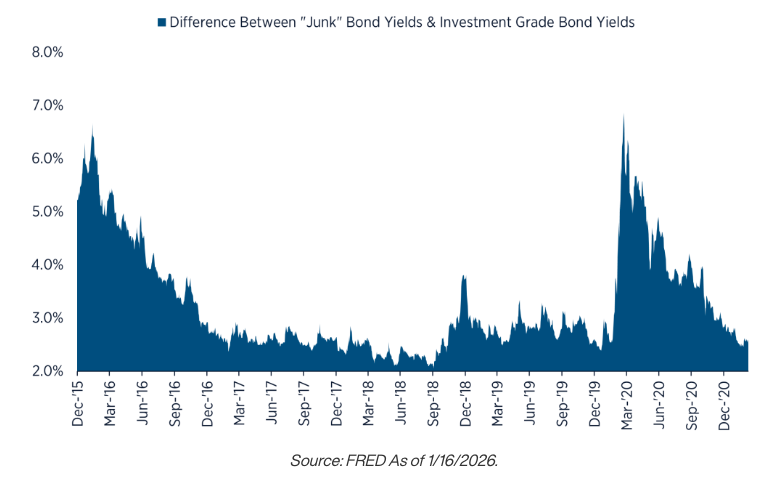
A closely related concept is the cost to insure an individual bond against default. These so called credit default swaps are most useful when applied to corporate bonds. A dramatic example of this is the bonds of Oracle corporation. ORCL had a very conservative financial posture since the tech crash of early 2000s. Recently Oracle decided to go into the artificial intelligence data center market in a big way. The result has been an explosion in the number of Oracle bonds outstanding and the cost to insure against their default has also risen dramatically.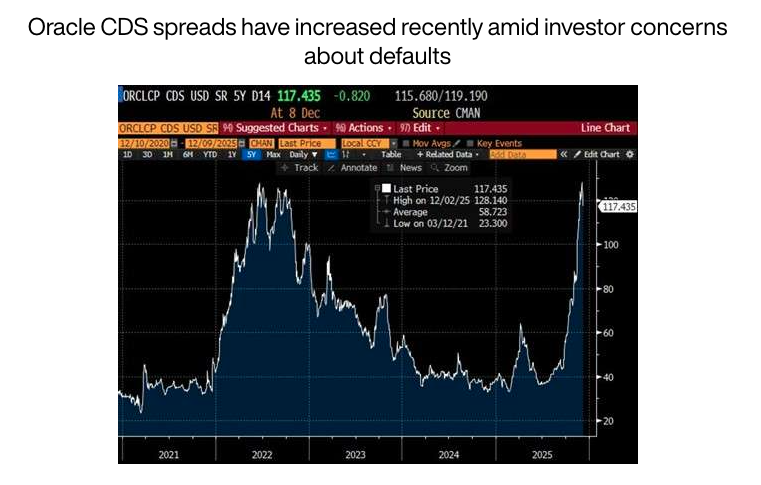
Liquidity
As used here, liquidity references the amount of readily available funds in the banking system. A sign of stress would be a rapid increase in the rate of interest for overnight funds borrowing between banks or banks and their customers. This indicator warrants closer examination and I will provide a more detailed analysis in a future update.
There are also several internal equity market indicators that I will be monitoring as well. I will cover these in a separate communication.
Please read important disclosures here.
A message from Advisor Perspectives and VettaFi: Discover something new! Click here to register for our upcoming webcasts.












