The importance of biodiversity as a nature-related risk in investors’ portfolios has become better understood in the past few years. Investors are beginning to appreciate how complex and nuanced biodiversity risk can be. For example, there’s a widespread assumption that deforestation is the biggest biodiversity risk in many portfolios. That’s understandable, given media attention around the topic, and because large-scale deforestation contributes to climate change, which can have a material impact on investments across the globe.
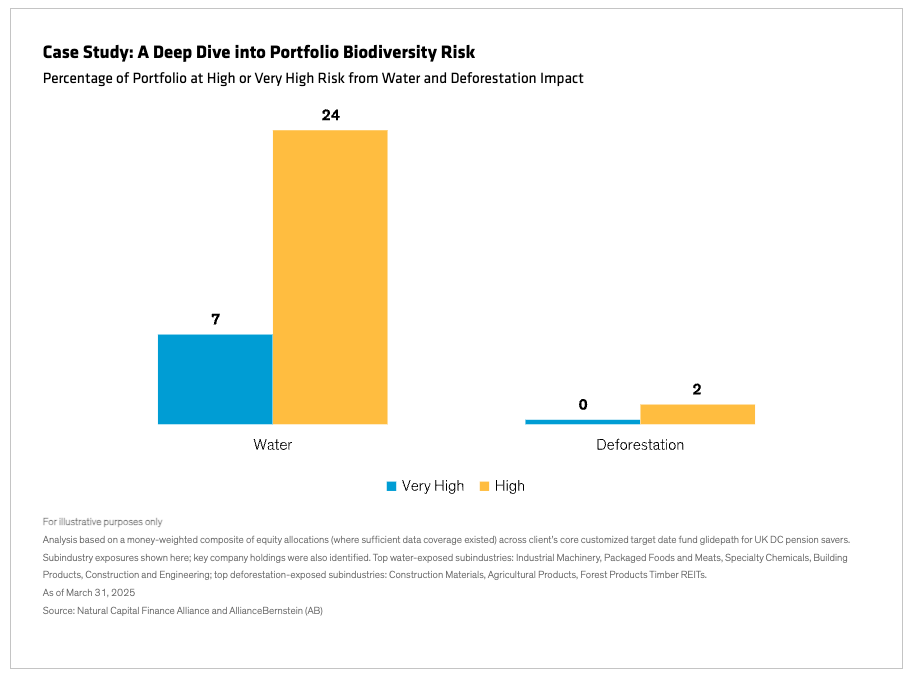
But such assumptions can fall short of reality. We recently analyzed the biodiversity risks in the equity allocations of a large UK pensions provider1 and found that water stress, not deforestation, was the biggest risk (Display).

This may seem surprising, given that the impacts of water stress tend to be localized and not so obviously global as those of deforestation and its links to climate.
But this particular client is not an outlier. Our analysis of the ENCORE2 industry biodiversity-risk database shows that the proportion of the MSCI ACWI Index for which water-related risk is high or very high is 35%—not very different from the client’s 31%. (The index also has a bigger exposure to high or very high deforestation risk—about 14%.) The insight underscores how important it is for investors and investment managers to analyze and identify their nature-related exposures correctly.
To that end, we have developed a proprietary risk-assessment framework that can identify nature-risk exposures across portfolios at the sub-industry level. In turn, this enables analysts to assess and engage with the potentially high-risk companies identified. We believe the framework may help reduce portfolio risk and unlock better returns.
Mapping Portfolio Biodiversity Risks
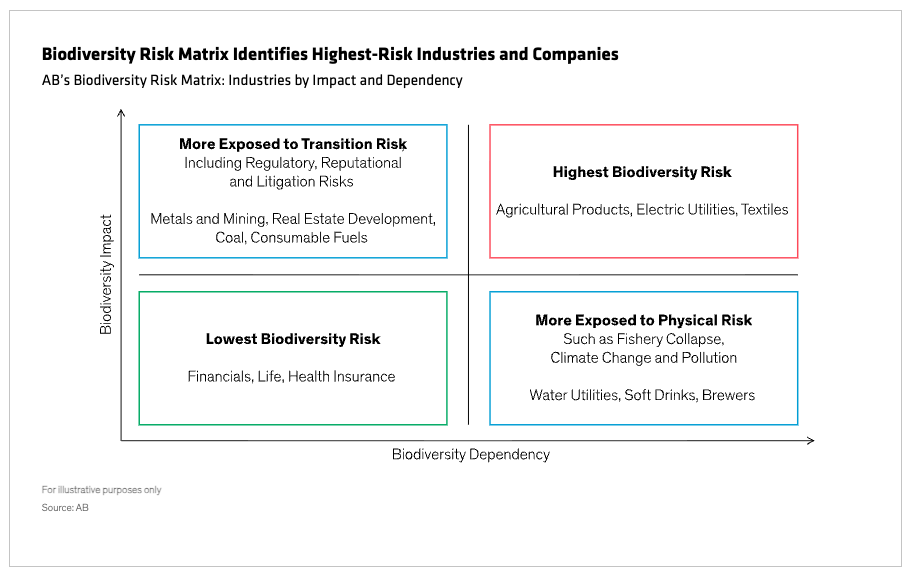
According to the Taskforce on Nature-related Financial Disclosures, nature-related risks are potential threats to an organization arising from dependency and impact on nature—the organization’s own, and those of society too. Dependency and impact are, respectively, physical and transition risks.
For example, fisheries that rely on water quality to sustain their fish stocks have a high dependency on nature, as they are exposed to the physical risk that water quality might deteriorate. Mining companies and property developers have a high impact on nature; as laws, regulations and trade practices change (transition) to reflect society’s growing awareness of biodiversity risk, they may become exposed to legal, reputational, market and other risks.
Using dependency, impact and related risks as a framework, we draw on the ENCORE database to map biodiversity risk exposure at the GICS3 subindustries level (Display).
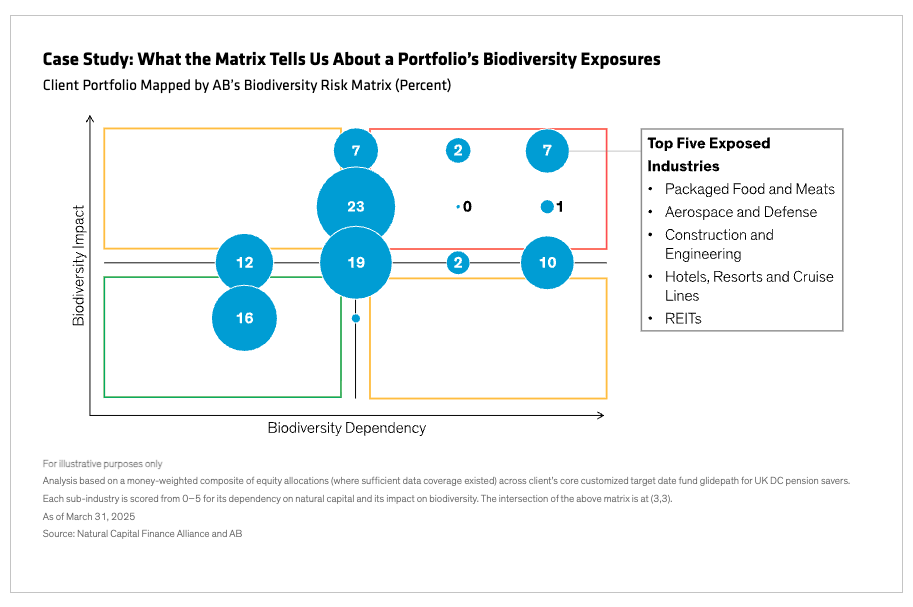
The industries that fall in the upper right quadrant have both high dependency and impact and, therefore, the most nature-related risk. Our analysis shows that 15.7% of MSCI ACWI falls into this quadrant. For the equity portfolio in our client case study, the proportion is significantly lower, at nearly 10% (Display).
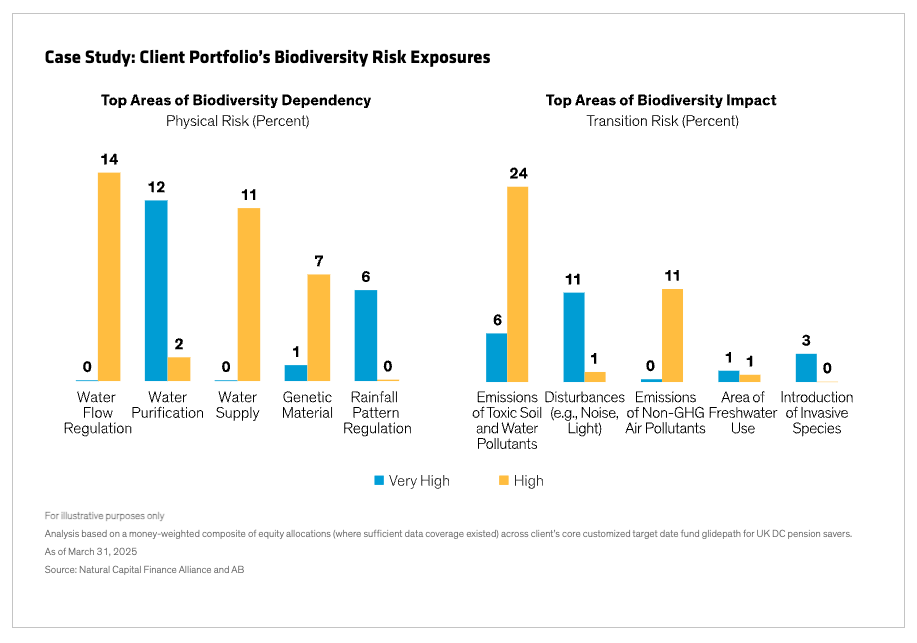
Understanding how dependency and impact risks are distributed across industries in a portfolio is a vital first step, but it’s also important to dive deeper to understand the risks at the issuer level. The ENCORE database lists risks individually and classifies them according to whether they are dependencies or impacts. Using this information, we can apply the framework to identify specific risks across a portfolio. This was how we discovered the extent to which the case-study portfolio’s biodiversity risks were dominated by water-related exposures (Display).
Most of these exposures fell in the dependencies category, but two of the top five impact exposures were also water-related—area of freshwater use, and emissions of toxic soil and water pollutants. This level of information is potentially helpful in deciding where to focus efforts to mitigate the portfolio’s biodiversity risks.
Having established which industries in a portfolio have the highest nature risk, we can identify individual holdings within those industries that we may wish to target for further research to understand which biodiversity risks are most material for them.
Company Engagements: Consistency and Comparability
For active portfolios managed by AB, this level of research may also lead us to engage4 directly with issuers to better understand their exposures and, if appropriate, work with them to help mitigate risks. We decide which issuers to engage with on a case-by-case basis, according to whether engagement is in clients’ best interests. When undertaking an engagement for clients whose strategy is implemented mostly with third-party funds, we partner with appointed managers to ensure that biodiversity is a priority for them. The engagement process may require multiple meetings over time to monitor issuers’ progress in achieving their risk-reduction goals.
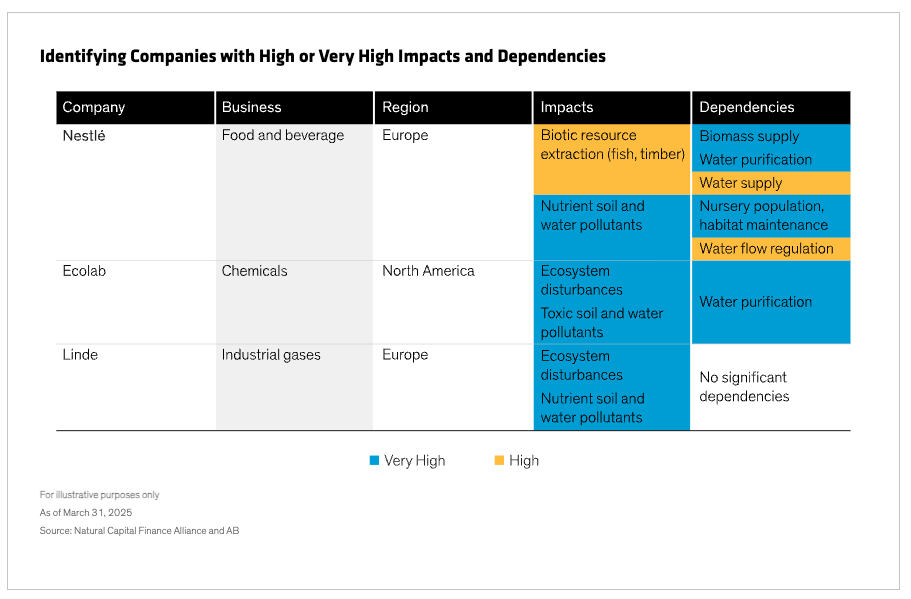
We have engaged on biodiversity risk with issuers in various client portfolios. These issuers include, for example, Linde, a UK-based supplier of industrial gases; US water-treatment company Ecolab; and Swiss processed foods group Nestlé (Display).
All fall in the top-right quadrant of the risk matrix. Linde ranks high for impact and moderate for dependency; Ecolab also ranks high for impact but higher than Linde for dependency. Nestlé ranks highest of the three on both counts. Below, we use Linde and Ecolab to illustrate how we engage on water-related risks and Nestlé on deforestation-related risks.
The process begins with defining the objective of the engagement. In the case of Linde, we wanted to know the water-risk implications of its hydrogen production—especially its move to producing green hydrogen. Traditional hydrogen production uses steam methane reforming, in which steam reacts with methane to produce hydrogen. Green hydrogen, which is powered by renewables, uses an electric current to split water into hydrogen and oxygen. Both processes are water intensive.
When engaging with Linde, we noted that it had reported considerable water savings, but its steam consumption had increased. The company explained that this had been possible because of a move to closed-loop production processes in which steam is fed back into the production cycle. It planned to use a similar technique to conserve water when producing green hydrogen. We asked Linde to consider introducing a company-wide water-usage target, and it said it planned to do so soon.
With Ecolab, we wanted an update on its effort to help customers conserve water and how it might be affected by plans to service water-hungry AI data centers. While the company had made considerable progress with conservation (226 billion gallons out of a 300 billion target), it noted that further gains were being complicated by increased water demand. But the expansion of data centers and utilities to power them was also creating opportunities for new efficiencies in energy and water supply, and the company was looking for commercial water-solution opportunities across the AI value chain.
Our engagement with Nestlé on deforestation illustrates some of the challenges of risk mitigation and the value of monitoring progress. In 2010, the company aimed to eliminate deforestation from five key supply chains—palm oil, soy, meat, paper and sugar—by 2022. It progressed well except for palm oil, which is sourced from high-risk countries: deforestation in the chain had fallen only 70% by 2020. We tracked progress, and in 2021 the company, aided by satellite and field monitoring, had eliminated deforestation across 90% of the chain. Its next goal was to be deforestation-free in all supply chains by the end of 2025.
Not Just Risks, but Opportunities, Too
Biodiversity exposures are material risks for many portfolios and need to be addressed appropriately, in our view. Our framework—supported by specialist, third-party industry data—can show how these exposures are distributed across portfolios and identify issuers with high nature-related risks. Combined with fundamental research and, where appropriate, issuer engagement and stewardship, it can lead to a deep understanding of issuer- and portfolio-level risks and the actions needed to mitigate them.
But it’s not just about risk: it’s about opportunity, too. For example, our engagement with Linde improved our understanding of how green hydrogen—an important step in the move to a low-carbon economy—could be produced in a way that conserves water usage. And Ecolab helped us understand how the growth in AI data centers might lead to enhanced water and energy efficiencies and related commercial opportunities.
As part of a broad-based active investment strategy, the framework, in our view, can not only identify and mitigate nature-related risks in portfolios, but it may help unlock better returns, too.
1 The analysis applied the framework to the client firm’s default investment offering for UK defined contribution (DC) pension savers to illustrate how the framework can surface biodiversity-related risks and highlight potential areas for deeper review. The results are provided for illustrative purposes only and are not intended as investment advice.
2 The Exploring Natural Capital Opportunities, Risks and Exposure (ENCORE) database is maintained by Global Canopy, the UN Environment Programme Finance Initiative and UN Environment Programme World Conservation Monitoring Centre.
3 Global Industry Classification Standard. Among the Standard’s various categories, the category “subindustries” provides the most granular classification of industries.
4 AB engages issuers where it believes the engagement is in the best interest of its clients.
The authors would like to thank Max Lulavy, Responsible Investing Research Analyst at AB, for his contributions to this article.
A message from Advisor Perspectives and VettaFi: Discover something new! Click here to register for our upcoming webcasts.
The views expressed herein do not constitute research, investment advice or trade recommendations, do not necessarily represent the views of all AB portfolio-management teams and are subject to change over time.
References to specific securities discussed are for illustrative purposes only and should not to be considered recommendations by AllianceBernstein L.P. It should not be assumed that investments in the securities mentioned have necessarily been or will necessarily be profitable.
The "target date" shown in a fund's name refers to the approximate year when a pension scheme member expects to retire and begin withdrawing from his or her account. Target date funds gradually adjust their asset allocation, lowering risk as a member nears retirement. Investments in target date funds are not guaranteed against loss of principal at any time, and account values can be more or less than the original amount invested—including at the time of the fund’s target date. Also, investing in target date funds does not guarantee sufficient income in retirement.
MSCI makes no express or implied warranties or representations, and shall have no liability whatsoever with respect to any MSCI data contained herein.
The MSCI data may not be further redistributed or used as a basis for other indices or any securities or financial products. This report is not approved, reviewed or produced by MSCI.
© AllianceBernstein
Read more commentaries by AllianceBernstein