Until recently, there was a broad sense that transatlantic trade relations had settled into a calmer state. Longstanding disputes lingered and irritants were never fully resolved, but the tone had clearly shifted. Conversation had become more procedural than confrontational, more incremental than expansive. On both sides, there was a quiet assumption that the most turbulent chapters of 2025 were behind them.
That assumption was disrupted this week. The U.S. administration’s renewed focus on Greenland revived a destabilizing strain of transatlantic rhetoric. President Trump has continued to underscore the strategic necessity of Greenland for the United States, and seemed willing to risk renewed trade confrontation with Europe to achieve his objective.
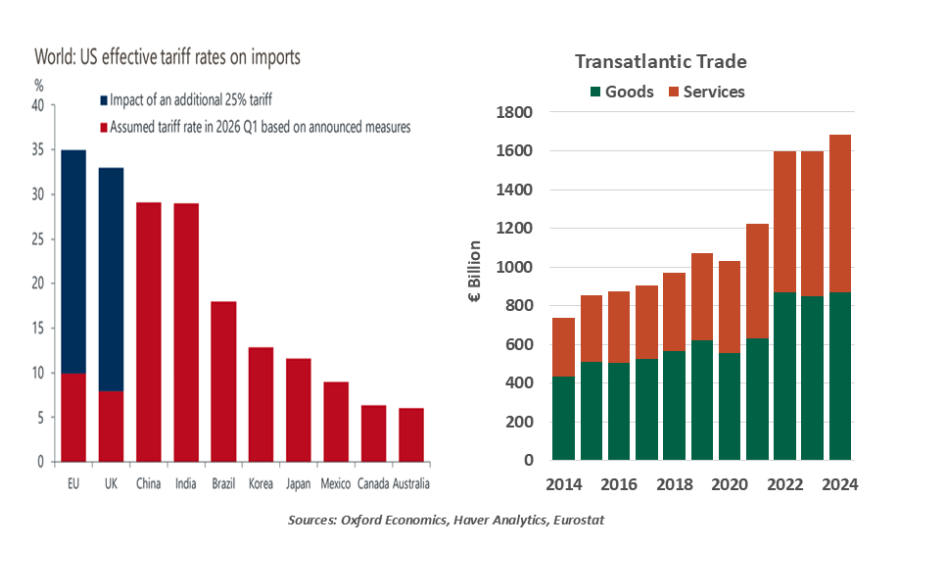
Over the weekend, Washington announced plans to impose a 10% tariff on goods from a series of European countries starting February 1, with the option of raising those duties to 25% by June. On Wednesday, those plans were rescinded in the wake of discussions with European leaders at the World Economic Forum in Davos. The 48 hours in between were filled with rancor that may have a more lasting impact.
Both sides should be glad that a trade war was averted, at least for now. Another round of tariffs would have harmed European economies and exacerbated the affordability challenges facing U.S. households. Global markets sold off on the tariff news, only to regain much of the lost ground a few days later.

As well, the European Union (EU) was seriously considering retaliating harshly against the U.S. The bloc had already moved to suspend the approval of the EU-U.S. trade agreement. Failure to successfully conclude a treaty would have pushed U.S. firms exporting to or operating in Europe into a new phase of uncertainty.
The EU might also have reactivated existing counter‑tariff packages. The bloc considered imposing retaliatory tariffs on €93 billion of American goods, across key sectors including aircraft, automobiles and agriculture.
While Europe would prefer to avoid escalation, this month’s episode is qualitatively different from last year’s, as it involves the sovereignty of a member state. If the EU and the United States, the two members of the world’s largest bilateral commercial relationship, edge toward renewed friction, global markets will be very unsettled.
Had the two sides failed to resolve their differences, the EU could have also invoked their Anti‑Coercion Instrument (ACI). If applied, the instrument could restrict access for U.S. goods, services, or firms to the EU single market. The services channel is particularly important: America runs a sizeable surplus in services trade with Europe, meaning any disruption could have material earnings implications for U.S. firms. Technology providers, already in the cross-hairs of European regulators, would have a lot to lose in this scenario.
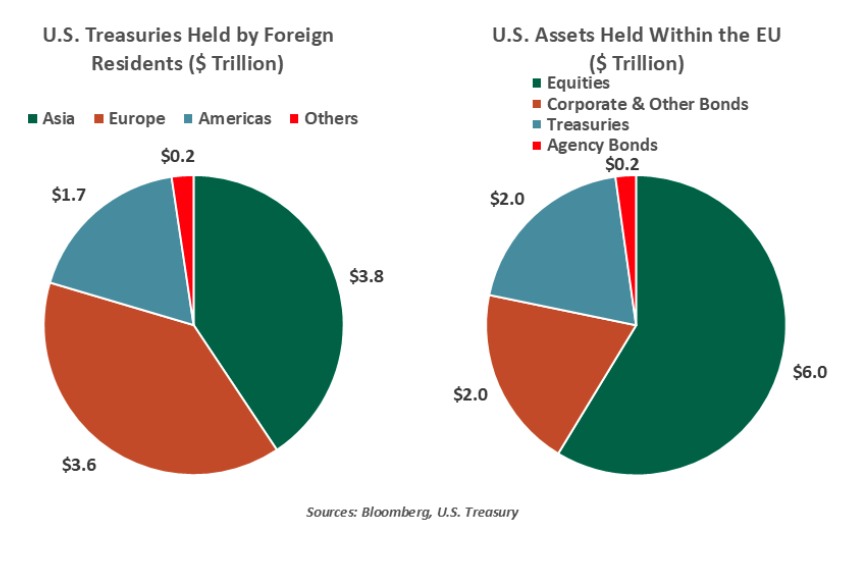
Constraints on access to European financial infrastructure could raise funding costs for American companies operating in the region, with second‑order effects for cross‑border capital flows. Beyond that, fanning the embers of anti-American sentiment could manifest as a reduced appetite for American assets. A significant reduction in European holdings would raise borrowing costs for American issuers, the U.S. government among them.
An overlooked aspect of the episode is that a Cold War-era agreement allows Washington to construct defense facilities in Greenland with NATO approval without challenging sovereignty. Europe has also committed to boosting investments, personnel and military assets. Therefore, the U.S. posture could reflect an aggressive bargaining strategy to gain greater influence over the island’s critical resources.
What appeared just months ago to be a stable and predictable transatlantic trade environment now looks conditional. The ground underneath transatlantic trade relations is once again shifting…even though critical portions of it are covered by permafrost.
Information is not intended to be and should not be construed as an offer, solicitation or recommendation with respect to any transaction and should not be treated as legal advice, investment advice or tax advice. Under no circumstances should you rely upon this information as a substitute for obtaining specific legal or tax advice from your own professional legal or tax advisors. Information is subject to change based on market or other conditions and is not intended to influence your investment decisions.
© 2025 Northern Trust Corporation. Head Office: 50 South La Salle Street, Chicago, Illinois 60603 U.S.A. Incorporated with limited liability in the U.S. Products and services provided by subsidiaries of Northern Trust Corporation may vary in different markets and are offered in accordance with local regulation. For legal and regulatory information about individual market offices, visit northerntrust.com/terms-and-conditions.
A message from Advisor Perspectives and VettaFi: Discover something new! Click here to register for our upcoming webcasts.
© Northern Trust
Read more commentaries by Northern Trust