Estate planning often sounds like something only wealthy families need to worry about. The federal estate tax exemption increased in 2026 under the One Big Beautiful Bill Act (OBBBA)—now shielding estates under $15 million for individuals and $30 million for married couples. Less than 1% of US households1 will face a federal estate tax, but that doesn’t mean planning is unnecessary for everyone else. Anyone who owns property, savings or personal belongings should consider and plan for someone to inherit them.
A helpful starting point is a simple question: If you weren’t here tomorrow, is there anything you’d want someone else to receive or enjoy? If the answer is yes, then simple estate planning can help ensure your wishes are honored. One of the easiest and most overlooked steps in basic planning is properly naming beneficiaries on retirement accounts, life insurance policies, and annuity contracts.
Good beneficiary planning can help heirs avoid delays, reduce administrative and tax costs, and prevent disputes or accidental inheritances. It also allows much of what you own to transfer quickly and privately.
Here are some important guidelines for individuals looking to establish an estate plan. Before they choose beneficiaries, they may want to review the following definitions and make an initial list before setting up a plan with a financial or legal professional.
Understanding probate vs. non‑probate assets
Before choosing beneficiaries, it’s important to know the difference between probate and non‑probate assets.
Probate assets
A will governs probate property. This typically includes:
- Real estate titled only in one name
- Vehicles
- Personal belongings such as jewelry, collectibles and heirlooms
- Financial assets individually owned that do not have a valid beneficiary designation
- Property titled as Joint Tenants in Common
- Probate is the court-supervised process that validates the will and oversees distribution of the assets. When there is no will—or the will is deemed invalid—state law takes over. This can lead to unintended outcomes. For example, in some states parents or siblings may inherit a portion of the estate, even if you prefer everything be left to your children.
A will is essential, but it does not cover everything you own.
Non‑probate assets
Beneficiaries can be named directly for these accounts and policies. Upon death, these assets transfer automatically—without going through probate.
Common non‑probate assets include:
- Retirement accounts (401(k), 403(b), IRA, pension, etc.)
- Life insurance
- Health Savings Accounts
- Annuities
- Certain bank or brokerage accounts (Payable on Death (POD)/Transfer on Death (TOD) forms)
- Employer stock or equity compensation
Naming beneficiaries for these accounts is one of the simplest ways to make sure a large portion of an estate reaches the right people quickly.
One major rule: Avoid naming your will as a beneficiary. Financial institutions generally cannot interpret wills and may treat the designation as invalid, forcing the asset through probate. A few words like “As stated in my will” have caused significant issues for families settling estates.
Choosing beneficiaries
Beneficiaries fall into two categories: individuals and entities.
Individuals: Includes spouse, children or other family members, friends or others.
It’s important to note when a minor is named as a beneficiary, the assets will be managed by a guardian until the child reaches the legal age determined by state law. Spouses have special treatment for inherited retirement accounts, allowing them to treat the account as their own—an option not available to non‑spouses.
Entities: Includes charities, trusts or an estate.
A trust may give the owner more control, such as directing how and when heirs receive money. However, trusts may also create different tax outcomes, particularly for retirement accounts. As a result, it’s important for individuals to consult with qualified professionals.
Pets and objects cannot be designated beneficiaries, but you can leave money for a caretaker or create a pet or other property trust which can provide instructions for the care of your property.
Primary and contingent beneficiaries
Most accounts allow for primary beneficiaries, which are the first in line to inherit, and contingent beneficiaries, who inherit only if one or all primaries have passed away.
This two‑level structure ensures assets are assigned even if life changes unexpectedly.
Understanding per capita and per stirpes
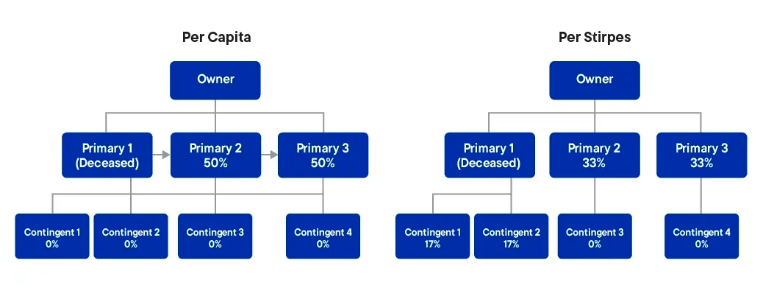
Many beneficiary forms allow for the determination of how a beneficiary’s share is redistributed if they pre-decease you. Two common contingencies are explained here:
-
Per capita (“by head”)
If one primary beneficiary has passed away, their share is divided among the remaining primary beneficiaries. Contingent beneficiaries only inherit if no primaries survive.
-
Per stirpes (“by branch” or “by root”)
A deceased beneficiary’s children inherit their parent’s portion. This keeps assets within each family line and is often preferred by those wanting their estate to pass generationally.
To illustrate these scenarios, consider this example of three primary beneficiaries with the following inheritance share—Primary 1 (34%), Primary 2 (33%), Primary 3 (33%). Primary 1 has two children and has pre-deceased the owner, and Primary 2 and 3 each have one child.

For something more nuanced, many institutions will accept custom instructions, but these must be written clearly and approved ahead of time. Certain types of accounts such as bank and brokerage accounts using POD/TOD designations typically have more limited beneficiary options.
Beneficiaries differ from account titling
It’s important not to confuse ownership with inheritance. Adding someone as a joint owner gives them immediate rights to an account or property and may create gift tax issues or eliminate tax advantages like a step‑up in cost basis at death on the joint tenant’s share of the asset. Beneficiary designations avoid these complications.
Reviewing and updating estate plans
When life events cause changes, beneficiaries may change, too. This underscores the importance of doing a beneficiary review with a financial or legal professional. Some common life events include:
- After marriage or divorce
- After a birth or death
- When financial situations change significantly
- Creating a trust
- Relocating to a new state (Wills may need updates per different state laws)
Reviewing beneficiaries every few years can help keep plans on track.
Key steps to prepare for a beneficiary review
- Make a list of assets and who you want to inherit them
- Update beneficiaries on non‑probate accounts
- Create or revise a will for probate assets
- Keep estate documents organized
- Consult tax, legal, or financial experts as needed
Register Here for the upcoming Financial Professional Webinar on February 3: The tax-aware advisor's 2026 playbook
A message from Advisor Perspectives and VettaFi: Discover something new! Click here to register for our upcoming webcasts.
Endnote
1 Institute on Taxation and Economic Policy, “The Estate Tax is Irrelevant to More Than 99% of Americans,” December 7, 2023.
WHAT ARE THE RISKS?
All investments involve risks, including possible loss of principal.
Any information, statement or opinion set forth herein is general in nature, is not directed to or based on the financial situation or needs of any particular investor, and does not constitute, and should not be construed as investment advice, forecast of future events, a guarantee of future results, or a recommendation with respect to any particular security or investment strategy or type of retirement account. Investors seeking financial advice regarding the appropriateness of investing in any securities or investment strategies should consult their financial professional.
Franklin Templeton, its affiliated companies, and its employees are not in the business of providing tax or legal advice to taxpayers. These materials and any tax-related statements are not intended or written to be used, and cannot be used or relied upon by any such taxpayer for the purpose of avoiding tax penalties or complying with any applicable tax laws or regulations. Tax-related statements, if any, may have been written in connection with the “promotion or marketing” of the transaction(s) or matter(s) addressed by these materials, to the extent allowed by applicable law. Any such taxpayer should seek advice based on the taxpayer’s particular circumstances from an independent tax advisor.
IMPORTANT LEGAL INFORMATION
This material is intended to be of general interest only and should not be construed as individual investment advice or a recommendation or solicitation to buy, sell or hold any security or to adopt any investment strategy. It does not constitute legal or tax advice. This material may not be reproduced, distributed or published without prior written permission from Franklin Templeton.
The views expressed are those of the investment manager and the comments, opinions and analyses are rendered as at publication date and may change without notice. The underlying assumptions and these views are subject to change based on market and other conditions and may differ from other portfolio managers or of the firm as a whole. The information provided in this material is not intended as a complete analysis of every material fact regarding any country, region or market. There is no assurance that any prediction, projection or forecast on the economy, stock market, bond market or the economic trends of the markets will be realized. The value of investments and the income from them can go down as well as up and you may not get back the full amount that you invested. Past performance is not necessarily indicative nor a guarantee of future performance. All investments involve risks, including possible loss of principal.
Any research and analysis contained in this material has been procured by Franklin Templeton for its own purposes and may be acted upon in that connection and, as such, is provided to you incidentally. Data from third party sources may have been used in the preparation of this material and Franklin Templeton ("FT") has not independently verified, validated or audited such data. Although information has been obtained from sources that Franklin Templeton believes to be reliable, no guarantee can be given as to its accuracy and such information may be incomplete or condensed and may be subject to change at any time without notice. The mention of any individual securities should neither constitute nor be construed as a recommendation to purchase, hold or sell any securities, and the information provided regarding such individual securities (if any) is not a sufficient basis upon which to make an investment decision. FT accepts no liability whatsoever for any loss arising from use of this information and reliance upon the comments, opinions and analyses in the material is at the sole discretion of the user.
Franklin Templeton has environmental, social and governance (ESG) capabilities; however, not all strategies or products for a strategy consider “ESG” as part of their investment process.
Products, services and information may not be available in all jurisdictions and are offered outside the U.S. by other FT affiliates and/or their distributors as local laws and regulation permits. Please consult your own financial professional or Franklin Templeton institutional contact for further information on availability of products and services in your jurisdiction.
Issued in the U.S. by Franklin Templeton, One Franklin Parkway, San Mateo, California 94403-1906, (800) DIAL BEN/342-5236, franklintempleton.com. Investments are not FDIC insured; may lose value; and are not bank guaranteed.
You need Adobe Acrobat Reader to view and print PDF documents. Download a free version from Adobe's website.
CFA® and Chartered Financial Analyst® are trademarks owned by CFA Institute.
© Franklin Templeton
Read more commentaries by Franklin Templeton