Private credit has grown from a small niche market to a major slice of the financial asset pie. Not many people outside of institutional finance talked about it twenty years ago. Now it’s estimated to be a $1.7-3.0 trillion market that competes with traditional corporate lending and is growing rapidly.
Supporters call it the future of lending, while others warn it could become the next subprime crisis. The reality is that when investors start chasing yield, and when that yield is the result of leverage and signs of shoddy due diligence, investors need to dig a bit deeper. But let’s start at a more basic level and explore what private credit is and its evolution.
What Is Private Credit?
Private credit refers to loans made by non-bank lenders, investment funds, business development companies (BDCs), insurance firms, and asset managers, to private companies. These loans are not publicly traded and are typically extended to middle-market businesses with $50 million to $1 billion in annual revenue.
They are usually floating-rate, tied to SOFR (Secured Overnight Financing Rate), which is around 4% as of mid-November, and offer spreads such as SOFR + 5%. Investors earn higher returns in exchange for illiquidity and limited transparency.
How the Market Started
The 2008 financial crisis and post-crisis reforms like Dodd-Frank and Basel III restricted bank lending. Private funds stepped in to fill the gap, offering faster execution and flexible structures.
Borrowers valued the discretion, and investors were drawn to higher yields with perceived stability. This combination fueled one of Wall Street’s most profitable growth areas.
Main Types of Private Credit
-
Direct lending: senior secured loans to private companies.
-
Asset-based finance: borrowing against receivables, real estate, or equipment.
-
Mezzanine and special situations: higher-yield loans below senior debt or to distressed borrowers.
-
Structured credit: loans packaged into private CLOs.
Why Your Yield is High: Leveraged Borrowers and Funds
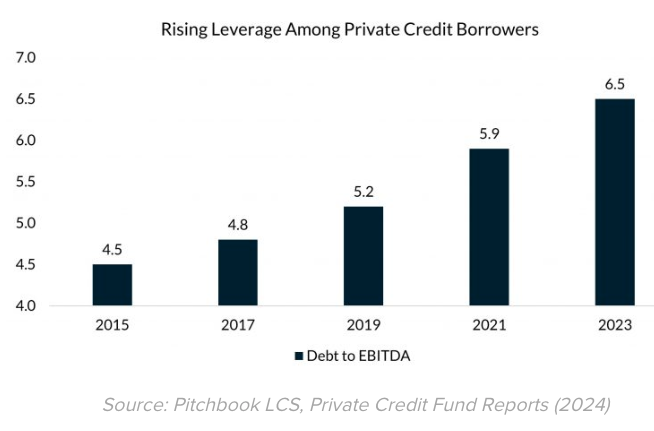
Private credit yields are generated through a mix of higher credit risk, illiquidity premiums, and leverage applied at multiple levels. The underlying loans are typically floating-rate instruments producing base coupons around 9-10%. Borrowers are usually middle-market companies with high leverage, roughly five to seven times EBITDA, and lower credit quality, typically BB to B or unrated. Because these loans are privately negotiated and illiquid, investors demand additional return for the lack of transparency and tradability. Origination fees, structuring premiums, and the occasional equity kicker further raise overall yield potential. As you can see below, the large inflows into the private credit space have actually allowed the end borrowers to increase their own leverage by about 50%.

Here’s how yield builds along the chain:
-
Borrower level: The company pays a base rate (SOFR approximately 4%) + credit spread (approximately 5 to 6%) = approximately 9 to 10% coupon to lenders.
-
Fund level: The private credit fund may borrow 20 to 30% of NAV through bank credit lines or NAV facilities at roughly 5%, investing that borrowed capital into loans yielding 10% to juice returns. Bank lending to Private Credit and Equity grew from $10bn in 2013 to $300bn in 2023.
-
Leverage effect: A $100 million fund borrowing $25 million at 5% to invest $125 million at 10% would earn approximately 10.4% net to investors after 1.5% fees.
-
Investor level: The resulting portfolio distribution yield to investors ends up in the 9 to 13% range, depending on fees and loan performance.
This layered structure, levered borrowers, funds employing additional financing, the inability to offer a fair market value for an illiquid loan, and investors earning an illiquidity premium, explains how private credit strategies transform loans into double-digit returns, albeit with higher risk, lower transparency, and limited liquidity.
Market Expansion: My, How We Have Grown
What once was a puny market has transformed in size. Private credit now rivals the U.S. high-yield bond and leveraged loan markets.
- $46 billion in 2000 → $800 billion in 2019 → $1.7-3 trillion in 2025.
- Growing 15 to 20% annually; two-thirds in the U.S.
Major Players
Below are the major players by size, though many newer less known players have entered the space. The top firms control over half the global market.
Fees and Liquidity
In terms of what the funds actually charge the end investor, it can vary. Typical institutional fees are essentially what you pay at a hedge fund: 1.5 to 2% management, plus 15 to 20% performance over a hurdle.
Interval funds for retail clients charge higher up-front fees (up to 2.75%) and allow limited quarterly withdrawals, which can be gated in stress periods, and may or may not charge a performance fee.
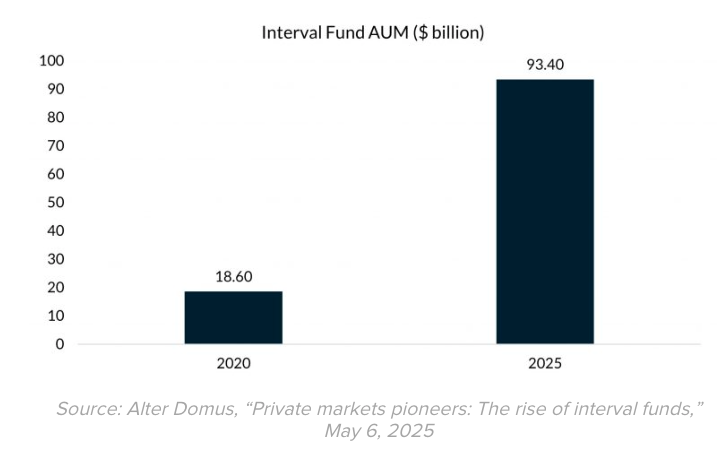
Assets in U.S. interval funds have risen over 4x from $19 billion in 2020 to over $90 billion in 2025.
Valuation Concerns
Opaque and illiquid markets have the issue that the fair-market value of a loan is simply unknown. This means that private loans are valued using internal models rather than market prices. It also creates a set of poor incentives for managers. Internal models can be decent proxies for current price, or a total fiction. They depend entirely upon the intellectual honesty and skills of the manager, who is incentivized to keep investors happy and from cashing out. Not surprisingly, during stress, BDCs showed smaller markdowns than public loans despite weaker assets. Inconsistent valuations across funds highlight these transparency risks and likely variable honesty across managers.
Rising Warnings and Risks
Investors tend to forget the last time things went bad. If this weren’t the case, we would never get stock market bubbles and crashes. The same holds in fixed income, but in a way it’s a lot simpler and more obvious. Fact: if you are getting a higher yield on your fixed income investment than the equivalent Treasury maturity, you are taking on more risk and there is a higher probability of default and that you will lose money on your investment. There is a reason the yield is higher. As a reminder of this in the mid-2000s people bought mortgage bonds for 6 to 8% when treasuries were at 4%. Then came 2008. From 1994 to 98, people bought EM debt at 8 to 12% when treasuries were 5 to 6% and lost 30 to 50% of their investment.
Maybe this time it is different, but the reality is that no one knows what will happen to the Private Credit market under stress, since there hasn’t been any. There are also plenty of critics in the media. The famous short seller Jim Chanos recently noted on Bloomberg that he is concerned about how private credit is being sold to investors: “it’s one of these too good to be true type promises. We’re going to give you senior debt exposure often secured somehow, but with equity rates return double digit type returns, which makes you wonder about the underlying credits themselves.” The recent First Brands Chapter 11 event also makes clear that some borrowers are not being properly scrutinized, as the company pledged the same collateral to multiple lenders. How pervasive across the industry is this total lack of due diligence from lenders who need to deploy their capital inflows?
When Stress Hits: The Dangers of Slowing Growth
There are two potential threats to Private Credit: one internal and the other external.
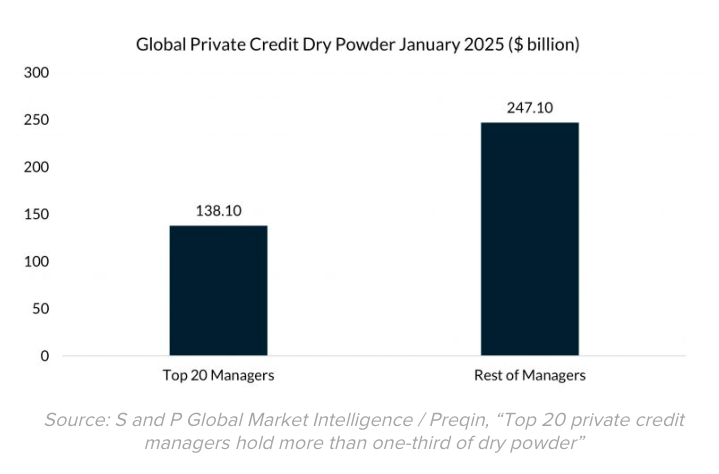
The structure that made the business work in the first place, connecting investors with underexposed borrowers, may be moving too fast, leading to poor investment decisions. More money may be entering the space than actually can be deployed. In the best-case scenario, large piles of undeployed cash may be piling up at lower yields.
In the worst-case scenario, loans may be being made with little to no due diligence. Fomo on the way up can be worse on the way down as well. If investors all decide to redeem at once, there will be no way to liquidate the underlying loans to pay them off, since almost no secondary market exists.
The second bigger external threat, which the industry has no ability to control, is an economic slowdown. Slower growth, either within a specific industry or the broad economy, which there are signs of in the labor market, means less revenue to service debt. As revenue decreases, defaults and losses in the space will rise. How individual interval funds handle this will vary widely.
In either case, at some point the private credit market will experience a cyclical downturn.
Opportunity or Risk?
Private credit provides essential capital and very attractive yields. But it carries real risks, leverage, opacity, and illiquidity. Higher yielding securities originating from highly levered borrowers have less margin for error and are thus more vulnerable to economic stresses.
Investors should remember:
- High yields mean higher risk of loss
- Withdrawals can be frozen.
- Marks may overstate value.
- Leverage is layered.
- Transparency is limited.
- Private credit is a new asset class that has never experienced stress
Originally published on ETF Trends
A message from Advisor Perspectives and VettaFi: Discover something new! Click here to register for our upcoming webcasts.
Disclosure Information
Make the most of these insights using Modelist. We create customized investment models for the fiduciary financial advisor. Get in touch with us at [email protected] for a personal consultation.
Modelist Inc. is a registered investment advisor. Registration with a regulatory authority does not imply a certain level of skill or training.
The information contained in this material is for educational and informational purposes only. It does not constitute an offer to sell, a solicitation to buy, or a recommendation of any security, investment, or investment strategy. All investments involve risks, including interest rate risks, inflation risks, and the risk of loss of principal, and are not guaranteed. Past performance is not indicative of future results.
Modelist Inc. believes, to the best of its knowledge, that this material does not contain any false or materially misleading statements or omit material facts.
This material includes information obtained from third-party sources. Modelist Inc. does not guarantee the accuracy, reliability, or completeness of such information and disclaims any liability for errors or omissions arising from its use. Returns cited are based on publicly available Treasury market data and may not reflect actual investment outcomes, fees, or expenses.
Each investor’s situation is unique; please consult with a professional financial advisor, tax accountant, or legal representative, as applicable, to develop an individualized plan or address any questions you may have.
© Modelist
Read more commentaries by Modelist