Federal Reserve Chairman Jerome Powell stuck to the script by announcing on Wednesday that the Fed would keep interest rates unchanged. Powell has historically telegraphed interest rate moves, and this time was no exception: the financial markets expected the Fed to stand pat. After three consecutive rate cuts, Powell sees the economy on solid ground and inflation only slightly elevated. In his remarks following the rate announcement, he argued rates sit within “a plausible range of neutral”. Going forward, the Fed will maintain its “wait-and-see approach”, monitoring economic indicators for signs that the job market is weakening or inflation is rising. With no surprises in the Fed’s announcement, the S&P 500 ended Wednesday little changed.
The Federal Reserve dominated headlines on Friday as well, with the President announcing Kevin Warsh as Powell’s successor. BlackRock’s Rick Rieder and National Economic Council Director Kevin Hassett had been seen at different times as the favorites for the position. Warsh served as a Fed Governor during the 2008 financial crisis, and also spent time in the private sector with Morgan Stanley. Viewed as experienced and pragmatic, his nomination eased fears about the Fed’s independence and was welcome news for the stock and bond markets. Gold and silver, however, plunged following the announcement. Both metals had rallied to start the year, but profit taking and possible margin-call selling pushed silver down a staggering 30 per cent and gold down 10 per cent.
Meanwhile, earnings season rolled on. More than 100 S&P 500 companies, including four of the so-called “Magnificent 7” delivered fourth-quarter results. Apple took center stage reporting a 23 per cent jump in iPhone revenue and a 38 per cent increase in China revenue. But record-breaking revenue and a best-ever quarter for the iPhone weren’t enough to lift the stock, as comments from CEO Tim Cook about the company’s possible margin pressure from high memory chip prices curbed enthusiasm. Tesla also posted good results, besting Wall Street’s estimates for earnings and revenue. But here, too, investors were left looking for more, as overall revenue and earnings dipped year-over-year. On plus side, Meta stock jumped 10 per cent thanks to strong Q4 earnings and a better-than-expected revenue forecast. On the weaker end, Microsoft shares dropped 10 per cent, as spending ballooned and Azure cloud growth moderated. Microsoft’s weakness bled into other software names, as Salesforce, ServiceNow, and others traded lower.
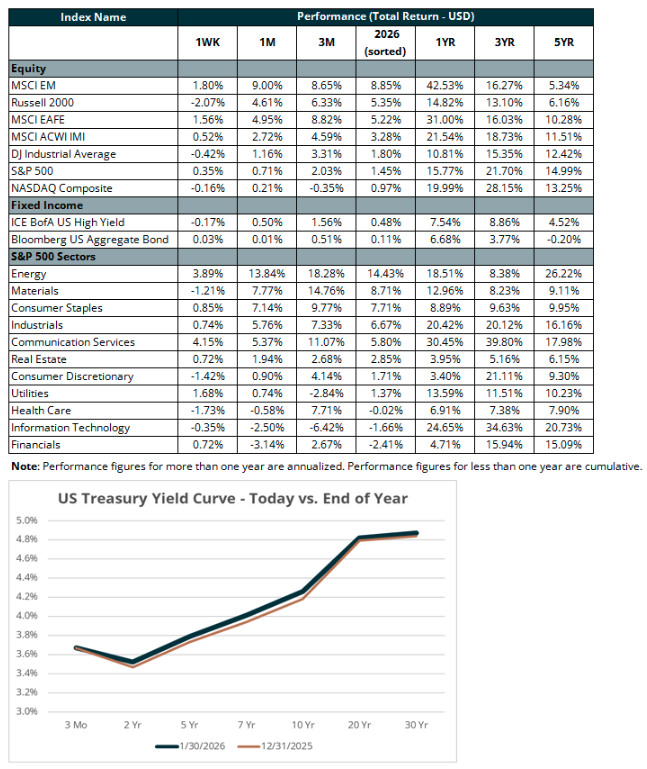
All told, the stock market posted mixed results for the week, with the S&P 500 delivering a small gain and the Dow and the NASDAQ returning small losses. For the year to date through January 31, however, all three benchmarks pushed higher, and a positive January typically signals a strong year ahead for the stock market.