If you’re still attempting to make investment decisions without fully integrating geopolitics into your analysis, you’re operating at a significant disadvantage in today’s markets.
I recently sat down with Marko Papic, chief strategist at BCA Research and godfather of the term “GeoMacro,” and the timing couldn’t be more pertinent.
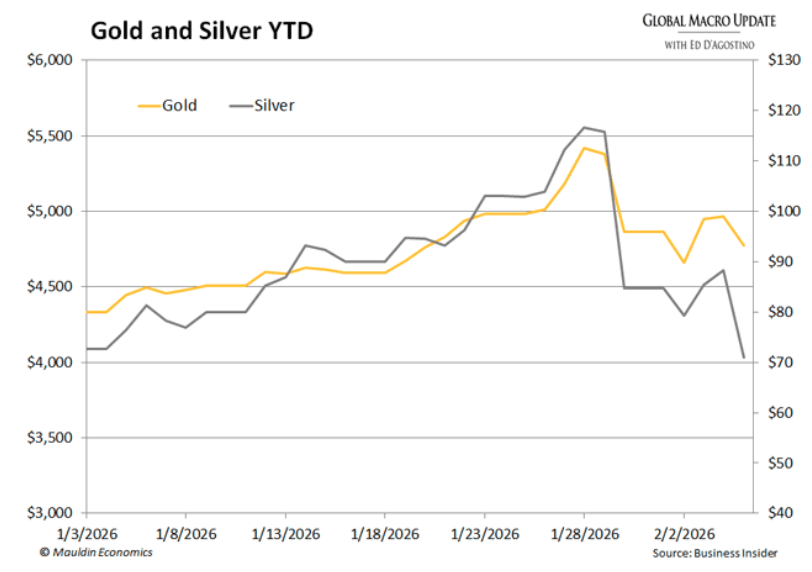
Consider what we witnessed over a three-week period: precious metals surging higher, commodities rallying, the dollar weakening against other currencies. President Trump commented that the dollar’s fine; that had to be walked back by Treasury Secretary Scott Bessent, who affirmed the US’s strong dollar policy; and two days later, Kevin Warsh was nominated for Fed chairman, triggering a big sell-off in precious metals.
If you had skin in the game on January 30, you know things got ugly for metals.

This is not your grandma’s market volatility. This is what happens when politics and geopolitics become drivers of the entire market narrative instead of background influences.
Narratives are tricky, though, and it can be difficult to distance ourselves from them. Sometimes they’re useful, but other times they get in the way of real-time analysis. As Marko puts it, “Narratives are cognitive shortcuts. They’re crutches we use to make sense of life.”
Long story short: The situation has changed—we’ve entered the era of GeoMacro—and you don’t want to get caught flatfooted, clinging to the past.
The Acceleration of Market Dynamics
While it’s tempting to attribute the increased velocity of market movements to technological advancement—social media platforms, instant information access, etc.—Marko identified three converging trends that are reshaping market behavior.
First, retail trading platforms like Robinhood have democratized options trading, enabling a much broader population to actively trade in real time. Second, the pandemic transformed information consumption patterns, creating a generation of constant news consumers and amateur geopolitical analysts. Third, the velocity of information dissemination itself has accelerated dramatically.
The consequence is a market environment where assets can become significantly overextended—as evidenced by recent movements in gold and silver—because participants are attempting to trade long-term structural themes on short-term time frames. This amplifies market volatility and creates challenging signal-to-noise dynamics.
Rethinking the Dollar “Debasement” Narrative
The question of dollar debasement and potential loss of reserve currency status remains a central concern for many investors. Marko’s perspective on this issue offers an important nuance that’s often missing from the debate.
In this week’s Global Macro Update, he expresses his reservations about the term “debasement” itself, noting that it tends to push investors toward an overly binary view that overweights hard assets. Instead, he draws a compelling parallel to the 2002–2007 period, when the dollar declined 35%—yet the United States maintained its reserve currency status throughout.
His analytical framework for anticipating a similar decline is grounded in several fundamental factors: monetary policy that’s likely to remain more accommodative than optimal, extraordinary fiscal expansion that has pulled forward years of growth (the US expanded its primary deficit by 40% of GDP since 2017, compared to just 12% for Japan, the closest major economy), and increasing resistance from both the bond market and Congress to continued deficit expansion. Recent attempts to pass fiscal measures, such as a $2,000 tariff rebate, have encountered significant political headwinds.
This analysis suggests not debasement but rather a necessary correction of an overvalued currency.
The Contrarian Case for European Assets
Perhaps the most counterintuitive element of our discussion was Marko’s view on European assets—a position that runs counter to the prevailing sentiment among many investors, myself included.
His investment thesis rests on seven distinct pillars but several merit particular attention.
First, the demographic challenge that typically dominates discussions of European growth potential requires more nuanced analysis. While birth rates remain low across the continent, Spain has emerged as a gateway for significant Latin American immigration, with workers who benefit from the EU’s free movement of labor provisions. Similarly, Poland has attracted substantial Ukrainian migration. These aren’t low-skilled workers; they’re often educated, productive individuals with cultural and linguistic ties that facilitate integration
Second, the defense spending imperative creates a substantial growth catalyst. European nations are not simply increasing defense expenditures—they’re prioritizing domestic procurement. This represents both new demand and a rotation away from long-standing US military contracts toward European defense manufacturers serving an increasingly multipolar global security environment.
When combined with fiscal stimulus measures, ongoing structural reforms, more attractive valuations relative to US assets, and potential currency appreciation, the investment case for European exposure becomes considerably more compelling than conventional wisdom suggests
The Path Forward
While I encourage you to listen to our conversation for the full picture, the central takeaway is clear: Traditional approaches to macro analysis are no longer sufficient. Investors cannot develop investment theses in isolation and subsequently layer geopolitical considerations on top as an afterthought.
Politics and geopolitics must be integrated into analytical frameworks from the outset. Whether evaluating the dollar, precious metals, European equities, or simply attempting to understand daily market dynamics, comprehending the underlying political and geopolitical forces is essential.
Does this approach add complexity? Certainly. Is the market environment more volatile and rapid than in previous eras? Yes. But as Marko notes, this is the reality of contemporary markets, and resistance to this reality is counterproductive.
Until next week, thanks for reading.
Ed D’Agostino, Partner & COO
A message from Advisor Perspectives and VettaFi: Discover something new! Click here to register for our upcoming webcasts.
© Mauldin Economics
Read more commentaries by Mauldin Economics