Federal Regime Change
Membership required
Membership is now required to use this feature. To learn more:
View Membership BenefitsLike people, institutions of all kinds get old. Some age less than gracefully. They become set in their ways, fixating on the past and ignoring new conditions. But because they’re “institutions,” change happens slowly.
The Federal Reserve System is a great example. It has a critically important role in the economy but is designed to act slowly. The modern economy isn’t slow at all. Things change before Fed officials even notice them, much less understand them.
That’s why Kevin Warsh’s nomination as Federal Reserve chair is so important: New leadership is an opportunity to break the status quo. These chances don’t come often, so we should all hope it leads to better policy choices. The economy depends on it.
News coverage generally framed the story as “Inflation hawk takes over.” That’s true, but doesn’t mean he’s a pure hawk. In his past Fed experience he voted to loosen monetary policy. I think Warsh has bigger ambitions than just controlling inflation. Today we’ll think about what he may be planning.
And in a few years, we’ll know if he succeeded. Everyone should be pulling for him.
The Key Question
As noted, getting a new Fed chair is a rare event. It’s happened only six times in the last 48 years.
- 1978: William Miller
- 1979: Paul Volcker
- 1987: Alan Greenspan
- 2006: Ben Bernanke
- 2014: Janet Yellen
- 2018: Jerome Powell
Some chairs don’t last long. William Miller stayed only 18 months. But Alan Greenspan lasted 18 years. Four different presidents appointed or re-appointed him.
How much time will Kevin Warsh get? We’ll see. But he has a lot of work to do. On paper, Fed chairs have little direct power. They preside over meetings and act as the Board’s main public face. They testify before Congress. Beyond that, their authority depends on gaining agreement from fellow governors and FOMC members.
The group whose cooperation Warsh will need is unlikely to change soon. The Board of Governors recently approved five-year renewals for all the regional Fed Bank presidents. And unless Powell leaves the Board when his term in the chair expires – or someone else resigns early – there won’t be another governor vacancy until 2028.
(Note, however, the Supreme Court is still considering the president’s power to dismiss Fed governors, as he tried to do with Lisa Cook last year. Depending how they rule, Trump could gain the ability to create more vacancies.)
This means a key question will be how persuasive Warsh is – and not just in speeches, but on a personal level with his colleagues. And also with senators and House members whose consent he may need to make broader reforms at the Fed.
Having seen Warsh speak at private events, he seems like a persuasive person. Time will tell. David Bahnsen is optimistic, writing this in his Dividend Café letter last Monday:
“On Friday, President Trump announced former Fed governor and former Morgan Stanley economist Kevin Warsh would be the new Federal Reserve chairman. Dividend Cafe readers know that I not only long hoped it would be Kevin Warsh, but have also been adamant in saying that it would be…
“Why do I like Kevin Warsh for this role? Well, first of all, for those who can find things Kevin has said in the last year that I would disagree with, I did not make a list of people who were not candidates and were never going to be and compare Kevin to them – I believe Kevin was the best of the actual candidates. As soon as I get a magic wand, I will expand my list. But as for intellectual gravitas and monetary policy POV, I believe Kevin’s early warnings about QE were among the most prescient I have read regarding the dangers of experimental monetary policy. I also believe he will be far more serious about genuine institutional reform than any other candidate.
“Essentially, people may like or not like what he does or doesn’t do with interest rate policy in the year and years ahead, but I see his perspective on the Fed’s balance sheet and on limiting the Fed’s role in accommodating governmental excesses as being very important for economic stability.”
David’s point on the balance sheet is critically important – maybe more so than whatever the Fed does to interest rates. It deserves the deeper dive.
Balance Sheet Bloat
In 2008, Kevin Warsh was a Fed governor during the Great Financial Crisis. He initially approved of quantitative easing as an emergency policy. He left the board when QE went from emergency policy to normal policy. He’s since been highly critical of the Fed’s bloated balance sheet, arguing it is an economic distortion that should be reduced faster.
Warsh said this in a November 2025 Wall Street Journal column:
“The Fed’s bloated balance sheet, designed to support the biggest firms in a bygone crisis era, can be reduced significantly. That largesse can be redeployed in the form of lower interest rates to support households and small and medium-size businesses.”
No such thing is currently happening. As of December, a smaller version of QE is now underway again, and again the Fed calls it a temporary policy to restore bank reserves to some undefined “ample” level.
If that’s true, it may end before Powell leaves the chair in May. But given how these things went in the past, it’s possible Warsh will take office with QE still underway. Then what?
Gavekal’s Will Denyer thinks other officials will agree with Warsh on this point.
“Arguably, current Fed policymakers have already cooled on the use of QE. They are all shaped by their experience of the last crisis. Their likely takeaway from the Covid-19 shock is that aggressive fiscal and monetary action can produce a V-shaped recovery, which is positive, but allowing that stimulus to persist long after the recovery begins can cause inflation to overshoot. As a result, the average Fed policymaker probably already shares some version of Warsh’s view that QE and other forms of stimulus are appropriate during emergencies, not afterward.”
The problem here is that QE is proving almost impossible to unwind. The colored areas in this chart show the balance sheet level. Even the QT round that began in 2022 has so far barely made a dent in the total. At that pace, we are looking at a decade or more just to get back to the pre-GFC asset level.
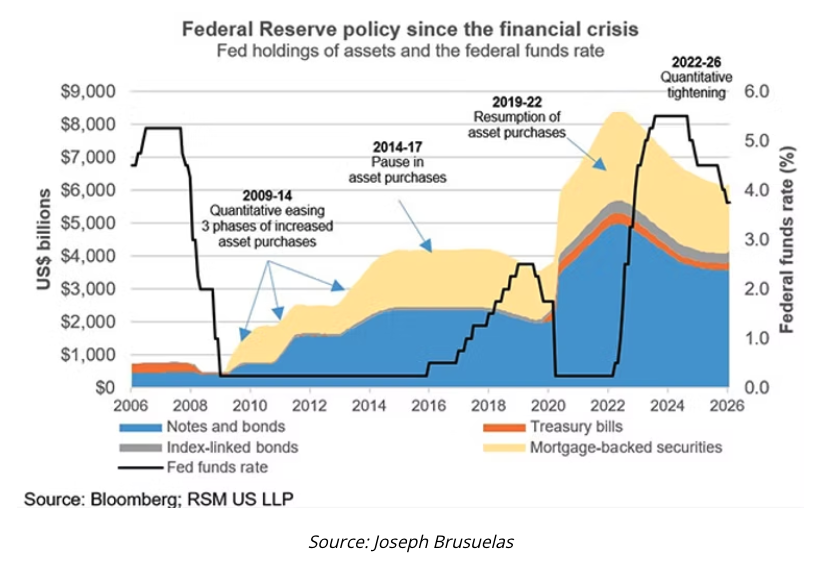
But going any faster – which would probably mean outright selling assets rather than letting them roll off at maturity – would reduce the price of those assets. They are mainly long-term Treasury bonds and mortgage-backed bonds. In bond math, lower prices mean higher interest rates. Hence, such action by the Fed would effectively a) raise Treasury rates when interest is already the federal government’s largest expense and also b) raise mortgage rates when the housing market is already struggling. Hardly ideal.
Let’s note, too, that both Warsh himself and most current FOMC members all agree QE is appropriate in “emergencies.” If you don’t see any emergencies coming, keep in mind no one saw COVID-19 coming, either. Warsh could easily find himself in a situation where the balance sheet is getting even bigger.
That said, I’m sure Warsh has thought of these things. Presumably he has solutions in mind. Then the questions become whether his solutions will work, and whether he can convince other policymakers to try them.
Refusal to Monetize
While interest rates and balance sheet plans are important, some think they’re relatively minor. Warsh has bigger plans, says my friend Brad Rotter.
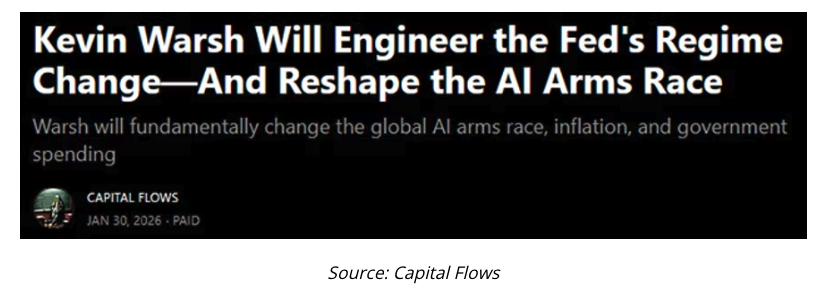
Brad’s article pulls several seemingly unconnected issues together. He starts by describing Warsh’s longtime relationships with Stan Druckenmiller, Scott Bessent and Palantir CEO Alex Karp. Palantir – which gets almost half its revenue from government contracts – is heavily involved in using its systems to find fraud and wasteful spending. This is proving both helpful to deficit control and profitable for Palantir. Here’s Rotter:
“I think it is very interesting that Humana, which has the largest government contract in excess of $100b, has been collapsing ever since Palantir has been rallying.
“Whether or not these two stocks are directly connected, the relative performance is worth paying attention to. Humana has built its business around the complexity of government healthcare reimbursement, complexity that has historically been difficult to audit at scale. Palantir is increasingly being deployed to bring transparency to exactly these kinds of programs.
“The divergence may be signaling a broader market repricing: companies that benefited from opacity vs. companies that provide visibility. If AI-powered oversight becomes the norm across federal spending, this dynamic could play out across many sectors, not just healthcare.”
How is this connected to Kevin Warsh? Read on:
“Warsh has been calling for ‘regime change’ at the Fed for over a decade. But what does that actually mean?
“It starts with a fundamentally different theory of inflation.
“The dominant models at the Fed, the ones built in the 1970s and still in use today, assume inflation happens when the economy runs too hot and workers get paid too much. Warsh rejects this entirely. In his view, inflation happens when the government prints too much, spends too much, and lives too well.”
The dominant model Brad mentions is the Phillips curve, which Warsh (and I) have long thought was nonsense. I was in the room when a former Fed senior economist acknowledged that the Phillips curve doesn’t work but then said they use it for lack of alternatives. Seriously. One of the things I really appreciate about Kevin’s view of the Fed is that he will reduce the bloat on the economic staff that continues to produce some of the most wrong forecasts of any institution in the world. Seriously, they are like 0 for 300. Simple random perversity would say that they should get it right more often. If your models are that bad and you stick to them, you are not helping anyone. Time to go to the private sector. Warsh will get a lot of pushback, and will need some help from Congress, but I wish him Godspeed
Warsh is also deeply optimistic about AI, arguing it will raise productivity and reduce inflation. The Fed is missing this, he thinks, because it is stuck in old paradigms.
Here’s why it matters:
“So on one hand, Warsh sees AI as structurally deflationary, a force that will drive costs down across the economy.
“On the other hand, he sees excess government spending and fraud as the primary source of inflation, money being pumped into the system without productive output…
“If Warsh is right that inflation is primarily fiscal rather than supply-driven, the traditional playbook breaks down. Rate cuts no longer signal dovishness. They signal confidence that spending discipline and AI-driven efficiency are doing the heavy lifting on inflation. The Fed becomes a partner to fiscal restraint rather than its adversary.
“A Fed that refuses to monetize deficits while actively supporting fraud reduction and spending cuts creates a fundamentally different monetary regime than what markets have priced for the last decade.
“And globally, this matters enormously. If the US demonstrates that AI can be deployed to enforce fiscal accountability at scale (cutting waste, identifying fraud, streamlining government operations) it becomes a model that other developed economies will either adopt or compete against. The AI arms race isn’t just about chips and models. It’s about who can deploy AI to restructure the relationship between governments and their economies first.”
This would mean our familiar ways of thinking have to change. As Rotter says, “The old mental models (hawk vs. dove, rates up vs. rates down, risk-on vs. risk-off) won’t capture what’s happening.”
Plausible? Sure. But on the other hand, simply identifying waste and fraud isn’t the same as eliminating it. I’ve talked before about how the same money you consider “wasted” is also someone else’s profit margin. They will fight to protect it.
Worse, the really big money in the federal budget is in widely popular entitlement programs. Yes, there are ways you could make them more efficient, tighten eligibility and so on. But anything beyond nibbling around the edges will probably generate a political backlash.
Sadly, I think real fiscal reform will happen only when we have no other choice. A crisis will have to force change on us. A crisis that may force Warsh to adopt creative strategies that aren’t in his playbook today.
All that said, I agree AI will likely be structurally deflationary in other ways. Add some tightening that comes not from higher rates but via QT balance sheet activity and it might reduce inflation to (or even below) the Fed’s 2% goal.
In that scenario, I suspect we would have a much steeper yield curve than anyone has seen in many years. The Fed would be neutral/loose at the short end and tight at the long end.
My Personal Impression of Warsh
Last year, I was invited to a small symposium at the Defense Department on economics, markets and defense. Chatham House rules applied, so I haven’t said much about it. It had a great group of speakers, but Kevin Warsh was the highlight. My friend Rene Aninao basically interviewed him in a fireside chat manner. No softball questions.
As longtime readers know, I have long been a fan of Kevin Warsh as Fed chair. I like his frequent writings and speeches and interviews, but this private conversation truly convinced me. His time at the Fed means that he understands its inner workings. He was also quite critical of QE in a 2010 article. When I listened to him explain exactly what he would like to do, I found my inner self standing up and cheering.
For instance, right now Powell is trying to provide more liquidity because the banks evidently need it. Changing a simple regulation could fix that. Today banks have to set aside a cash reserve to hold short term treasuries. Why? Allow them to hold short term treasuries without setting aside reserves and they would back up the truck to buy them and that would give them the liquidity without having to do QE. In fact, it would allow for quicker quantitative tightening, too.
I think Powell has been a rather poor chair. He overdid QE during Covid creating inflation and then refused to raise rates until inflation was well over 9%. There were many of us calling for him to raise rates a year earlier.
As Warsh has written, that QE was done in order to boost asset prices – both stocks and homes. Bernanke explicitly said this. That created the great income and wealth divide which is destabilizing society and has lasted for some 15 years. Warsh intends to slowly reverse this. He won’t move fast because nobody wants to break the market, but what will the balance sheet look like in four years?
None of us knows because we don’t know what the fiscal process is going to be. If we can somehow get spending under control, rates will naturally fall, especially on the longer term bonds. Wishful thinking? Pretty much.
Quoting David Bahnsen:
“I happen to fervently disagree with those who believe that the Fed's mistakes the last few years have been ‘political.’ The basic, indisputable, empirical facts of all that simply do not allow for such a conclusion. But that is very different from saying the Fed has been doing the right things. My concern is not politicization at the Fed, but excess, intervention, and mission creep. I believe Warsh is by far the most conscientious of some form of reform-driven marginalization. It can't come soon enough.
“What is far more interesting for its uncertainty is the new Fed Chair’s plans for the Fed’s $6.6 trillion balance sheet. Warsh has been a public critic of the Fed’s ballooning balance sheet over the years and was a prominent voice in the ear of then-Fed chair, Ben Bernanke, about the unappreciated trade-offs that QE (quantitative easing) created back when the practice was first implemented post-GFC. Now, in fairness, being critical of the rapid expansion of the Fed’s balance sheet is very different from advocating for a rapid reduction of the balance sheet, and Warsh has said nothing to indicate he wants to conduct ‘shock and awe’ on the present asset level of the Fed. There is almost nothing he could do to rapidly shrink the balance sheet that would not strain liquidity in financial markets, and I would be surprised if something dramatic were implemented.”
And Peter Boockvar:
"One more thing on Kevin Warsh and why I think he’s the right person for this job. It’s his experience in markets working for Stan Druckenmiller and his knowledge of them before he even got to the Fed. I saw Kevin speak about 10 years ago and he told a story when he first got to the Fed in 2006 and arrived at his office at the Eccles Building for the first time. He requested a Bloomberg terminal so that he could follow the markets but immediately learned that there was just one in the entire building. Until one was eventually hooked up for him about three weeks later, he used Yahoo Finance to get his market quotes which at the time were not providing him credit default swap markets. I’ll add that it was in 2006 that the credit markets started to show shaky legs when market signals started to emanate that something was going on.”
A Fed chair with market experience? Who sat next to Druckenmiller for 14 years? Color me optimistic and happy.
But again, this hopeful vision hinges on Kevin Warsh’s ability to lasso an institution that doesn’t want to be caught. I hope he can do it.
I mentioned that I would give you a link to the best paper I read on Warsh. It was written today by my friend David Bahnsen, who knows Warsh (and many of the people in treasury). This is a full throated Dividend Café with the real details on how KW will change the Fed and its policies. You should subscribe to his daily Dividend Café which is one of the best summaries of the markets, and on Fridays you get a longer form philosophical peace to make you think.
Many of my readers have decided to let The Bahnsen Group manage their wealth portfolios in addition to a wide array of services (financial planning, trusts, taxes, family offices, etc.) to help you. I have done a slew of papers and videos with David. You can ask the rep you talk to the point you to them. Every client who I have talked with is happy they did so. I believe you will be too.
Scottsdale, Los Angeles, West Palm Beach, Washington DC and New York
My preferred sedentary lifestyle is on hold. Lots of trips coming up, mostly for longevity clinic purposes or to attend longevity conferences, but also what will be a powerful Inner Circle meeting in LA to meet with cutting edge tech entrepreneurs who are changing the world. The first meeting we had went incredibly well and I am really looking forward to repeating these three or four times a year.
Our Dallas clinic doctor has elected to take another position. So that means for the next three weeks Dr. Mike Roizen himself will be at the Dallas clinic overseeing the procedures. If you have ever wanted to meet with Mike personally, this is your opportunity. You can get Therapeutic Plasma Exchange and talk with Mike about all things longevity while you’re in the chair. You just need to get the Dallas.
For those who are interested in longevity, Mike Roizen says the first part of your journey should begin with therapeutic plasma exchange. Seriously. You can learn more at Lifespan-Edge.com (note the dash). If you haven’t, you really need to read our main research report. The research and other information can make a real difference in your life. You can set up a discovery call either online or call by phone to talk with our nurses or Mike about the procedure, as well as look at a lot more research.
With that, it’s time to hit the send button. I will enjoy the Super Bowl with a lot of friends, where I will probably pay more attention to the commercials than the actual game. You have a great week!
My preferred sedentary lifestyle is on hold. Lots of trips coming up, mostly for longevity clinic purposes or to attend longevity conferences, but also what will be a powerful Inner Circle meeting in LA to meet with cutting edge tech entrepreneurs who are changing the world. The first meeting we had went incredibly well and I am really looking forward to repeating these three or four times a year. You can learn more about the Inner Circle here.
Your very happy about the Fed chair appointment analyst,
John Mauldin
A message from Advisor Perspectives and VettaFi: Discover something new! Click here to register for our upcoming webcasts.
Membership required
Membership is now required to use this feature. To learn more:
View Membership BenefitsSponsored Content
Upcoming Virtual Events View All












