There’s no stopping the momentum in the ETF market. January 2026 brought a record $166 billion in net inflows, surpassing the last three Januarys combined. One engine of growth has been a decisive rotation away from U.S. mega-cap concentration. Advisors and investors are now increasingly looking abroad for opportunities, as global growth prospects start to look more compelling across the pond.
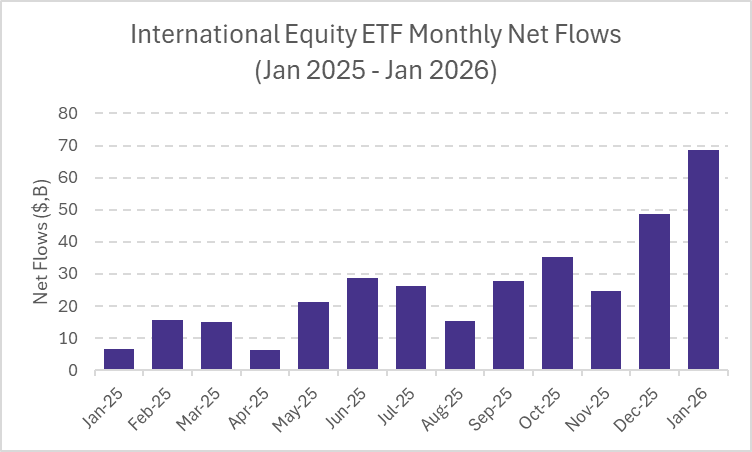
International equity ETFs pulled in $68 billion in January — also a record. They outpaced U.S. equity ETF inflows for the first time since February 2023. Despite representing just 17% of the total ETF asset pie, international funds were responsible for roughly one-third of net inflows. Four of the top 10 most popular equity ETFs this year focus on international markets. Early February has extended the trend, with global ex-U.S. ETFs already adding another $1.4 billion. More broadly, global ex-U.S. equity funds just saw their strongest inflow streak in four and a half years — as investors rotate out of pricey U.S. tech names and into cheaper markets propped up by positive macro catalysts abroad.

Source: VettaFi
Much of the Street is convinced this shift has staying power. Many strategists expect international equities to deliver total returns comparable to — or better than — U.S. equities due to diversification demands, cheaper valuations, higher dividend yields and currency dynamics. The S&P 500 trades near 22 times forward 2026 earnings, versus closer to 13 times earnings for the rest of the world. The bar remains high for big tech earnings to impress. So far, positive earnings surprises just aren’t cutting it anymore. Notably, the 10 largest weights from the S&P 500 posted negative returns in January even as the benchmark index ended in the green.
Regional Flows Gain Traction
Among diversified international funds, the Vanguard Total International Stock ETF (VXUS), Vanguard FTSE Developed Markets ETF (VEA) and Avantis International Equity ETF (AVDE) have all topped or neared the top of the flow leaderboard.
Emerging markets have led performance momentum ever since the Nasdaq 100 peaked in late October. Three of the top 20 most popular ETFs period are emerging markets ETFs — the iShares Core MSCI Emerging Markets ETF (IEMG), the iShares MSCI Emerging Markets ETF (EEM) and the Vanguard FTSE Emerging Markets ETF (VWO). IEMG alone has taken in roughly $9 billion this year, second only to the Vanguard S&P 500 ETF (VOO).
South Korean stocks have seen explosive gains, fueled by tech leadership and robust demand for the nuts and bolts behind AI. Funds tracking the Kospi have seen record interest. The iShares MSCI South Korea ETF (EWY) has risen 28% year-to-date, with a haul of roughly $1.7 billion in net inflows.
Europe-focused ETFs also drew strong demand in January, with inflows into both equity and bond funds outpacing U.S. counterparts. Defensive growth areas, including aerospace and defense, helped drive demand into funds, such as the Vanguard FTSE Europe ETF (VGK).
Japan is quickly becoming a bigger story. This week’s landslide victory for the Liberal Democratic Party has solidified hopes for aggressive fiscal stimulus and corporate governance reform under Prime Minister Sanae Takaichi.
But still no help from China on the flows front. Despite strong stock performance and improving investor sentiment, China remains a “contrarian trade.” Flows into China-focused ETFs simply aren’t there. Still, the KraneShares CSI China Internet ETF (KWEB) attracted north of $2 billion in new money last year and is seeing positive inflows so far. Investor attitudes are also shifting. At last month’s Goldman Sachs’ Global Strategy Conference, 90% of attendees said they now consider China investable. That’s up sharply from 60% two years ago.
Precision via ADRs
Beyond broad ETF exposure, advisors are increasingly using ADRs for targeted global exposure. The ADR market now represents a $2 trillion opportunity, with U.S. institutions holding more than $800 billion. Chinese firms make up half of that universe. However, ADRs also provide access to companies across developed Europe, emerging Asia and other regions.
Historically, ADR investing lacked the same indexing infrastructure available in traditional equity markets. To close that gap, VettaFi has developed a new suite of ADR indexes spanning developed, emerging and global exposures. These benchmarks are designed for use in SMAs and portfolios leveraging direct indexing, offering more precise avenues to access international opportunities through U.S.-listed securities.
Jack Eisenreich, director of index product development at TMX Vettafi, said ADRs allow advisors to pair country or regional allocations with high-conviction single-stock exposure.
“We designed our ADR indices to mimic the exposures of the underlying indices that they track so we can better replicate the returns of the parent indices,” he said. “We do this by matching exposures by country, sector and region while maintaining that each company’s weight remains relatively close to its weight in the parent index.”
Bottom line: International investing is no longer just a diversification play — it’s becoming a return driver. ETFs provide broad access, while ADRs provide precision. Together they give investors smarter ways to participate in the next phase of global market leadership.
For more news, information, and analysis visit the Thematic Investing Content Hub.
Originally published on ETF Trends
A message from Advisor Perspectives and VettaFi: Discover something new! Click here to register for our upcoming webcasts.
Read more commentaries by VettaFi