Former U.S. President Dwight D. Eisenhower once observed that “what is important is seldom urgent, and what is urgent is seldom important.” The Europeans appeared to take this mantra at face value for many years, allowing strategically important trade negotiations with major economies to drift. Over the past few weeks, the European Union (EU) has shown a renewed urgency to conclude agreements that might help reduce reliance on the United States.
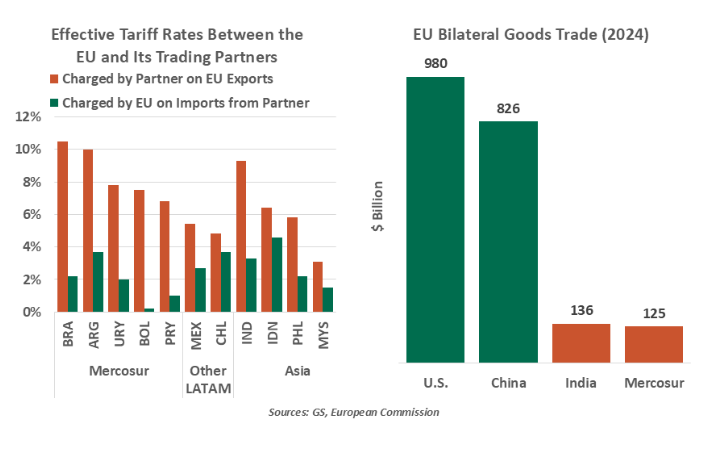
After more than two decades of talks, the EU has reached a free trade deal with Mercosur, the South American common market that includes Brazil, Argentina, Uruguay and Paraguay. More recently, Europe concluded an agreement with India, an accord nearly twenty years in the making. Taken together, these pacts signal a deliberate recalibration of Europe’s economic strategy in a world where trade has become increasingly weaponized. But it is the accord with India, branded as the ”mother of all deals,” that most clearly illustrates the shift in ambition.
Europe’s agreement with India lays the foundations for a free trade zone that links two billion people across continents. The deal eliminates or lowers tariffs on nearly 97% of EU exports, the most ambitious trade opening India has ever granted to a partner. Sectors such as alcohol, high-end automobiles, machinery and food will see steep tariff reductions, from as high as 150% down to 10%-50%. Levies on auto parts will be phased out over time. India will also open up government procurement to European firms.
Together, these measures will help double EU goods exports to India over the next six years. In exchange, more than 99% of Indian exports will gain preferential access to Europe, which will charge much lower tariffs for textiles, apparel, footwear and other labor-intensive manufactured goods.
Though smaller in scale, the Mercosur agreement will also create one of the world’s largest commerce zones, covering roughly 700 million consumers. Since 2000, the EU’s share of Mercosur trade has steadily declined from around 23% to 14%. The deal will dismantle tariffs on a wide range of European exports, from agricultural products and pharmaceuticals to cars and machinery. With current duties as high as 35% on auto parts and 28% on dairy, the pact is expected to boost exports to Mercosur countries by an estimated 39%, or about €50 billion per year, by 2040. The deal also makes it easier for EU countries to invest in Latin America’s critical raw materials, thereby strengthening Europe’s position in supply chains critical to green and digital transitions.