We have been inundated with employment and labor data over the past few weeks. Some of it is finally catching up from reports delayed due to the government shutdown. Readers can be forgiven for feeling a bit of whiplash from the widely varying analysis of those numbers. Depending on who you read, things are either finally starting to turn for the better, or the underlying numbers portend a disaster. I read dozens of such reports, trying to discern some underlying key themes and trends.
You can indeed see this latest slew of results in a positive manner. You can also see underlying data that makes you uncomfortable, if you take a historical view. Why is this tried-and-true employment sector shrinking? Why are we adding more jobs here? Are we getting the “right kind” of jobs? If there are problems over “there,” why is it not showing up in the overall unemployment number? Wages and hours went up. Unemployment went down. The number of people employed went up. We have boomers to thank for much of the rise in the number of workers. Etc.
Let’s start with my prediction: we are at the beginning of an employment paradigm shift. I think what we are experiencing is a paradigm shift, so we’re getting data that seemingly conflicts, when really it doesn’t. What it is telling us is that the nature of employment is once again shifting (as it has since the beginning of the Industrial Revolution). And given what we know about some of the direction and its causes, employment is going to shift faster than it ever has in the past, causing more disruption but also creating a great deal of opportunity, for both employees and employers. Why would the outcome from this paradigm shift be that much different from the last three or four (depending on how you count)?
Past paradigm shifts caused considerable angst while they were happening, but they all resulted in an explosion of new opportunities and whole new industries. None of which was envisioned beforehand. It is human nature to want to improve our own personal situation. And we are seemingly pretty good at it.
Today we’re going to look at the recent employment data, and begin our exploration of what it will be like to be in the midst of a paradigm shift, on top of all of the other changes in society and finance. Without trying to be cliché, it is part and parcel of The Fourth Turning.
Note: if I see the same piece of data in three letters, I am assuming it is commonly known. If an idea is unique to a source I will give a hat tip, and of course I’ll link to anything I quote. If I make a comment in the middle of a quote I will put it in brackets []. There will be a lot of charts in this letter.
The Employment Glass is More Than Half Full
First of all, the monthly employment numbers were solid: 130,000. Both average hours worked and average wages went up. Unemployment went down to 4.3%. There has never been more people employed in this country then today at 159 million. The fly in the ointment? As Brian Syztel noted, “while that has doubled in my lifetime, it would be significantly higher if the participation rate weren't five points below where it was in the mid-nineties.” Although it did tick up last month to 62.5%.
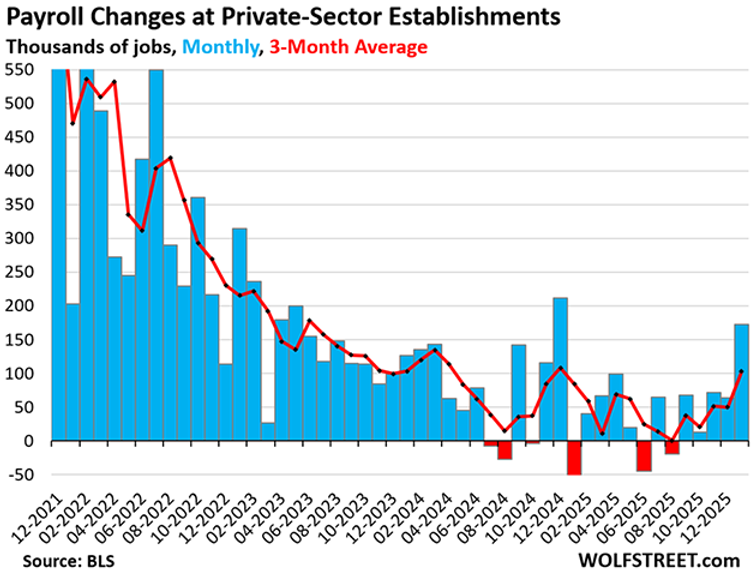
The private sector contributed 173,000 jobs. Predictably, 34,000 jobs were lost at the government level. “The household survey said 528k jobs were added and as it was above the 387k person rise in the labor force, the unemployment rate fell to 4.3% from 4.4%. The all-in U6 rate fell to 8% from 8.4%, helped by a drop in those working part time because they can’t find full time work.” (Peter Boockvar)
I will go into the huge negative revisions in the overall employment numbers, but first let’s focus for a minute on private sector growth.
“Since the beginning of 2025, [the private sector] added 539,000 jobs. Since the beginning of 2024, it added 1.56 million jobs, with six of those months showing job declines, much weaker than previously reported, according to today’s revised figures.
“But private sector job growth has ramped up in recent months.

“The Fed should keep its eyes on private-sector jobs for its monetary policy decisions. While the drop in government employment impacts the unemployment rate, consumer spending, and the economy, it is the result of a political decision by the White House, and not the result of weak demand, slow consumer spending, or other economic weakness that might be considered a reason for rate cuts.”
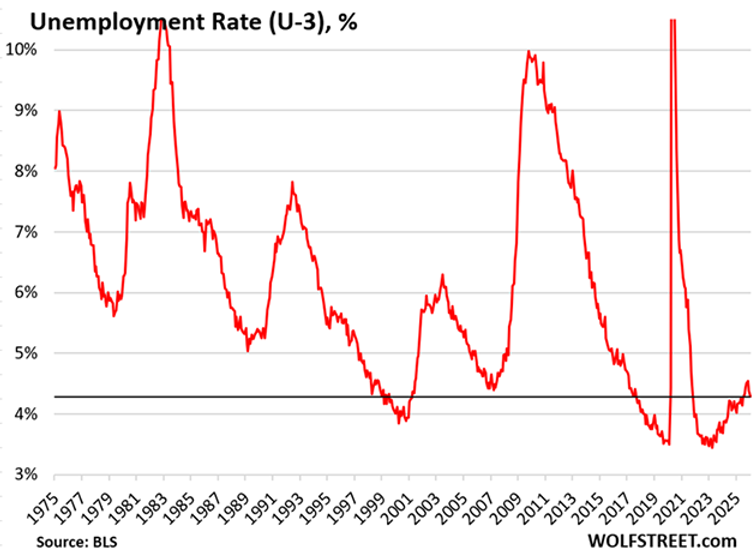
The unemployment rate moved down slightly to 4.28%. While that is up over the last two years, as the chart below shows, it is historically low.
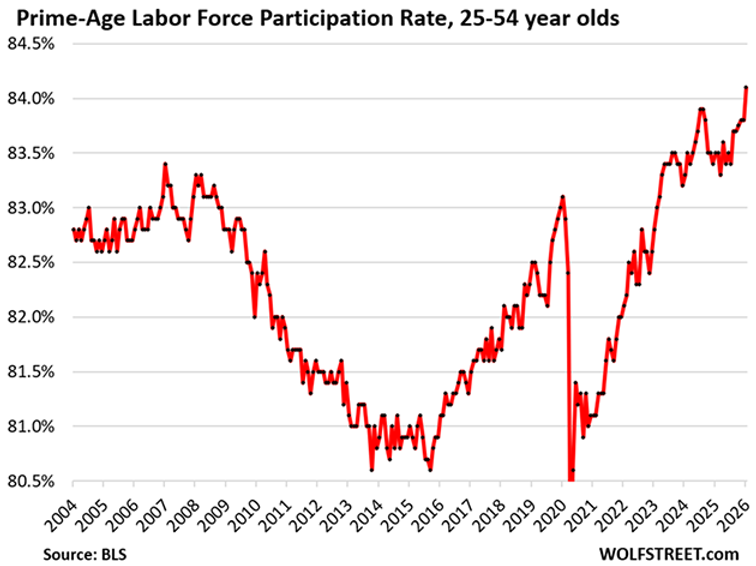
And while the participation rate as noted above is lower, the participation rate among the 25 to 64-year-olds is at a recent high. This is the prime demographic we should be watching.
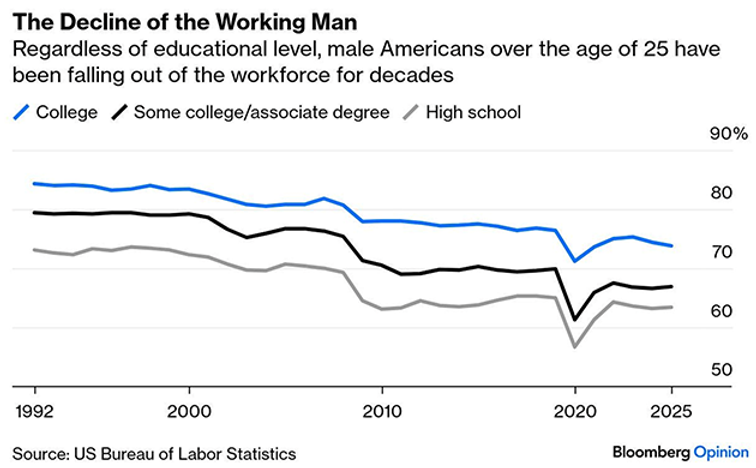
As Nicholas Eberstadt wrote last week in the Washington Post, there are 7 million American men between 25 and 54 who are not working—or even trying to find a job. According to Eberstadt, among unemployed men, there are three who are not looking for work for every one trying to find a job. (H/T Newt)
This is an extreme deviation from past generations. That trend is not our friend, especially in a future world of AI and robotics.
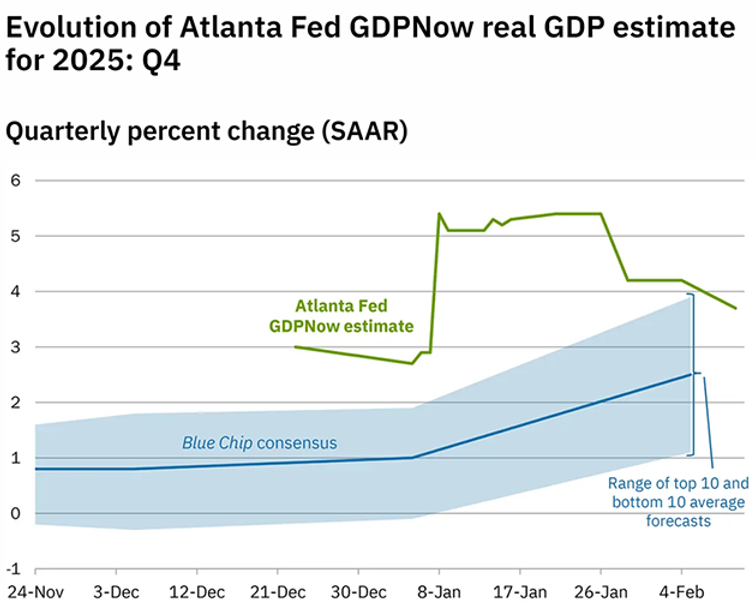
GDP is growing nicely at +3. Historically, that is not the stuff that labor recessions are made of.
The Employment Glass is More Than Half Empty
Now let’s look at what has some analysts concerned. David Rosenberg posted this one paragraph in a group thread:
“Over 100% of the job gain was in health/education – the other 80% of the economy lost jobs. Over 100% of the job gain came from the Birth-Death model … employment from the actual survey declined.”
[Rosie is highlighting the fact that the Birth/Death model has been significantly revised. I have gone into this in detail in the past, but the short version is that there is no way the Establishment Survey can capture new small businesses whenever they are created or they fail. So they had to create a “plug factor” to try to capture it. Which means you have to look at backward looking data. Which means that when there is a change in the economy, either positive or negative, the Birth/Death model will be wrong, sometimes significantly. It always gets revised. Given the modest weakness in small business surveys, it suggests there will be some significant revisions here as well.]
“The response rate [to the BLS survey questionnaire] at 64% is at a record low and compares to 82% pre-pandemic, which is why we see unusually large revisions.”
[This is important. The data revisions for the last three or four years have been rather dramatic. When over 25% of the data comes in later, it is illogical to think there won’t be significant revisions. Businesses are just not responding to the surveys as fast as they have in the past, which renders the first month number (which the market moves on) to be almost guaranteed to be revised significantly. I will confess I don’t understand.]
The raw non-seasonally smoothed data showed a 2.65 million plunge in payrolls … a generous SA adjustment factor …
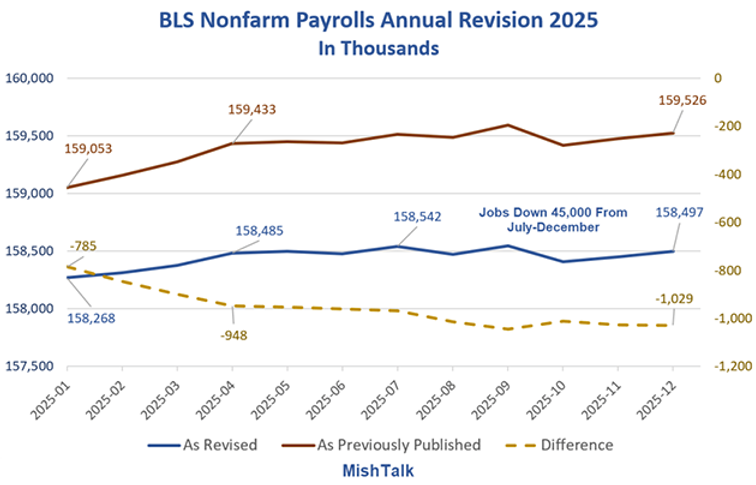
We noted above that private-sector employment is rising. But if you look at the overall data, you get a completely different picture. The revisions they made this month essentially wiped out much of the job growth in 2025. For the full year in 2025, the economy only added 229,000 jobs. From July through December, the economy lost 45,000 jobs
That being said, we reduced government jobs by 317,000. Plus Boomer retirement issues are a factor, and while it was clearly not a great year, it wasn’t a disaster. Diving even deeper, it does get a little bit more disconcerting.
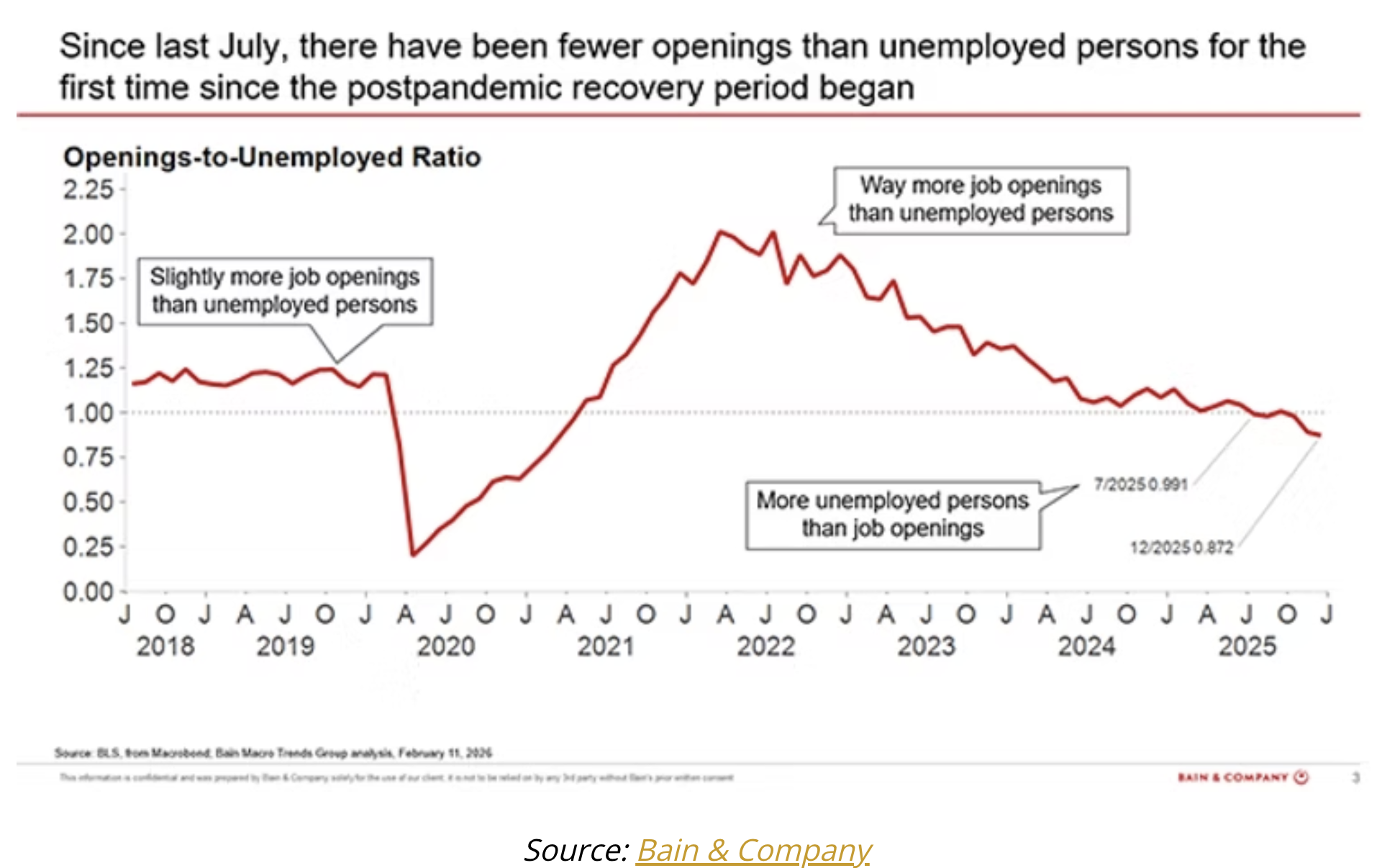
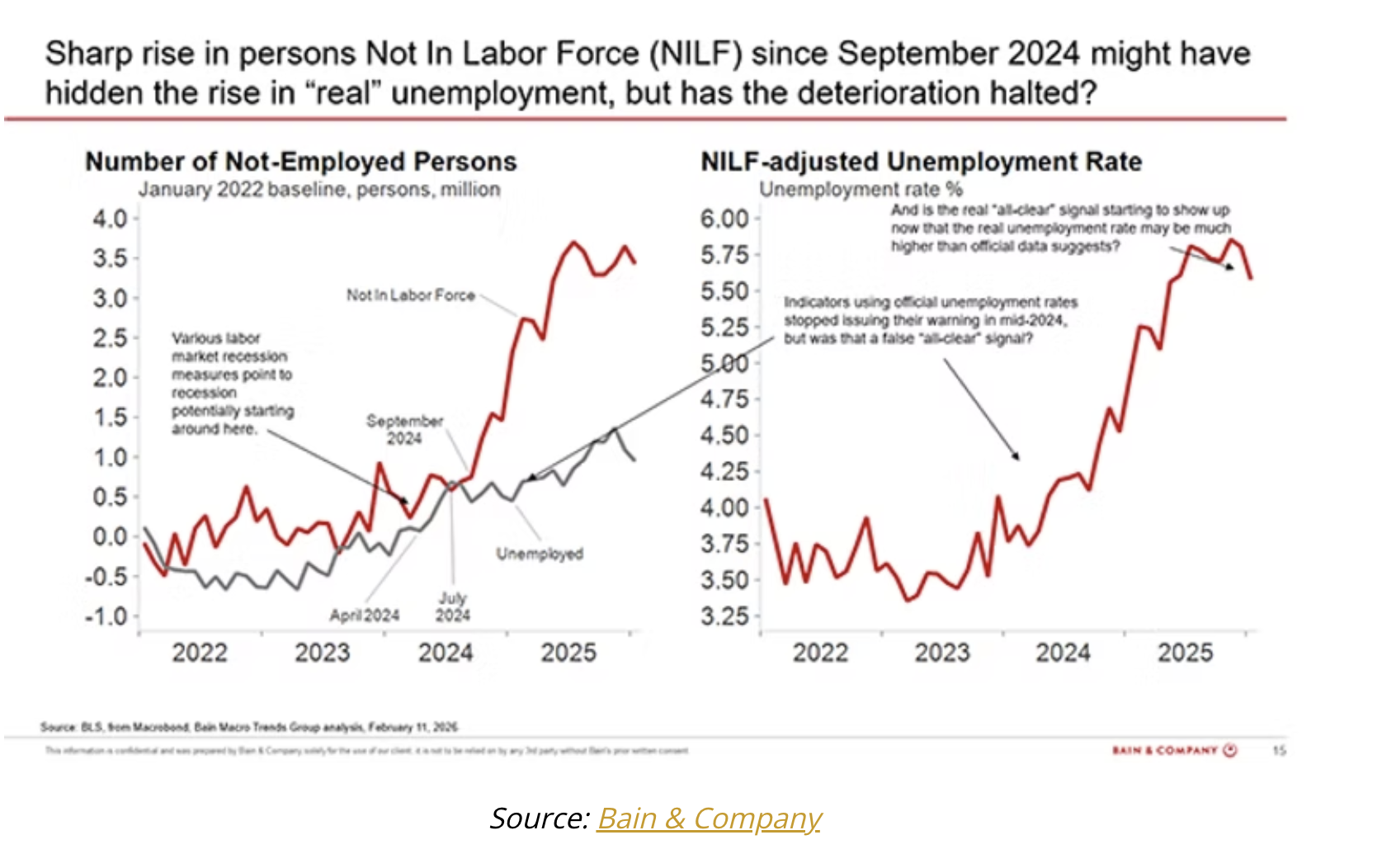
Next let’s look at some data from Karen Harris of Bain and Company’s Macro Trends Group (they do serious work and are one of my favorite sources). Here’s some slides from the latest deck she sent me. This first one does not portend well.
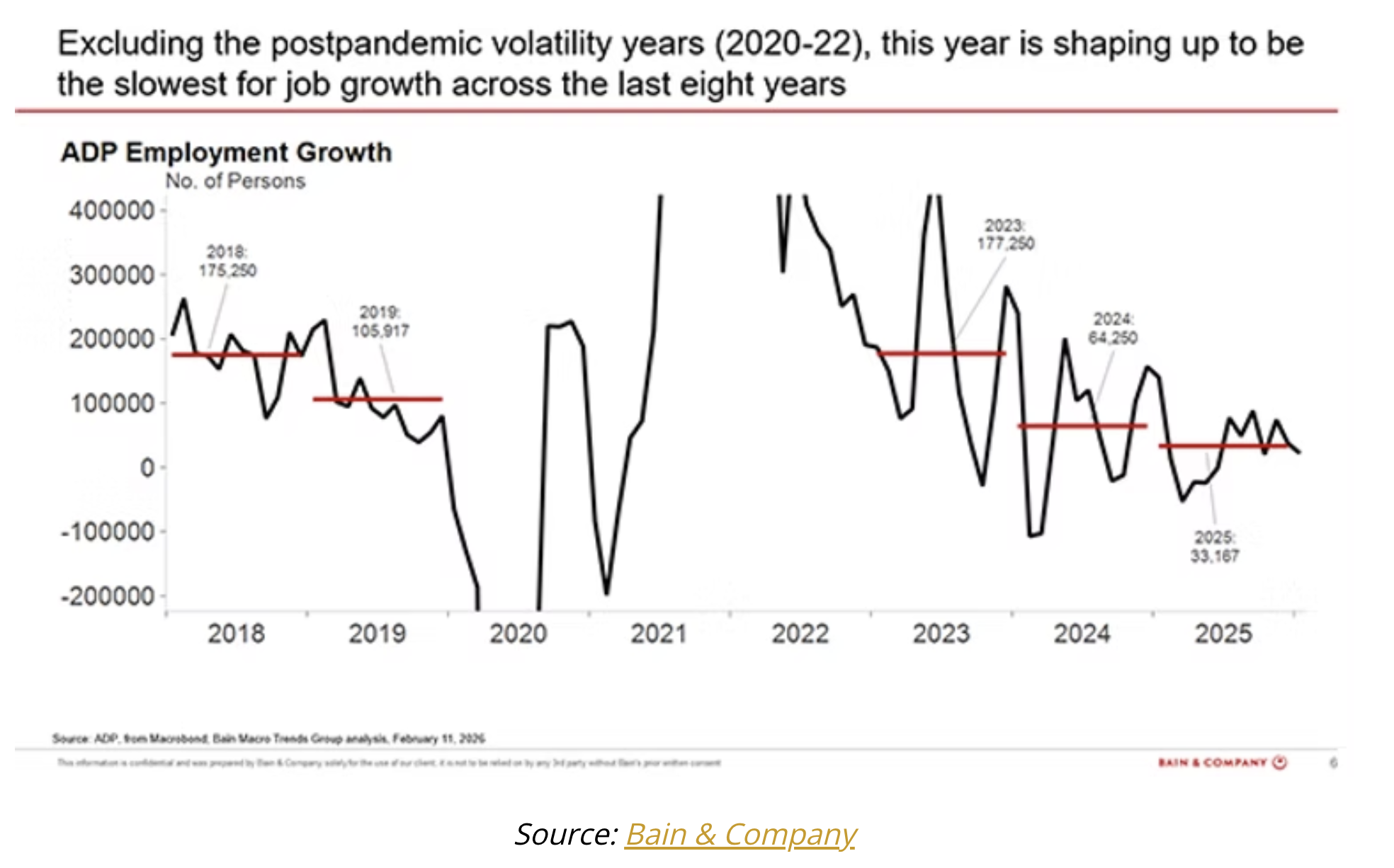
What this says is that the drivers of employment are softening. Not falling out of bed, just softening. Which is strange in a 3% GDP world.
Another anomaly: the rather low unemployment rate is partially a reflection of the fact that the number of not-employed persons (people who are not counted as in the labor force) has risen significantly in the past few years. Remember, when they do the employment survey they asked if you have looked for a job in the last 30 days. If you haven’t, they basically take you out of the total workforce. This can happen for all sorts of good reasons, like you’re going to school, you had to quit work to take care of one of your parents for a period of time, etc. Or it could be that you keep trying to get a job and are discouraged and give up. Either way, you are not in the workforce and are not counted as unemployed.
One final chart from Karen. As we noted above, education and health services has been the driver of recent employment growth. Within that sector, family services is driving the surge. These are people helping with home healthcare, social services, mental health and so on. As our Boomer generation ages, we need more help.
The Migration of Jobs
Historically, the relatively slow growth in jobs would suggest a higher unemployment rate and lower GDP. That is not the case, which begs the question, why?
I think there are several reasons. The first is immigration. There has been a significant reduction in immigrants, legal or otherwise in the US. If I am skeptical of BLS data, I am a magnitude more skeptical of the data from Homeland Security or opposing groups massaging their own data. That being said, trying to more or less average the rather disparate claims, ICE says they deported 605,000 illegal immigrants in 2025. Give or take. Actually, given that this number was exceeded by Obama and Trump 1, that doesn’t seem excessively high. The interesting thing is how many immigrants have self-deported. DHS says it’s 2.2 million. Others claim it’s less than 1 million, but whatever the number, it is significant.
It means that roughly 2 million people who presumably were spending money and therefore had jobs (or government or close family assistance) are no longer in the workforce. Somebody has to do the jobs they had and that is why I suspect that we’ve seen a tick up in the participation rate and the number of people in the labor force. That is more than 1% of the workforce. Have any of those people had jobs? We don’t know. But a lot of them did.
Are we still getting legal immigrants? Yes. Which is a good thing because we need immigrants for our workforce at all levels.
I would also point out reducing 300,000+ federal workers is no small thing. If we talked about 300,000 jobs in the auto industry being lost in one year, it would be a headline disaster in every paper. I suspect there will be more federal jobs lost this year.
AI Is Showing Up In the Data
Secondly, supporting my labor paradigm shift is that we can actually begin to see some impact from AI. Remember, AI wasn’t a significant factor even two years ago. Today it is everywhere (I’m at the “trying to figure out what the hell this is” stage).
There is a famous quote from 1987 by Robert Solow (1987), who got the Nobel Laureate for his work on economic growth. It was great work. But when asked about the effect of computers on productivity he quipped, “You can see the computer age everywhere but in the productivity statistics.”
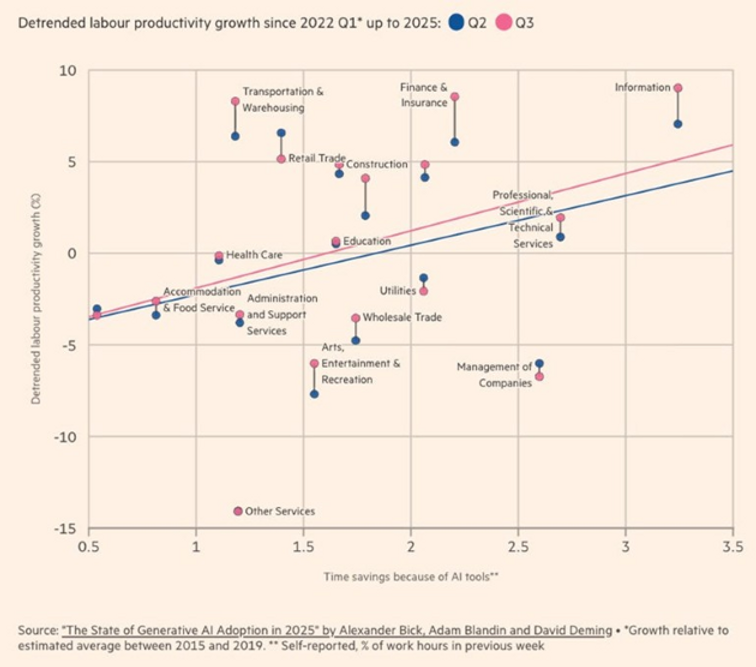
Now in just two years, from the beginning of 22 through 2025 you can actually see the increase in productivity in the productivity statistics. This chart from the Financial Times via Adam Tooze contrasts time savings with actually increase in productivity.
The recent releases from Anthropic/Claude AI and chat GPT 5.3 have produced a paradigm shift in AI. Hallucinations are down and ease of use is up. It didn’t help the software as a service (SaaS) stocks, as it is becoming a powerful coding tool with the potential to reduce the need for SaaS.
This makes sense, as developers are focused on creating software which will allow them to improve their own AI software. It makes them more productive. We are now beginning to see the beginnings of AI writing its own software, improving it as it goes through iterations and debugs its own code. This is a huge step forward.
Of course, many other professions think they are fine because their jobs aren’t writing software. But that same software will soon be turned on other professions with repetitive work that can be analyzed and programmed.
Remember the chart above where I noted that the number of job openings in professional services was dropping significantly over the last year? This is a reflection of AI. So yes, AI is coming for a lot of professional jobs. But it is going to create a lot more potential jobs as everyone will seek to optimize their personal circumstances. We just don’t know what those jobs will be yet.
My true concern is not that in 2040 we won’t have figured out how to adapt and expand human progress and employment and well-being. It is that the change is going to happen so rapidly that it makes adaptation far more difficult than it has been in the past in any generation.
And we are going to do this during a period of major social change (The Fourth Turning/elite overproduction/sovereign debt crisis…) which will make the response cycle even more difficult. I think I can make one prediction fairly confidently: politicians are going to increase their competition to make promises to voters about how they will “fix” things.
And in a crisis, voters on the margin are going to respond to those promises. The political swings will be significant. Stay tuned and strap in.
Scottsdale, Houston, LA, West Palm Beach, DC And More
Yes, I know that I said a few weeks ago that I had nothing on my travel schedule, but things change. I will be in Scottsdale at the end of the month for a longevity conference with some of my associates. From Scottsdale I fly to Houston where I am on an economic advisory board for the Rice University economics department, but the key draw for me will be having dinner with Dr. Ken Rogoff, who along with Carmen Reinhart wrote what I think is one of the five most important economic books of this century, This Time Is Different. The title is meant to be ironic.
Then I will be in LA meeting with the Inner Circle, exploring several companies that are literally changing the technology landscape of defense and energy. Then we will be opening clinics in West Palm Beach and the DC area, hopefully in March. Construction has begun. Boston is looking like June. The SIC will be early May and it will be our best ever.
And with that, I will hit the send button. I am not sure if you noticed, but this is one of the shortest letters I have written in 26 years. I could add a lot more, but I think you got the gist. Things are changing. Change can be both terrifying and awesome. I think we just embrace it and move on. The world is going to be a better place!
You have a great week. Family and friends will help soothe your soul. Spend more time with them!
Your working to make sure AI doesn’t replace me analyst,
John Mauldin
A message from Advisor Perspectives and VettaFi: Discover something new! Click here to register for our upcoming webcasts.
© Mauldin Economics
Read more commentaries by Mauldin Economics