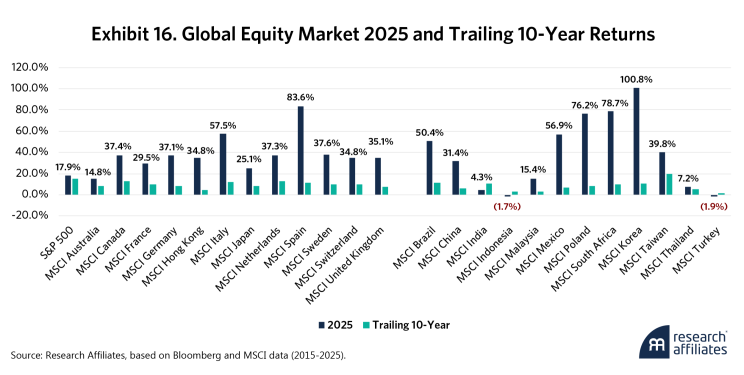
U.S. equities had another strong year in 2025. Returns were impressive, headlines were dominated by large-cap growth, and investor confidence remained high. Yet a quieter and more important story unfolded beneath the surface. Non-U.S. equities meaningfully outpaced their U.S. counterparts.
That outcome should not have been surprising. Starting valuations still matter, especially over long horizons, and U.S. stocks entered 2025 priced for near perfection. Outside the U.S., the picture looked very different. Lower starting multiples, improving fundamentals, and a weakening dollar created a more favorable backdrop for global equities.
The Valuation Gap Is Hard to Ignore
One of the most persistent features of today’s market is the valuation gap between U.S. and non-U.S. stocks. U.S. equity multiples sit well above historical long-term norms, reflecting optimistic growth assumptions and continued confidence in dominant business models. By contrast, developed ex-U.S. and emerging market equities trade at far more modest valuations, closer to historical averages.
This gap matters because valuations are among the most reliable predictors of long-term returns. Expensive markets can stay expensive for a time, but they leave little margin for disappointment. Cheaper markets do not require heroic assumptions to deliver reasonable outcomes.
What the Data Shows
The performance divergence was clear in 2025. As shown below, developed and emerging market equities led global returns, outperforming U.S. stocks after years of lagging behind.

This was not a narrow rally driven by speculative capital. Non-U.S. equities benefited from attractive valuations, improving earnings expectations, and currency tailwinds as the U.S. dollar weakened. In many cases, local fundamentals mattered more than U.S. policy headlines.
Why Global Investing Feels Uncomfortable
If global stocks look attractive on paper, why do investors remain so heavily concentrated in the U.S? The answer is behavioral as much as analytical. Investors anchor to what has worked recently. Over the past decade, U.S. equities dominated, reinforcing the belief that global diversification was optional.
But cycles change. Leadership rotates. Markets that feel uncomfortable often offer the best prospective returns, while markets that feel safe tend to be priced accordingly.
A Broader Opportunity Set
Looking ahead, global diversification offers more than just return potential. It provides exposure to different economic cycles, policy regimes, and sector compositions. It also reduces reliance on a single market that is already priced for exceptional outcomes.
These themes are explored in more detail in my full 2025’s Implications for the Future: “Some Like it Hot"? The article reviews the global performance reset in 2025 and explains why valuation-based investing increasingly points investors outside the U.S.
It is a big world. Investors who limit themselves to one market risk may be missing it.
Disclosures & Disclaimers
Research Affiliates, LLC and its affiliated entities, including Research Affiliates Global Holdings, LLC and Research Affiliates Global Advisors (Europe) Limited (collectively, “Research Affiliates” “we,” “us” or “our”) hereby provide these disclosures and disclaimers. You acknowledge your understanding of these disclosures and disclaimers with respect to the Research Affiliates activities and you, including with respect to the document, information or website (“Communication”) that linked to these disclosures and disclaimers.
Research Affiliates is not responsible in any manner for direct, indirect, special or consequential damages, however caused, arising out of your use of our Communication. Links to other websites from our Communication are for convenience only. No endorsement of any third-party products, services or information is expressed or implied by any information, material or content referred to or included on, or linked from or to our Communication.
Users of any content found on or accessible through our Communication or on Research Affiliates’ website (“Content”) should be aware of the risks associated with data sources and quantitative processes used to produce Content. Errors may exist in data acquired from third party vendors, the calculations or coding used to produce Content, the assumptions or models used in relation to Content, or the display or updating of any Content. While Research Affiliates takes steps to identify errors so as to minimize the potential likelihood or impact of such errors, Research Affiliates cannot guarantee that such errors will not occur. The user therefore agrees, as a condition precedent to usage of such Content that (i) all Content is accepted on an “as is” basis; (ii) the user hereby fully disclaims all warranties of merchantability, fitness for a particular use, or any implied warranties; (iii) the user freely and knowingly assumes all risks of any Content usage; and (iv) the user fully releases and holds Research Affiliates harmless, along with its affiliates and all of their employees, owners, managers, and agents, from any damages or losses resulting from the use of such Content by the user along with indemnifying Research Affiliates for any damages, costs or attorneys’ fees incurred by Research Affiliates as a result of any uses of such Content by the user.
The Content in our Communication is not intended for distribution to, or use by, any person or entity in any jurisdiction or country where such distribution or use would be contrary to law or regulation, or which would subject Research Affiliates to any registration requirement within such jurisdiction or country. Information provided by Research Affiliates and other sources in our Communication is believed to be accurate and reliable when placed in our Communication, but we cannot guarantee it is accurate or complete or current at all times.
Information provided by Research Affiliates to you, including these Disclosures & Disclaimers, is the property of Research Affiliates. Research Affiliates intends to retain all of the rights in such property and by allowing public access to it, does not grant any license to any person to copy, retransmit (either electronically or otherwise), revise, or otherwise exercise any rights of ownership associated with intellectual property generally under the copyright and other applicable laws of the United States and equivalent laws of any other country. Any person who seeks to exercise any ownership right in the information provided to you by Research Affiliates without first obtaining the express written consent of Research Affiliates will be prosecuted to the fullest extent permitted under law.
A message from Advisor Perspectives and VettaFi: Discover something new! Click here to register for our upcoming webcasts.
© Research Affiliates
Read more commentaries by Research Affiliates