Decisions rooted in data
To stay at the forefront of lifecycle investing, fiduciaries must continually evolving to meet the changing realities of markets, participants, and longevity. Every refinement made to glidepath design, asset allocation and portfolio implementation is rooted in evidence and data. It’s a research philosophy that emphasizes a continuous process—refining assumptions, incorporating new data and aligning lifecycle design with real participant needs.
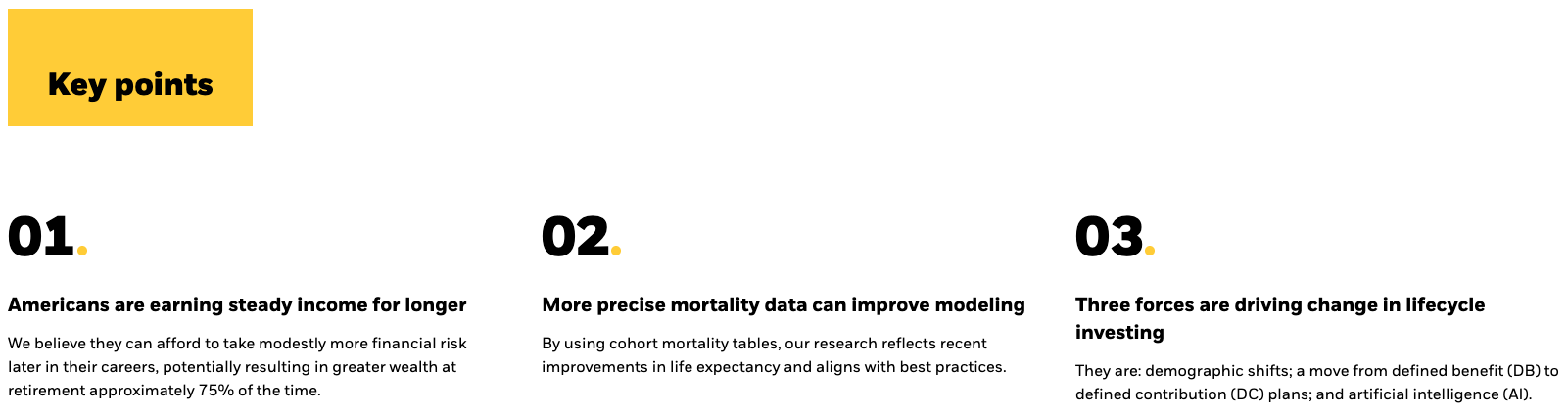
Today, three structural forces are driving the need for further evolution:
- Populations are aging and longevity is increasing: According to the U.S. Census Bureau, more Americans are turning 65 than ever before, and they are living longer, redefining the retirement planning landscape.
- The source of retirement spending is shifting. The move from defined benefit (DB) to defined contribution (DC) places the burden of portfolio construction on individuals rather than institutions.
- The impact of artificial intelligence (AI) is wide ranging. This technology is redefining the future of work and labor income, as it also transforms how we model, measure, and manage risks and opportunities.
A new era for portfolio construction
Lifecycle investing is evolving into a unified system for the DC era, one that adapts over time and across asset types—and aims to build an integrated platform: public and private markets, insurance solutions, and dynamic management to deliver more personalized outcomes. It’s the next evolution in retirement plan innovation , which has included shifts from accumulation to income and fund-building to system-building, always with a focus on helping participants retire with confidence and control.
Steady income for longer
Throughout a person’s career, earnings rise, peak and then decline. For those just starting out, lifecycle investing recognizes that the earnings runway is long and these individuals can afford to take greater risk with their financial capital. For those closer to retirement, that runway is a lot shorter and therefore the levels of financial risk should be reduced.
The changing income levels earned over the course of one’s career inform the level of financial risk a lifecycle investment strategy takes over time:
- Grow: Maximize growth potential when young.
- Protect: Aim to minimize certainty during the retirement window.
- Spend: Maximize spending consistency in retirement.
Until now, we’ve anchored our research in the University of Michigan’s Panel Study of Income Dynamics (PSID). However, we are now enhancing our modeling by combining PSID and data from the Current Population Survey (CPS).
Why? Recent plan design work revealed that actual participant income patterns align more closely with CPS, which: offers a broader, more up-to-date view of current income dynamics, covers 110,000 individuals and is updated monthly. It focuses on individuals rather than households, aligning better with retirement savings decisions.
The latest CPS data shows that earnings decline more gradually after their peak than PSID suggests, meaning people earn steady income for longer. As a result, BlackRock believes they can afford to take modestly more financial risk later in their careers—specifically between ages 45 and 60.
Fine-tuning longevity accuracy
Longevity risk—the risk of outliving savings—is a major concern. It complicates retirement planning because no one knows exactly how long their savings will need to last. Additionally, about 50% of workers retire earlier than expected,1 impacting lifetime earnings and savings. With that in mind, we believe most people should plan for a retirement window rather than a specific year.
To address this savings uncertainty, the industry uses mortality tables, which estimate life expectancy. There are two main types:
- Period (static) tables assume current mortality rates apply to everyone.
- Cohort (generational) tables adjust rates based on birth year and expected changes over time.
BlackRock’s latest research uses cohort mortality tables for U.S. private-employer DB plans, reflecting recent improvements in life expectancy and aligning with best practices (the IRS adopted these tables for pension reporting in 2024). This update doesn’t materially change recommended risk levels, but it does improve modeling accuracy.
Greater potential for wealth
Our updated models now incorporate broader population data and more realistic assumptions about income stability and longer lifespans. We believe this all supports a slower, more measured reduction in risk between ages 45 and 60, potentially resulting in greater wealth at retirement approximately 75% of the time.
This research reflects a continuous process of refining assumptions, incorporating new data, and ensuring lifecycle design stays aligned with real participant needs.
A message from Advisor Perspectives and VettaFi: Discover something new! Click here to register for our upcoming webcasts.
1Alliance for Lifetime Income, “Welcome to the Peak 65® Zone,” 2024
This material is provided for educational purposes only and should not be construed as research. The information presented is not a complete analysis of the global retirement landscape. The opinions expressed herein are subject to change at any time due to changes in the market, the economic or regulatory environment or for other reasons.
None of the information constitutes a recommendation by BlackRock, or an offer to sell, or a solicitation of any offer to buy or sell any securities, product or service. The information is not intended to provide investment advice. BlackRock does not guarantee the suitability of potential value of any particular investment. The information contained herein may not be relied upon by you in evaluating the merits of investing in any investment.
No part of this material may be reproduced, stored in any retrieval system or transmitted in any form or by any means, electronic, mechanical, recording or otherwise, without the prior written consent of BlackRock. This publication is not intended for distribution to or use by any person or entity in any jurisdiction or country where such distribution or use would be contrary to local law or regulation.
The information and opinions contained in this material are derived from proprietary and non-proprietary sources deemed by BlackRock, Inc. and/or its subsidiaries (together, “BlackRock”) to be reliable. No representation is made that this information is accurate or complete. There is no guarantee that any forecasts made will come to pass. Reliance upon information in this material is at the sole discretion of the reader.
Investing involves risk, including possible loss of principal.
©2026 BlackRock, Inc. or its affiliates. All rights reserved. BLACKROCK is a trademark of BlackRock, Inc. or its affiliates. All other trademarks are those of their respective owners.
© BlackRock
Read more commentaries by BlackRock