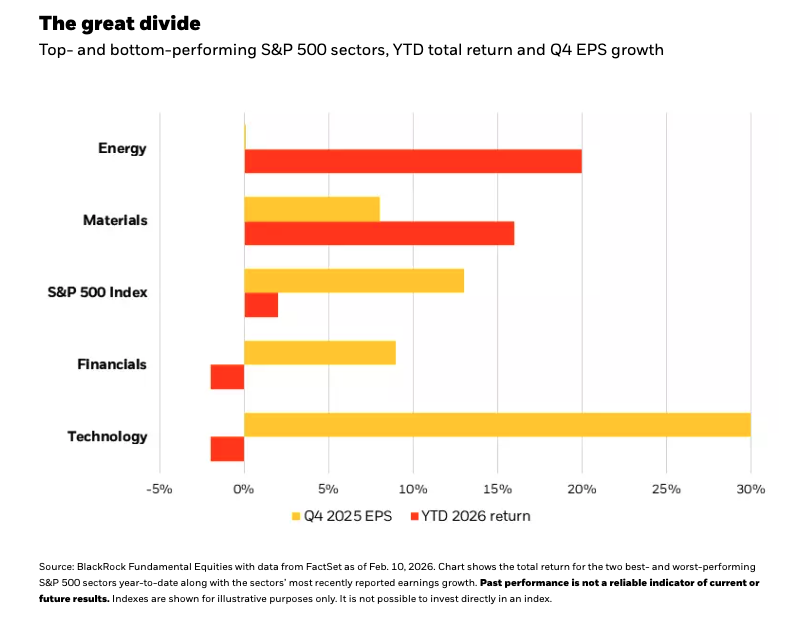
Corporate America delivered again, with the S&P 500 Index of U.S. stocks on pace for 13% growth in earnings for Q4 2025. This would mark the fifth consecutive quarter of double-digit growth, a stretch not seen since the 2021-2022 emergence from COVID-induced economic shutdowns. Revenue growth was the highest recorded for the index since Q2 2022.
The makeup of the quarter’s results was familiar: The “magnificent” mega-cap stocks led the charge once again, with estimated earnings per share (EPS) growth of 30%. From a sector perspective, technology posted the hottest earnings growth (30%) followed by industrials (26%) and communication services (13%). At the opposite end of the spectrum, consumer discretionary, energy and healthcare showed flat to slightly negative EPS growth in the quarter.
In another familiar pattern, an impressive 80% of companies beat their EPS estimates, though market reaction was muted relative to history. And as these solid earnings rolled in, S&P 500 Index performance was largely unchanged, with some strong drawdowns countered by equally robust rebounds.
Why the disconnect between solid earnings and volatile markets? It’s nuanced, but three things keep us optimistic as we look ahead to the start of 2026 earnings:
1. Data supports strong 2026 earnings
Earnings momentum does not appear to be slowing, as indicated by four key factors:
-
Analyst earnings estimates are climbing. Data from FactSet suggests another round of double-digit earnings growth in each of the four quarters of 2026, with current estimates placing growth at 14% for the year.
-
Corporate sentiment is at a record high, according to a Bank of America analysis that parses positive and negative language in earnings calls.1
-
AI’s impact is broadening. Earnings calls and surveys show AI-related productivity gains are touching more industries.2 This could mean further upside to margins, which are already at historic highs (13% in Q4).
-
More companies are raising guidance than lowering guidance.
2. Fundamentals shine across time
History has shown that fundamentals drive stock returns over longer time horizons. Yet short-term market action can be fickle and diverge from current fundamentals.
Looking at Q4 earnings alongside year-to-date stock returns shows two notable dislocations:
- Despite reporting flat year-over-year earnings, energy is the best-performing sector so far this year, as shown in the chart below. This is in response to non-fundamental events, including recent geopolitical developments in Venezuela that could open up this large market to U.S. companies. Stocks of oilfield service and equipment companies rose in reaction. We also saw stock prices react to the cold snap across the U.S. A more than 20% uptick in natural gas prices in a matter of days boosted related stock prices. This illustrates that recent events can trigger transitory price moves that seem divorced from reported earnings.

- Conversely, the technology sector is underperforming this year despite reporting stellar earnings for Q4. While earnings were positive across subsectors, dispersion in stock price performance has been outsized. Only semiconductors and companies leveraged to the AI infrastructure buildout are outperforming the broad market year-to-date. Meanwhile, software companies posted earnings results that were double expectations (30% vs. an outlook for 15%) but have undergone the largest 12-month non-recessionary drawdown in 30 years.3 Even the AI hyperscalers, after delivering stellar Q4 earnings results, are underperforming as larger-than-expected capex spending comes under further scrutiny.
3. Dislocations can create opportunities
Much ink has been spilled on the fear of AI disrupting the business models of software companies. The debate rages on and we are watchful on an individual stock basis. At the same time, we are focused on the opportunities created by AI. Early-year selling in tech stocks has been indiscriminate in some areas, providing ample opportunity to look for spots where the baby has been thrown out with the bathwater.
One thing seems relatively clear: AI will speed up coding and result in the creation of more content. This has us setting our sights on companies that observe, store and secure data as a potentially misunderstood opportunity. Our view is for AI to continue powering market returns in 2026, even as the complexion of leaders and laggards may change ― a topic we discuss in An equity investor’s guide to 2026.
Our key takeaway after parsing Q4 2025 earnings and coincident 2026 ytd stock price performance: There will always be worries that move the markets and defy fundamentals. As active stock investors, we embrace this as an opportunity to identify mispricings and establish or add to positions in fundamentally sound companies. It’s an exciting time to be actively invested.
Carrie King, Global CIO, BlackRock Fundamental Equities
1 Bank of America as of January 2026.
2 Goldman Sachs as of Jan. 30, 2026.
3 JPMorgan Global Markets Strategy as of Feb. 10, 2026.
Unless otherwise noted, earnings figures cited herein are from FactSet using blended growth data as of Feb. 13, 2026. Blended growth combines already reported and latest estimates for companies yet to report Q4 2025 earnings.
This material is not intended to be relied upon as a forecast, research or investment advice, and is not a recommendation, offer or solicitation to buy or sell any securities or to adopt any investment strategy. The opinions expressed are as of February 2026 and may change as subsequent conditions vary. The information and opinions contained in this post are derived from proprietary and nonproprietary sources deemed by BlackRock to be reliable, are not necessarily all-inclusive and are not guaranteed as to accuracy. As such, no warranty of accuracy or reliability is given and no responsibility arising in any other way for errors and omissions (including responsibility to any person by reason of negligence) is accepted by BlackRock, its officers, employees or agents. This post may contain “forward-looking” information that is not purely historical in nature. Such information may include, among other things, projections and forecasts. There is no guarantee that any forecasts made will come to pass. Reliance upon information in this post is at the sole discretion of the reader. Past performance is no guarantee of future results.
Investing involves risk. Equities may decline in value due to both real and perceived general market, economic, and industry conditions. Diversification does not ensure profits or protect against loss.
Prepared by BlackRock Investments, LLC, member FINRA.
©2026 BlackRock, Inc. or its affiliates. All rights reserved. BLACKROCK is a trademark of BlackRock, Inc. or its affiliates. All other trademarks are those of their respective owners.
MKTG0226-5248475-EXP0227
A message from Advisor Perspectives and VettaFi: Discover something new! Click here to register for our upcoming webcasts.
© BlackRock
Read more commentaries by BlackRock