Takeaways
-
Blowout reports from NVDA and retailers such as HD and TJX boosted Q4 EPS growth
-
Despite uncertainty swirling around US trade policy and AI, American CEOs remain confident on future growth
-
Next week, 1,068 companies are expected to report, including results from CrowdStrike, Ross Stores, Abercrombie & Fitch, Gap and more
Trade Risk Returns Just as Retailers Begin to Report
With over 90% of S&P 500® earnings reported, the season wraps up next week with a final trickle of retail names. Overall it was a great season for these large cap names, with EPS growth topping 13%, the fifth consecutive quarter of double digit growth, and revenue growth of 9%.1 Will those types of growth numbers continue in 2026, especially now that trade risk seems to be back on the table?
After the Supreme Court struck down President Trump’s 10% global tariff on February 20, he bypassed the ruling by invoking Section 122 of the 1974 Trade Act to impose a statutory maximum 15% surcharge.2 This "balance-of-payments" authority is limited to 150 days, forcing a high-stakes legislative showdown by July 2026 to determine if the tariffs become permanent.
Tariff turmoil already started to hit the last batch of earnings reports. On Tuesday, Home Depot said they were still analyzing the impacts of the new Section 122 proclamation. While the home improvement retailer has high domestic sourcing for items such as lumber, CEO Ted Decker noted that the 15% global surcharge on imported hardware and tools will likely lead to "necessary price adjustments" if the tariffs remain in place for the full 150-day window allowed by the Act.3
TJX reported a strong double-beat yesterday, posting adjusted earnings of $1.43 per share on $17.7 billion in revenue, comfortably ahead of Wall Street's expectations. CEO Ernie Herrman highlighted a "strong start" to 2026, noting that the U.S. consumer remains resilient and attracted to the "treasure-hunt" value model as consolidated comparable sales rose 5%. Regarding recent trade volatility, CFO John Klinger stated that the company's full-year guidance assumes they can largely offset tariff pressures through their flexible sourcing and merchandise margins. Despite the beat, the stock experienced a slight "sell the news" reaction, trading down about 0.3% in early action as investors weighed a conservative FY2027 guidance that came in just below consensus estimates. That stock has since popped up by nearly 1.5% today.4
Incoming Tailwind for Retailers - A $100B Tax Windfall
Retailers are also poised to benefit from an upcoming tax refund windfall which will likely fall in the $100B - $150B range this year. Consumers typically use these lump sum refunds to pay off credit card debt from holiday spending, or make large ticket purchases such as appliances or autos.
While not referred to by companies themselves, analysts believe there will be several retail winners from these refunds. Off-price retailers such as TJX should capture the "No Tax on Overtime" demographic, workers who now have retroactive savings and are using them for wardrobe refreshes and home goods.5 Analysts also believe Target will be a refund winner.6
The IRS filing season began on January 26 and the first two weeks of data are in. So far that data shows that as of February 13, the average refund payment is up 14.2% YoY. This is a win for American households and will likely lead to a boost in spending for the first half of 2026.7
Blowout Beat, Tempered Reaction: The World’s Most Valuable Company Reports
Nvidia delivered another blowout performance for their fiscal Q4 2026, reporting $68.1B in revenue (up 73% YoY) and an adjusted EPS of $1.62 (up 82% YoY), comfortably beating Wall Street expectations. The surge was powered by record Data Center sales as the Blackwell chip ramped up and demand for Agentic AI infrastructure reached a fever pitch. Despite zero revenue from China due to export restrictions, the company’s guidance for next quarter came in at a massive $78B, signaling that the AI build-out is nowhere near its peak.
The market initially responded with enthusiasm, sending shares up roughly 3.5% as investors cheered the strong margins (75%) and the growth of sovereign AI revenue from national governments. Analysts have since shifted price targets higher, viewing Nvidia not just as a chipmaker, but as the essential backbone of the global AI economy. While the stock has moderated slightly after the initial jump, (down nearly 5% at the time of this publication) it continues to trade near all-time highs as supply for their next-generation architectures remains the only real bottleneck. Also, as close NVDA watchers know well, the stock often runs into the report, and slumps afterwards, despite typically beating estimates.
US CEO’s Appear Confident, For Now
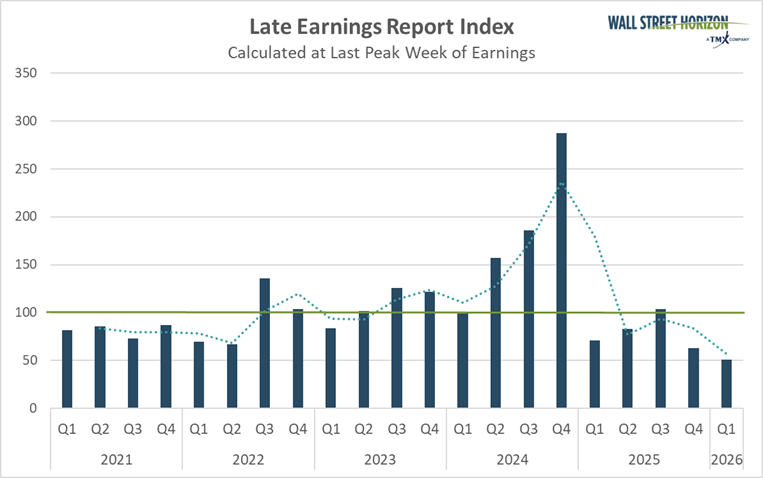
The Late Earnings Report Index, our proprietary measure of CEO uncertainty, posted its lowest post-peak number ever since we began collecting this data five years ago.
The LERI tracks outlier earnings date changes among publicly traded companies with market capitalizations of $250M and higher. The LERI has a baseline reading of 100, and anything above that indicates that companies are feeling uncertain about their current and short-term prospects. A LERI reading under 100 suggests that companies feel they have a pretty good handle on the near-term.
The official post-peak season LERI reading for Q4 (data collected in Q1) stands at 51, well below the baseline reading, suggesting companies are feeling more certain about economic conditions than they were for the last three quarters. As of February 26, there were 106 late outliers and 186 early outliers.
In mid-April we will get numbers for the pre-peak LERI for the Q1 2026 reporting season, with uncertainties now swirling around everything from trade policy to AI it will be interesting to see how corporations react.

Q4 2025 Earnings Wave
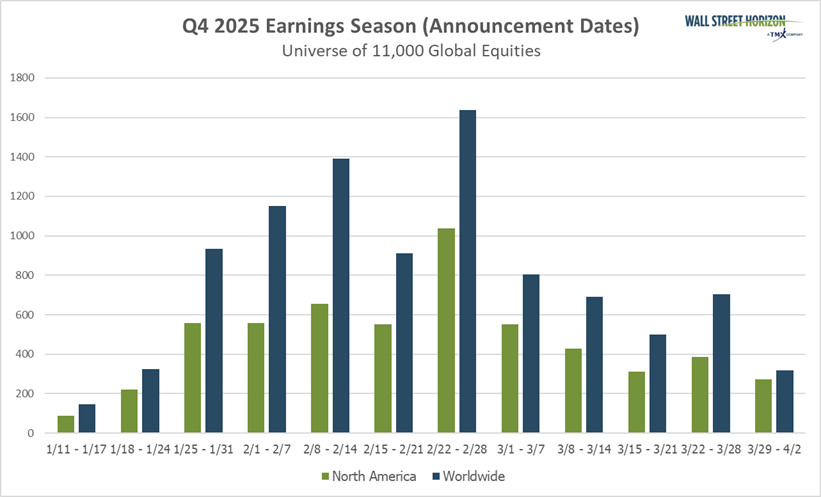
In what is more-or-less the final big week of the Q4 earnings season, 1,068 companies are expected to release results (out of our universe of 11,000+ global names). Thus far, 61% of companies have reported.
The Bottom Line
As the Q4 earnings season draws to a close, the market finds itself at a crossroads of record-breaking AI growth and shifting fiscal policy. While the 15% trade surcharge introduces a fresh layer of complexity for retailers, the massive $100 billion tax windfall will likely benefit them. Investors must now weigh whether these significant consumer tailwinds can offset the "sell the news" sentiment currently hitting even the strongest performers like Nvidia. Ultimately, the transition into the Q1 2026 reporting cycle will determine if this corporate confidence can survive a high-stakes summer of legislative and trade showdowns.
1 FactSet Earnings Insight, John Butters, February 13, 2026, https://advantage.factset.com
2 “President Donald J. Trump Imposes a Temporary Import Duty to Address Fundamental International Payment Problems,” The White House, February 20, 2026, https://www.whitehouse.gov
3 The Home Depot Announces Fourth Quarter and Fiscal 2025 Results; Increases Quarterly Dividend by 1.3%;Provides Fiscal 2026 Guidance, The Home Depot, February 24, 2026, https://ir.homedepot.com
4 The TJX Companies, Inc. Reports Q4 and Full Year FY26 Results, February 25, 2026, https://investor.tjx.com
5 “Bigger Tax Refunds Are Coming. Which Retailers Gain the Most.” Barron’s, Sabrina Escobar, January 24, 2026, https://www.barrons.com
6 “The OBBBA 'Refund Ripple': How a Retroactive Tax Windfall is Fueling a 2026 Consumer Surge,” Market Minute, February 24, 2026, https://markets.financialcontent.com
7 Filing season statistics for week ending Feb. 13, 2026, IRS, https://www.irs.govistics-for-week-ending-feb-13-2026
Copyright © 2026 Wall Street Horizon, Inc. All rights reserved. Do not copy, distribute, sell or modify this document without Wall Street Horizon's prior written consent. This information is provided for information purposes only. Neither TMX Group Limited nor any of its affiliated companies guarantees the completeness of the information contained in this publication, and we are not responsible for any errors or omissions in or your use of, or reliance on, the information. This publication is not intended to provide legal, accounting, tax, investment, financial or other advice and should not be relied upon for such advice. The information provided is not an invitation to purchase securities, including any listed on Toronto Stock Exchange and/or TSX Venture Exchange. TMX Group and its affiliated companies do not endorse or recommend any securities referenced in this publication. This publication shall not constitute an offer to sell or the solicitation of an offer to buy, nor may there be any sale of any securities in any state or jurisdiction in which such offer, solicitation or sale would be unlawful prior to registration or qualification under the securities laws of any such state or jurisdiction. TMX, the TMX design, TMX Group, Toronto Stock Exchange, TSX, and TSX Venture Exchange are the trademarks of TSX Inc. and are used under license. Wall Street Horizon is the trademark of Wall Street Horizon, Inc. All other trademarks used in this publication are the property of their respective owners.
A message from Advisor Perspectives and VettaFi: Discover something new! Click here to register for our upcoming webcasts.
© Wall Street Horizon
Read more commentaries by Wall Street Horizon