Magnificent 7 Fatigue? Investing in ‘The Best of the Rest’
Membership required
Membership is now required to use this feature. To learn more:
View Membership BenefitsThe U.S. stock market has been driven by narrow forces over the past three calendar years as the collective energy around artificial intelligence (AI) supercharged early leaders in the “Magnificent 7” ― the mega-cap stocks in the S&P 500 highly leveraged to the AI buildout.
Ibrahim Kanan, Head of the U.S. Core Equity team within BlackRock Fundamental Equities, sees change afoot. After a multi-year period of historic concentration in the widely tracked S&P 500 Index, a long-anticipated broadening is finally starting to take shape ― and, in the process, seeding a robust field for active stock selection.
Analyst estimates point to a narrowing earnings growth gap between the Mag 7 and the rest of the market in 2026, as shown in the chart below. As a portfolio manager and active stock picker, Mr. Kanan sees this presenting opportunity to enter or add to positions in fundamentally sound (and some forgotten) companies at undemanding valuations.
Minding the gap
S&P 500 Index earnings per share growth, 2023-2026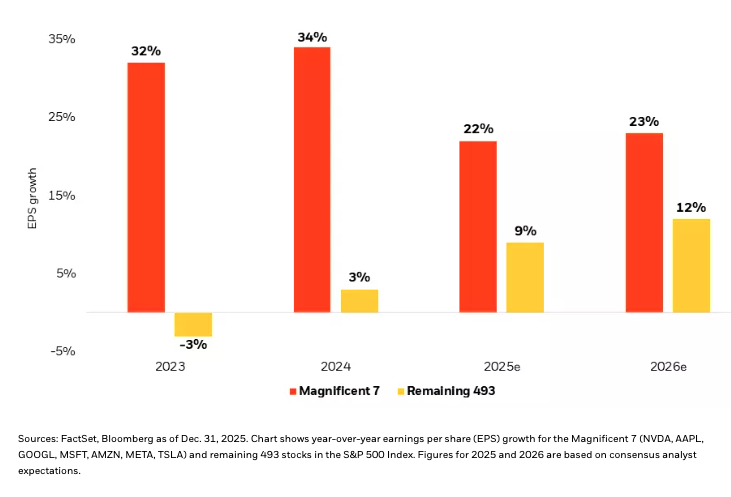
He offers three reflections as this market broadening unfolds, informed by his strategic focus on targeting above-market returns:
Broaden your lens, but narrow your picks
The 10 largest stocks by market cap still represent close to 40% of the S&P 500 Index today. This compares to 19% at the end of 2010.1 In Mr. Kanan’s assessment, this means many large U.S. companies that are “great, quality businesses” have been overlooked ― and that many investors are left underexposed to them by virtue of tracking the index.
He cites Intel as an example. The U.S. semiconductor company is in the midst of writing a new chapter. At less than 0.4% of total S&P market cap as of mid-February,2 index-hugging investors may be undershooting its potential upside.
Some investors have looked to other indexes for “diversification” away from the S&P 500’s top-heavy bias. Among them: the equal-weighted S&P 500 and the small-cap Russell 2000. Mr. Kanan cautions that leaning into the former means neutralizing AI outperformance, while pivoting to the latter comes with a quality sacrifice, as many small public companies today are unprofitable. He further notes that the equal-weighted S&P 500, which apportions each of the 500 constituents at equal measure, has underperformed its market-cap-weighted counterpart amid the recent broadening.
Pro tip: Widen your lens beyond 2025’s top 10 and sharpen your pen to home in on the next leg of potential leaders. Mr. Kanan is targeting a small group of names with prospects of delivering more return than the broader U.S. indexes. One area of interest: industrials, particularly those that are facilitating and feeding into the AI data center buildout.
Choose companies first, not factors or sectors
Dispersion is evident across the market, including among the Mag 7. And Mr. Kanan expects to see greater differentiation between AI “winners” and “losers” over the next 18-24 months.
As Carrie King, Global CIO of BlackRock Fundamental Equities, notes in a recent episode of The Bid podcast The first-round leaders in the AI super cycle are unlikely to repeat the exponential revenue growth, margin expansion and share price appreciation that they’ve enjoyed since 2023. Yet the AI theme is well-poised to remain a market-driving force.
Mr. Kanan is looking in new places to capitalize on AI progress and sees opportunities emerging across sectors as use cases for the technology begin to materialize.
Pro tip: AI is still a force not to be ignored. Choose your mega-caps wisely and sniff out other high-potential candidates, not on factor or sector preferences but on their individual ability to grow earnings beyond consensus expectations. Mr. Kanan is looking for companies among the “other 493” that are essentially emerging from a 2023-2024 earnings recession.
Diversifying in AI
Many investors believe firmly in AI as an investment opportunity but may be worried about crowded positioning or the untold return on big capex spending ― or they may simply be seeking unique expressions of the theme.
Mr. Kanan sees a growing number of companies across industries using AI to gain a competitive advantage. He and his team run a quantitative screen to identify such companies. They then apply fundamental analysis to see if it’s bearing out in their financials ― i.e., having measurable impact on company margins and revenues. Their evaluation finds the list of companies is small but growing, making it a potentially good time to pick up on a budding trend. See chart below.
Expanding AI rewards
S&P 500 firms seeing positive financial impact, 2024-2025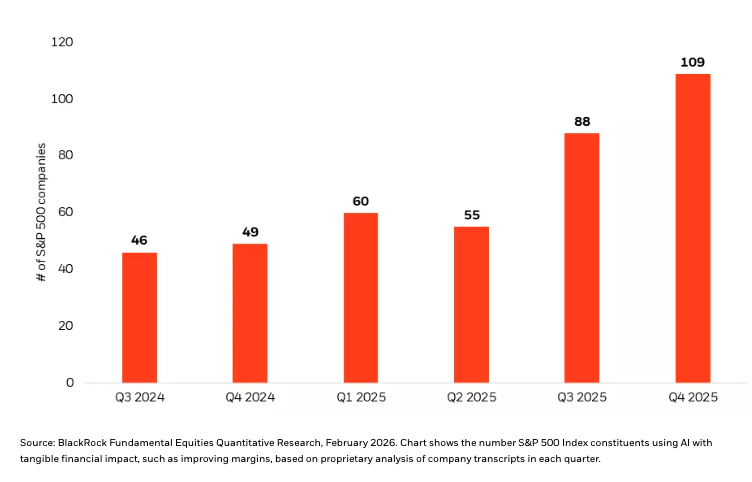
Each of the above are not just ideas but active strategies put into practice as Mr. Kanan and his team seek to advance their record of alpha generation in 2026, navigating what they see as a broader market ripe for stock picking.
1Source: BlackRock Fundamental Equities with data from FactSet, Feb. 13, 2026.
2Source: BlackRock Fundamental Equities with data from FactSet, Feb. 13, 2026.
A message from Advisor Perspectives and VettaFi: Discover something new! Click here to register for our upcoming webcasts.
BlackRock does and may seek to do business with companies covered in this content. As a result, readers should be aware that the firm may have a conflict of interest that could affect the objectivity of this content.
Investing involves risk, including possible loss of principal. Investment in a specific sector can entail greater volatility given the narrower focus of the investment universe and concentration in sector-specific risks. Technology companies may be subject to severe competition and product obsolescence. AI technology relies on large data sets, which can lead to inaccuracies. Companies in AI face competition, rapid obsolescence, and depend on demand from various industries. Regulatory scrutiny could limit AI development, with data collection facing closer examination and potential fines. Country-specific regulations could also impact AI and big data companies.
This material is not intended to be relied upon as a forecast, research or investment advice, and is not a recommendation, offer or solicitation to buy or sell any securities or to adopt any investment strategy. The opinions expressed are as of February 2026 and may change as subsequent conditions vary. The information and opinions contained in this post are derived from proprietary and nonproprietary sources deemed by BlackRock to be reliable, are not necessarily all-inclusive and are not guaranteed as to accuracy. As such, no warranty of accuracy or reliability is given and no responsibility arising in any other way for errors and omissions (including responsibility to any person by reason of negligence) is accepted by BlackRock, its officers, employees or agents. This post may contain “forward-looking” information that is not purely historical in nature. Such information may include, among other things, projections and forecasts. There is no guarantee that any forecasts made will come to pass. Reliance upon information in this post is at the sole discretion of the reader. Past performance is no guarantee of future results.
Prepared by BlackRock Investments, LLC, member FINRA.
©2026 BlackRock, Inc. or its affiliates. All Rights Reserved. BLACKROCK is a trademark of BlackRock, Inc. or its affiliates. All other trademarks are those of their respective owners.
MKTG0326-5260489-EXP0327
Membership required
Membership is now required to use this feature. To learn more:
View Membership BenefitsSponsored Content
Upcoming Virtual Events View All












