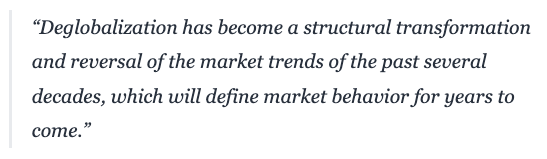
Gold is going to become increasingly important as the deglobalization and de-dollarization trend that took off last year continues to gain steam, according to a recent report.
What do we mean by “deglobalization?”
As the report described it, it’s the impact of a breakdown in post-WWII alliances, erosion of political and military norms, and an upending of foundational assumptions underpinning currencies and commodities.

This will drive persistent inflation, elevated geopolitical risk premiums, and asset revaluation, including precious metals and “critical minerals.”
Analysts Paul Wong and Jacob White say this growing disorder will accelerate de-dollarization, with gold increasingly filling the gap.
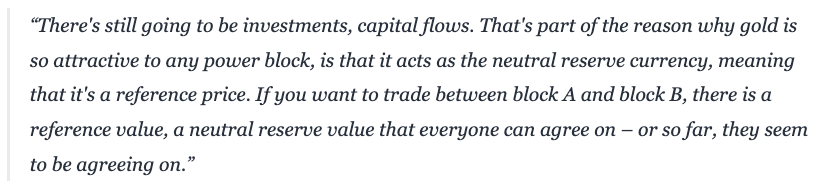
Wong said that even as political alliances fragment and shift, power blocks will continue to trade with each other. Gold will play a key role as the global economy reorients.
Central bank gold buying reflects the growing importance of the yellow metal in the quickly evolving global economy.
Last year was the fourth-largest expansion of central bank gold reserves on record. The all-time high was set in 2022 (1,136 tonnes). It was the highest level of net purchases on record, dating back to 1950, including since the suspension of dollar convertibility into gold in 1971. We also saw central bank purchases eclipse 1,000 tonnes in 2023 and 2024. To put that into context, the annual average for 2010-2021 was 473 tonnes.
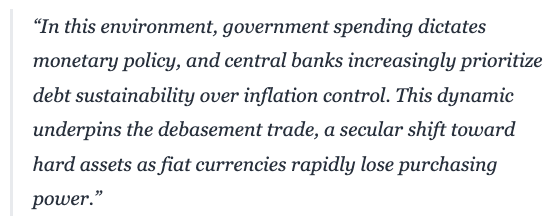
The report notes the growing debasement trade with investors rotating out of “fiat-denominated assets and into stores of value such as gold, other precious metals, and select commodities.”
This is due to growing worries about global debt and surging inflation. The report argues that “the pandemic-era policy mix of greater debt, deficits and stimulus has entrenched fiscal dominance as a structural regime.”
Due to the Debt Black Hole, central banks may adopt a “run-it-hot” monetary policy, choosing inflation over a potential economic meltdown.
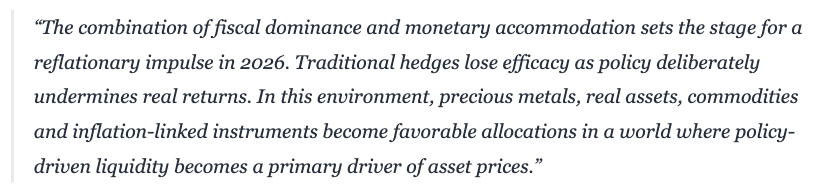
The analysts say they think “the debasement trade is likely to accelerate, reinforcing the strategic case for hard assets in institutional portfolios.”
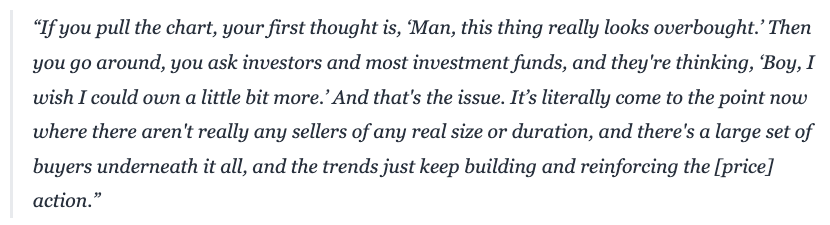
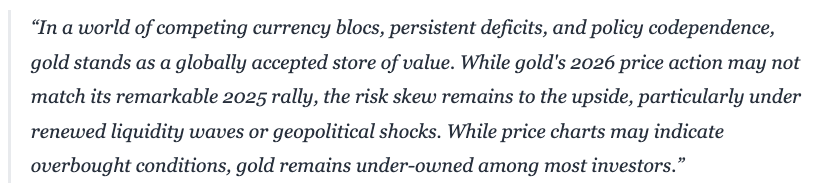
They also take aim at the notion that gold is overbought. Wong and White concede it looks that way, but the yellow metal remains underinvested. Central bank buying laid the foundation for the current gold market, but a lot of investors still haven’t hopped on the bandwagon.
The tide seems to be turning, especially after Morgan Stanley CIO Michael Wilson said investors should consider abandoning the traditional 60/40 equity/bond portfolio allocation and adopt a 60/20/20 distribution with 20 percent allocated to precious metals.
On average, most Western investors (institutional and private) hold less than 1 percent of gold in their portfolios. If investors take even modest steps toward that allocation, it will add significant demand to the equation, further increasing upward price pressure.
Given the evolving economic and market dynamics, analysts say gold is positioned to shine.
Wong summed it up with a rhetorical question.
A message from Advisor Perspectives and VettaFi: Discover something new! Click here to register for our upcoming webcasts.
Our Service, Use, and Transaction Terms (“Terms”) and Privacy Policy (collectively, the “Policies”) govern your access to and use of this Website. By using the Website or engaging in transactions with Money Metals, you acknowledge that you have read and agree to be bound by the Policies, which are incorporated herein by reference. NOTICE REGARDING MARKET RISKS, ORDER ACCEPTANCE, AND CANCELATIONS: By placing an order online or over the phone with Money Money Metals Exchange, you agree to be bound by our Terms and liable for any and all losses in value of the items you ordered. You may not cancel any order after you place it with Money Metals. If you fail to follow through with timely payment on an order, you are responsible to Money Metals for any monetary damages (including, but not limited to, market losses, collection fees, setoffs, etc).
Read more commentaries by Money Metals Exchange