The Iran War: Scenarios for Investors
Membership required
Membership is now required to use this feature. To learn more:
View Membership BenefitsThe war in Iran and the risk that it could lead to a wider regional conflict have roiled global financial markets. Oil and European gas prices have spiked while equity markets have seen sharp declines.
The prevailing fear is that the world might be about to experience an energy price shock as violent as the one seen in the aftermath of Russia’s invasion of Ukraine.
Although this can’t be completely ruled out, it is not our base case scenario. It is rare for geopolitical crises to inflict lasting damage on growth and financial markets; the only major exception was the oil crisis during the 1970s, and there is little to suggest a repeat of that.
The global economy is much less oil intensive than it was then; US is a net exporter of petroleum, while global supplies of crude are ample and reserve buffers remain reasonable.
So even if the price of crude rises 30%, it would shave only about 0.2 percentage points from global GDP growth and lift inflation by little more than one percentage point.
But oil is not the only factor at play. Investment sentiment is another important consideration, and here, markets look more vulnerable.
Equities and other riskier assets were in a fragile equilibrium in the weeks leading up to the US-Israeli military strike on Iran. Markets were caught between improving macroeconomic fundamentals on the one hand and a loss of confidence in the outlook for US technology stocks on the other. For this reason, stocks could prove more volatile than they otherwise would have been.
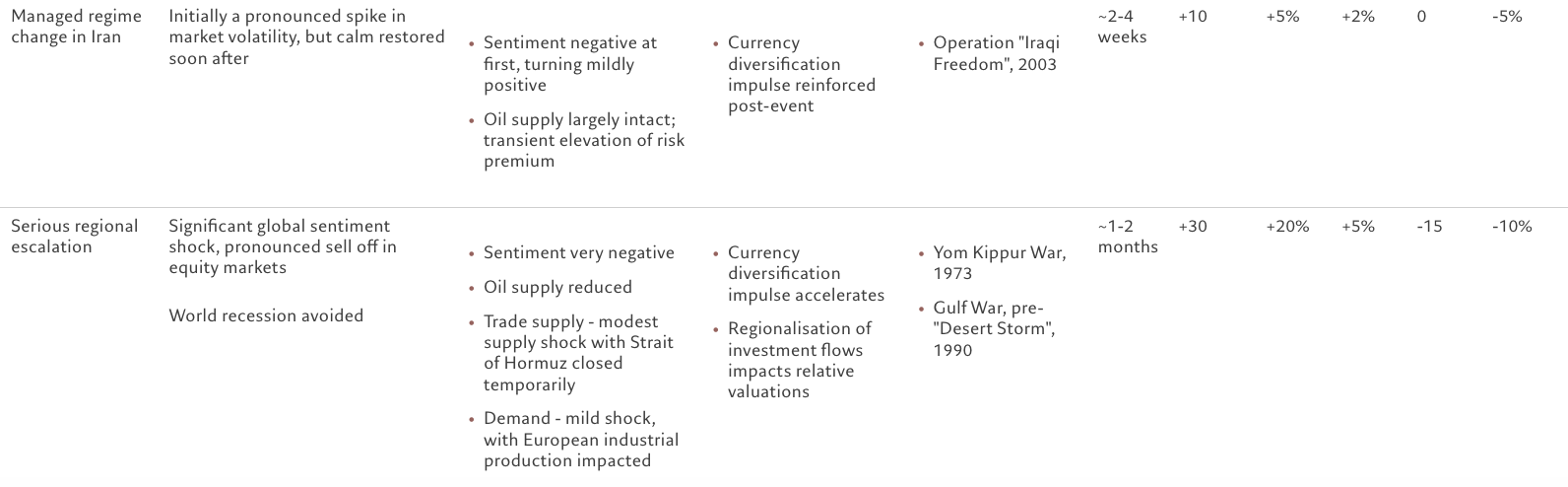
To better understand how events could unfold, we have conducted an analysis that explores various conflict scenarios.
At one end of the scale, the conflict ends quickly, with Iran’s military weakened but with its current regime remaining in place. Under the most extreme scenario, we imagine what might happen in the unlikely event that the war that spreads beyond the region.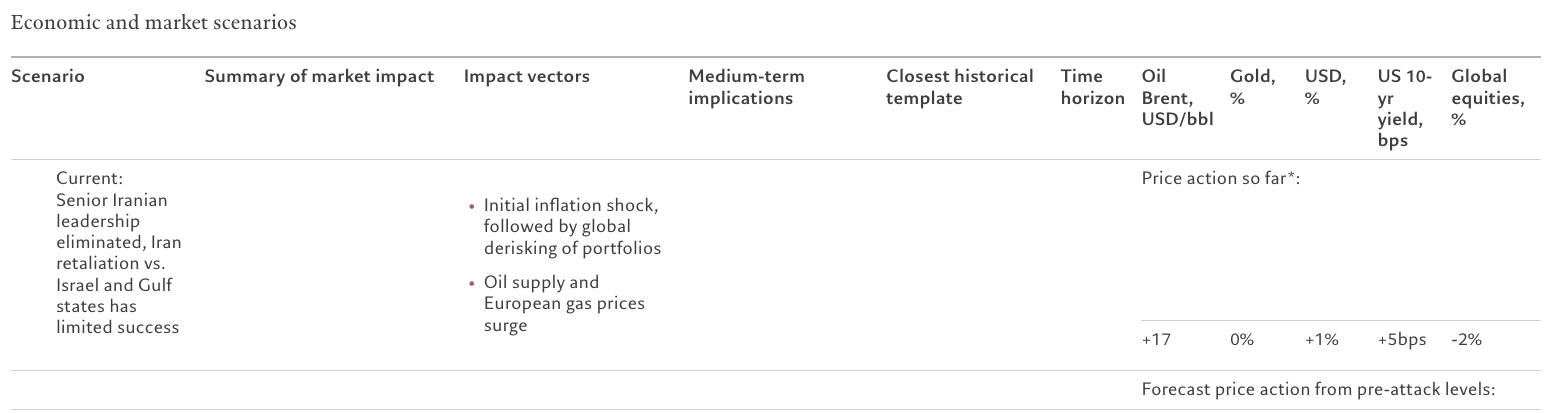


Scenarios to consider
Equity market declines should remain modest in most scenarios unless the conflict broadens materially, for example, to include Russia and China.
Bonds may initially struggle as higher oil prices keep inflation elevated. But a more severe escalation would likely cause a fall in consumer spending and business confidence, which would fuel expectations for interest rate cuts and cause bond yields to fall.
Gold is likely to be a key beneficiary, acting as a high‑liquidity store of value and a strategic hedge against inflation over time, even if it remains vulnerable to bouts of volatility. The US dollar should also appreciate initially on safe‑haven demand, supported by the US’s position as a major energy producer. It would then resume a gradual decline if the conflict comes to an end.
Changes in our positioning: hedging against declines
In the days since the US-Israeli attack on February 28, our multi-asset investment teams have scaled back their holdings of riskier assets and have put in place hedges against further market falls via put options in both stocks and corporate bonds.
Our portfolios have also increased their weighting in the US dollar – whose function as a safe harbour should come to the fore, particularly in light of the Japanese yen’s weakness. If conflict continues for some time, the dollar has room to appreciate. We would expect the Swiss franc to gain too, especially as the Swiss National Bank would likely support such appreciation to counter inflationary pressures arising from higher energy prices.
Our overweight in the Swiss franc and our high‑conviction overweight stance in gold form the main bulwark of the portfolio.
We also highlight the early resilience of emerging markets outside of the tech-heavy North Asia. We have consistently argued that emerging equities are not merely a leveraged play on the global risk cycle, but a strategic allocation underpinned by strong domestic growth fundamentals.
A message from Advisor Perspectives and VettaFi: Discover something new! Click here to register for our upcoming webcasts.
Marketing Communication
The information and data presented in this document are not to be considered as an offer or solicitation to buy, sell or subscribe to any securities or financial instruments or services. The information used in the preparation of this document is based upon sources believed to be reliable, but no representation or warranty is given as to the accuracy or completeness of those sources. Information, opinions and estimates contained in this document reflect a judgment at the original date of publication and are subject to change without notice. This material does not contain sufficient information to support an investment decision and it should not be relied upon by you in evaluating the merits of investing in any products or services offered or distributed by Pictet Asset Management. Pictet Asset Management has not ensured the suitability of the securities mentioned in this document for any specific investor, and it should not be relied upon as a substitute for independent judgment; investors are advised to determine the suitability of the investment based on their financial knowledge, experience, goals and situation, or to seek specific advice from an industry professional before making any investment decisions. Investors should read the prospectus or offering memorandum before investing in any Pictet managed funds. Tax treatment depends on the individual circumstances of each investor and may be subject to change in the future. Past performance is not a guide to future performance. The value of investments and the income from them can fall as well as rise and is not guaranteed. Investors may not get back the amount originally invested.
Terms & Conditions
Conditions of use
By accessing this website and the products, services, information, tools and materials that it contains or describes (hereinafter, "the website"), you acknowledge that you have understood and accept the following conditions of use.
Access to the website
Access to the website is forbidden to any person from a jurisdiction (by reason of their domicile, residence, nationality or other) whose applicable laws and/or regulations prohibit the publication and/or availability of the website.
No offer
The information provided on this website is not intended to be a substitute for the funds’ full documentation. Hence, the information on this website does not constitute an offer or a recommendation to implement or liquidate an investment or to carry out any other transaction. It should not be used as the sole basis for any investment decision or other decision. Any investment decision should be based on appropriate professional advice specific to the investor's needs.
Exclusion of warranty
The information and opinions on this website are provided by Pictet Asset Management SA for general information purposes only. Pictet Asset Management SA and its data suppliers make every effort to ensure that the information on this website is accurate and complete at the time of its inclusion. However, although this information is obtained from sources that are believed to be reliable, Pictet Asset Management SA and its data suppliers do not guarantee, explicitly or implicitly, that it is accurate, reliable, up-to-date or exhaustive. Furthermore, any view or opinion expressed on this website is subject to alteration without notice. Pictet Asset Management SA cannot guarantee that the information on this website has not been altered as a result of technical malfunctions (disconnection, interference by third parties, computer viruses, etc.). The latest versions of the prospectuses, Key information Documents (“KIDs”), annual reports and semi-annual reports of the investment funds are the only versions deemed to be official fund publications on which investment decisions may be based.
Limitation of liability
Pictet Asset Management SA and its data suppliers accept no liability for any loss or damage of any nature whatsoever, whether direct, indirect or consecutive, arising from accessing, using, consulting or navigating its website, or from links to other websites.
Investment performance
Past performance is no indication or guarantee of future results. Moreover, the value of and returns on the securities or financial instruments mentioned on the website may go down as well as up and investors may not get back the full amount originally invested. The risk factors are described in the fund prospectuses. Finally, the performance shown does not take account of any commissions or costs charged when subscribing to or redeeming units.
NAVs relating to dates on which shares are not issued or redeemed (“non-trading NAVs”) may be published here. They can only be used for statistical performance measurements and calculations or commission calculations and cannot under any circumstances be used as a basis for subscription or redemption orders.
For hedged shareclasses, only the compartment's consolidation currency is hedged into the shareclass currency. Foreign exchange exposure, resulting from assets in the portfolio which are not denominated in the consolidation currency, can remain.
Local legal restrictions
None of the investment funds mentioned nor any of the related prospectuses shall be distributed to persons resident in any State in which the distribution of such funds or prospectuses is contrary to local laws and/or regulations. Such persons are forbidden to access this website. It is your responsibility to ensure that you are authorised to access this website. This website contains information on a large number of investment funds registered and managed in different jurisdictions. You will be required to indicate your place of residence before being allowed to access information relating to the said investment funds. Please note that access by private investors to the said information shall be limited to the investment funds authorised for sale to the public in their country of residence. The latest versions of the prospectus, Key information Documents (“KIDs”), annual report and semi-annual report translated into the language of your country of residence conform with any requirements laid down in the laws or regulations of that country.
Switzerland
Foreign collective investment schemes that have appointed a Swiss paying agent and a representative (Art. 120 para. 4 CISA) and that are exclusively offered to qualified investors in Switzerland, including high-net-worth retail investors who declare that they wish to be treated as professional investors (Art. 5 para. 1 FinSA ), are exempt from the requirement to obtain authorization from the Swiss Financial Marketing Supervisory Authority (FINMA).
Singapore
For Singapore investors, the investment funds mentioned in this website are not authorised or recognised by the Monetary Authority of Singapore and are not allowed to be offered to the retail public.They are exclusively intended for (i) institutional investors as defined under Section 304 of the Securities and Futures Act, Singapore Statute Cap. 289 ("SFA"), (ii) to a relevant person pursuant to Section 305(1), or any person pursuant to Section 305(2), and in accordance with the conditions specified in Section 305, of the SFA, or (iii) any other person otherwise pursuant to, and in accordance with the conditions of, any other applicable provision of the SFA.
Italy
In Italy, P shares of Pictet sicav are offered by the Pictet Group in its role of General Distributor only to the Pictet Group's employees and to "Qualified Investors" as defined by art. 100 of Legislative Decree no. 58/1998.
United Kingdom
Entities of the Pictet Group outside the United Kingdom are not covered by the standards and regulations for investor protection issued by the Financial Services Authority. UK residents have no right to claim compensation through the Financial Ombudsman Service following losses resulting from failure to comply with certain obligations arising from the relevant regulations.
United States of America
None of the investment funds mentioned on this website is or will be registered under the "United States Securities Act" of 1933, as amended. Similarly, the investment funds mentioned on this website are not and will not be registered under the "United States Investment Company Act" of 1940, as amended. Consequently, the above-mentioned investment funds must not in any circumstances be offered or distributed: (i) in the United States of America, in any of its States or in any other political subdivision of the United States of America, or (ii) to or on behalf of or for the benefit of any United States Person (as defined in Regulation S of the "United States Securities Act" of 1933).
Material interests
The Pictet Group, its managing partners, directors, managers and staff may hold or may have held interests or positions in the securities referred to on this website or may have negotiated or acted as a market maker in respect of these securities. Furthermore, these entities or persons may have – or may have had – relationships with directors of the companies issuing the above-mentioned securities, and may supply – or may have supplied – financial or other services to them, or may hold or may have held directorships of the companies in question.
Tax
Tax treatment depends on the personal circumstances of the investor and is subject to change. Investors are advised to seek specific professional advice before making any investment decision.
Ownership of website, brands and copyright
Pictet Asset Management SA and the other Pictet Group brands mentioned on the website are registered trademarks or service marks of the Pictet Group or its affiliated companies. Unless otherwise indicated, the entire website is protected by copyright. It is forbidden to reproduce (in full or in part), transmit (by electronic or any other means), amend, create a link to or use this website for any public or commercial purposes without the prior agreement of Pictet Asset Management SA
Links to other websites
This website may provide automatic links to other websites. You use such links to any external websites entirely at your own risk. Pictet Asset Management SA does not verify the accuracy of the information provided on the websites mentioned on this website. Pictet Asset Management SA therefore accepts no liability for their content or for the products, services or other offers available through them.
Disclaimer
I have read and accept the present terms and conditions of use.
Membership required
Membership is now required to use this feature. To learn more:
View Membership BenefitsSponsored Content
Upcoming Virtual Events View All










