Key takeaways
- Markets are responding primarily to uncertainty, with oil prices rising and equities volatile.
- The economic impact will depend largely on energy supply disruption, particularly whether oil prices remain contained or move sharply higher.
- Our portfolio positioning remains near strategic targets, with potential to lean into risk assets if volatility creates attractive entry points.
What happened? How did markets react?
Over the weekend, the United States and Isarel launched a joint attack on Iran, which President Trump has indicated may continue for several weeks. Equity markets originally sold off on the news Monday morning before rebounding to near the flatline. Equity market volatility continued into Tuesday, with U.S. equities oscillating between a decline of 1% and 2.5%. Meanwhile, oil prices climbed further, reaching around $80 a barrel on fears that Iran may close the Strait of Hormuz — a vital passageway for global energy.
How could this impact asset prices moving forward?
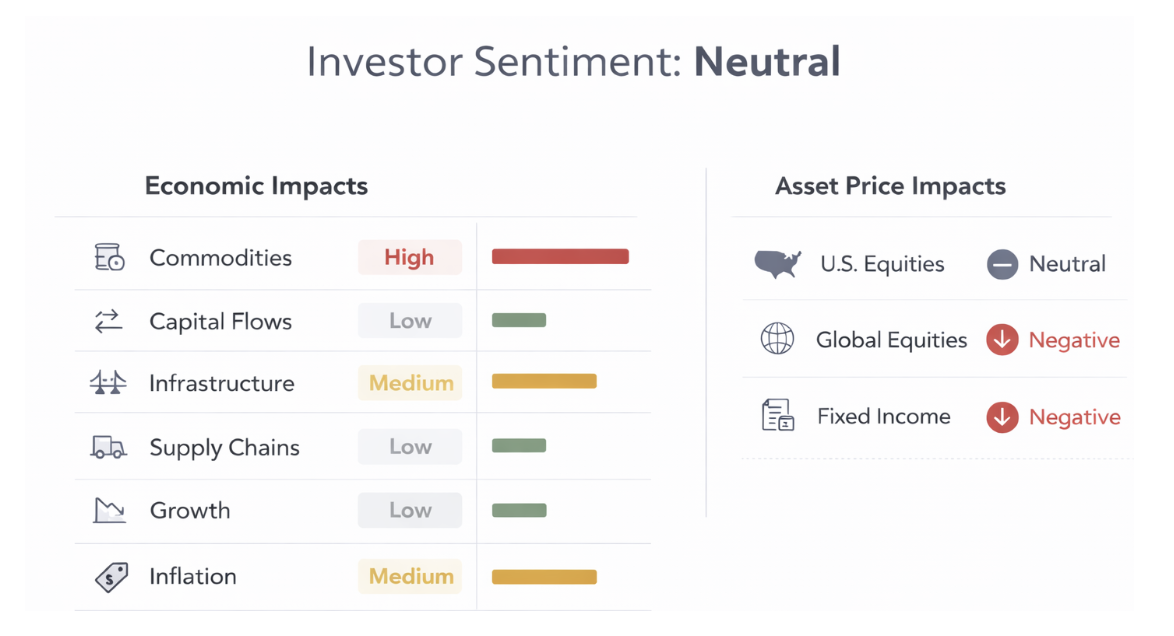
Geopolitics affects asset prices through two primary pathways — sentiment and economic fundamentals — as rising uncertainty dampens spending and increases risk aversion, while disruptions to commodities, capital flows, supply chains, and even physical infrastructure ripple through growth, inflation, earnings, and ultimately valuations.
In the current situation, movements in oil prices and changes in global risk sentiment are the key indicators we are monitoring closely. Here’s how we see the current episode flowing through those channels — and what it means for asset prices.
We think global equities are more likely to be negatively impacted by the rising oil prices and supply chain disruptions in the Middle East. In the U.S., although some volatility is likely, we expect lesser impacts to asset prices overall since the country is a net oil exporter and is on solid economic footing.

Meanwhile, although U.S. Treasuries are generally viewed as a safe-haven asset during times of market volatility, the oil price shock may cause investors to worry that stickier inflation could lead the Fed to remain on a protracted hold instead of cutting rates further, potentially adversely impacting fixed income. Corporate bonds could sell off as credit spreads widen on higher risk aversion.
How does this impact our positioning?
For now, we remain close to our strategic asset allocation because we do not see signs of the crisis meaningfully disrupting U.S. and global growth. Because of this, we may potentially lean into risk assets during any potential market drawdowns.
What are the different high-level scenarios?
-
Base case
Oil prices stay below $80 a barrel, limiting economic impacts. Markets are volatile in the short-term but ultimately grind higher as fundamentals hold and investors look through the conflict.
-
Bull case
The conflict resolves quickly, oil flows through the Strait of Hormuz are restored, and oil prices drop towards $60 a barrel. Markets rebound on the prospects for uninterrupted growth.
-
Bear case
A protracted closure of the Strait leads to energy shortages globally. Oil prices jump well above $100 a barrel and sustain at those levels, leading to a spike in inflation and a sharp drop in markets. Consumer spending pulls back, and the global business cycle slips into a recession.
Manager perspectives
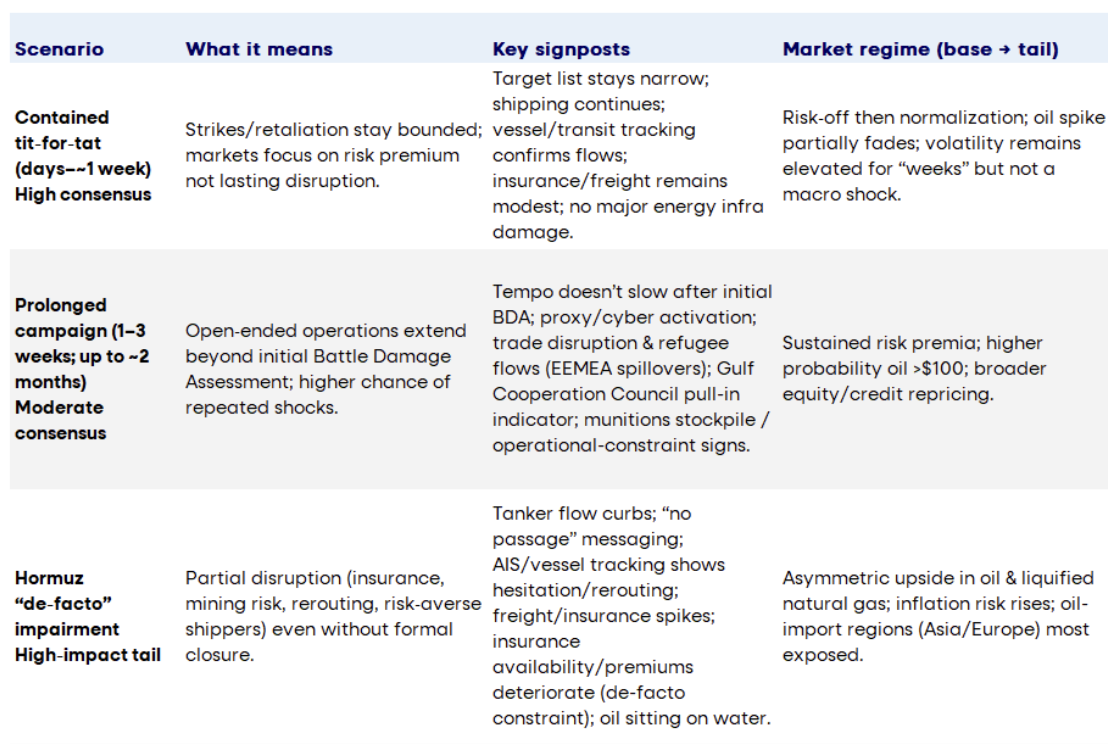
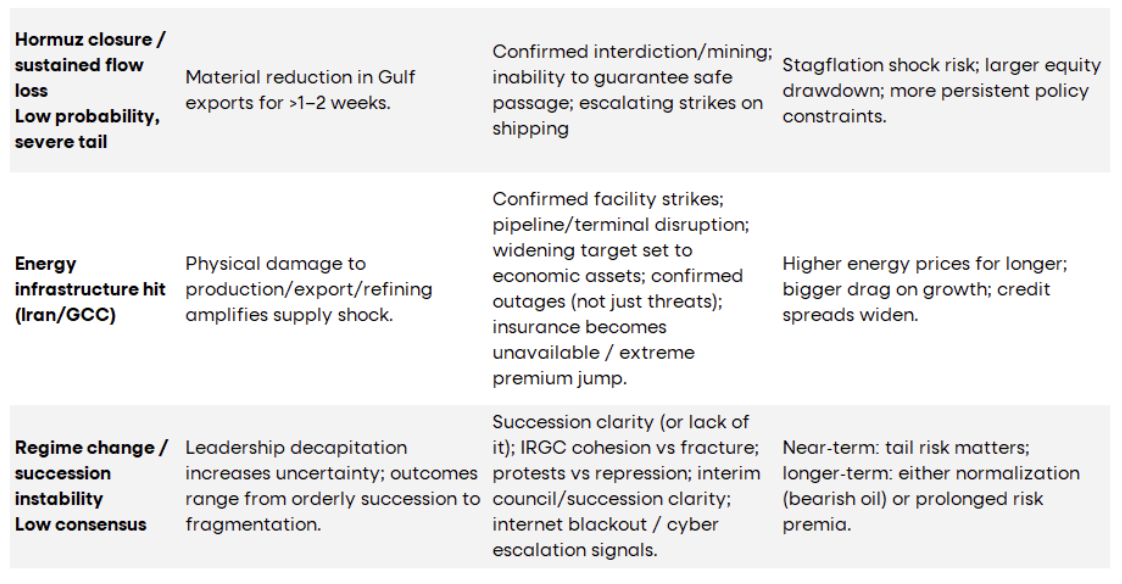
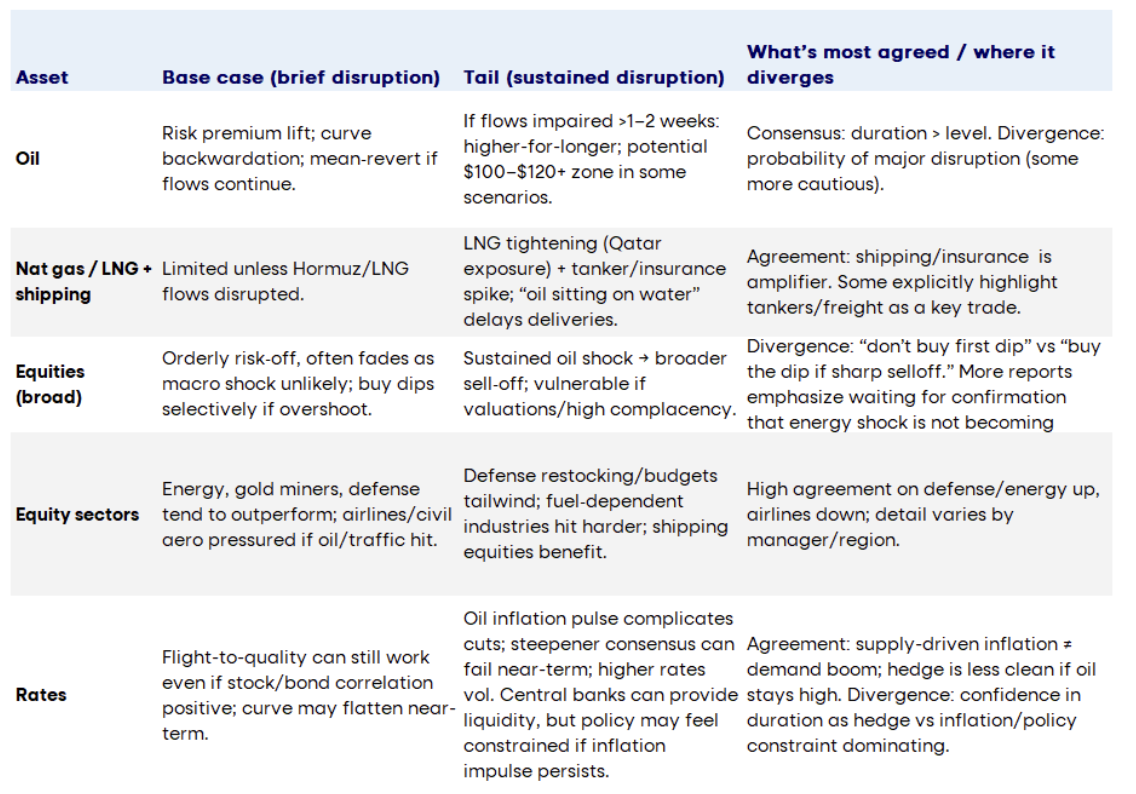
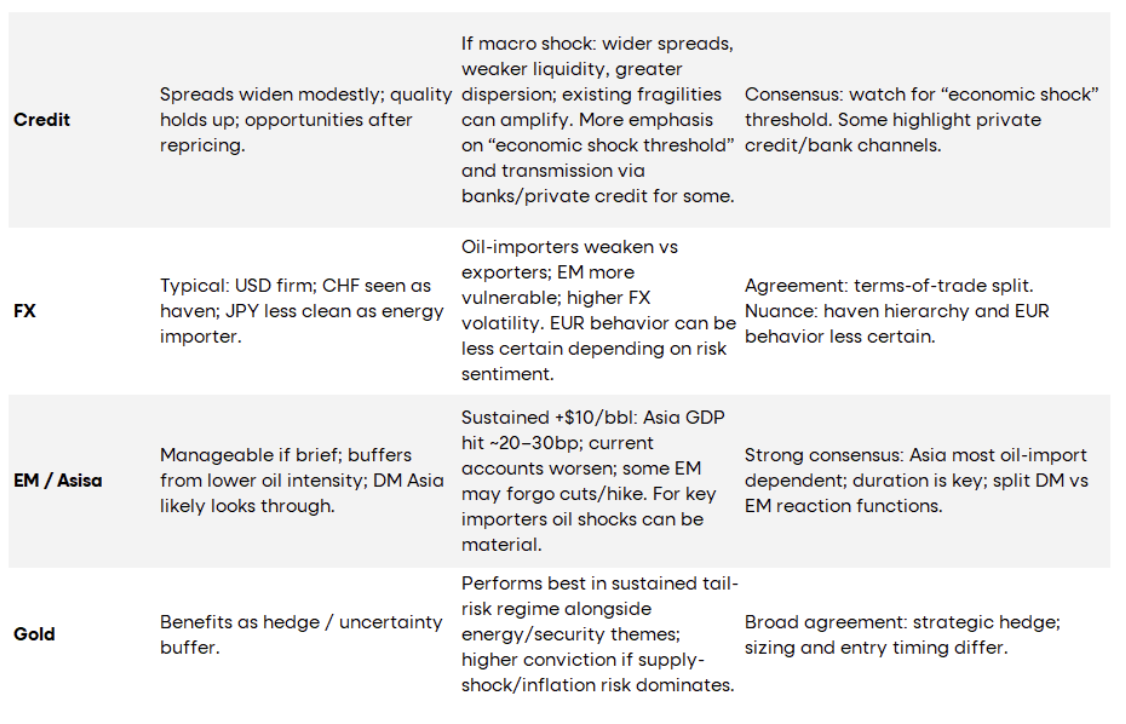
We surveyed a broad cross-section of our underlying managers on the conflict, and their views coalesce around a base case of contained disruption with manageable market spillovers, while highlighting clear tail risks — particularly around energy flows, capital channels, and inflation — that would drive more sustained repricing across asset classes if escalation persists.
A summary of their viewpoints is shown below.
Chart 1: Scenarios
Chart 2: Investment implications by asset class (base vs. tail)
A message from Advisor Perspectives and VettaFi: Discover something new! Click here to register for our upcoming webcasts.
Important information pertaining to the hypothetical example: Past performance does not predict future returns. Return level is proportionately scaled in line with cash level to be overlaid. Source: Russell Investments. Assumptions: Average cash level 1.0%, 10-year history from 12/31/2023, gross of fees. Opportunity cost from not securitizing cash varies by asset allocation and time period, and is represented by horizontal bars as marked within the chart legend. Target asset allocation used: 0% cash, 74% MSCI World, 26% Global Aggregate (GBP Hedged). For illustrative purposes only. Does not represent any actual investment. Indexes are unmanaged and cannot be invested in directly. Performance benefit (net) of overlaying cash by last 5 individual calendar year is as follows: 2023:20 bps, 2022:-17bps, 2021:16bps, 2020:14bps, 2019:23bps.
These views are subject to change at any time based upon market or other conditions and are current as of the date at the top of the page. The information, analysis, and opinions expressed herein are for general information only and are not intended to provide specific advice or recommendations for any individual or entity.
This material is not an offer, solicitation or recommendation to purchase any security.
Forecasting represents predictions of market prices and/or volume patterns utilizing varying analytical data. It is not representative of a projection of the stock market, or of any specific investment.
Nothing contained in this material is intended to constitute legal, tax, securities or investment advice, nor an opinion regarding the appropriateness of any investment. The general information contained in this publication should not be acted upon without obtaining specific legal, tax and investment advice from a licensed professional.
Diversification and strategic asset allocation do not assure a profit or guarantee against loss in declining markets.
Please remember that all investments carry some level of risk, including the potential loss of principal invested. They do not typically grow at an even rate of return and may experience negative growth. As with any type of portfolio structuring, attempting to reduce risk and increase return could, at certain times, unintentionally reduce returns.
The Russell Investments logo is a trademark and service mark of Russell Investments
The information, analyses and opinions set forth herein are intended to serve as general information only and should not be relied upon by any individual or entity as advice or recommendations specific to that individual entity. Anyone using this material should consult with their own attorney, accountant, financial or tax adviser or consultants on whom they rely for investment advice specific to their own circumstances.
Products and services described on this website are intended for United States residents only. Nothing contained in this material is intended to constitute legal, tax, securities, or investment advice, nor an opinion regarding the appropriateness of any investment, nor a solicitation of any type. The general information contained on this website should not be acted upon without obtaining specific legal, tax, and investment advice from a licensed professional. Persons outside the United States may find more information about products and services available within their jurisdictions by going to Russell Investments' Worldwide site.
Russell Investments is committed to ensuring digital accessibility for people with disabilities. We are continually improving the user experience for everyone, and applying the relevant accessibility standards.
Russell Investments' ownership is composed of a majority stake held by funds managed by TA Associates Management, L.P., with a significant minority stake held by funds managed by Reverence Capital Partners, L.P. Certain of Russell Investments' employees and Hamilton Lane Advisors, LLC also hold minority, non-controlling, ownership stakes.
Frank Russell Company is the owner of the Russell trademarks contained in this material and all trademark rights related to the Russell trademarks, which the members of the Russell Investments group of companies are permitted to use under license from Frank Russell Company. The members of the Russell Investments group of companies are not affiliated in any manner with Frank Russell Company or any entity operating under the "FTSE RUSSELL" brand.
© Russell Investments Group, LLC. 1995-2026. All rights reserved. This material is proprietary and may not be reproduced, transferred, or distributed in any form without prior written permission from Russell Investments. It is delivered on an "as is" basis without warranty.
© Russell Investments
Read more commentaries by Russell Investments