Dear fellow investors,
Spring training started in Arizona recently and it reminded us of the 2025 World Series. The series ended a Major League season which was delightful and instructive. First, the favorite and ultimate winner lived and died on home runs (the Dodgers). Secondly, the Toronto Blue Jays did something almost non-existent in today’s game, they hit the ball where it was pitched. This was especially true in their two-strike counts. This strategy almost caused them to beat a much more talented and much more highly paid team.
This flies in the face of what the baseball sabermetrics had told teams to do. Don’t worry about batting averages; instead, get your most powerful hitters more at-bats. This really started with Kyle Schwarber, the Phillies slugger. He was put in the leadoff spot and the team had success from doing so. The Dodgers star, Shohei Ohtani, became the better poster child for the strategy because he also produced a strong batting average and on-base percentage. Therefore, in our mind, Toronto nearly stunned the baseball world and challenged the sabermetrics.
What brought this up was being reminded of how Warren Buffett viewed Ted Williams’ approach to hitting. With less than two strikes, Williams was looking to swing at pitches only in his most favorite parts of the strike zone. These were the spots he would most likely get a base hit or hit a home run. In 1941, Ted Williams had a .406 batting average, and nobody in major league baseball has hit .400 since then.
What were the stock market sabermetrics from 2011 to 2025? The best factors in investing were growth (especially large cap) and momentum. If you bought the best-performing large-cap growth stock of the year every year for 15 years, you would have beaten the S&P 500 Index.
Effectively, in our way of viewing, the U.S. stock market, as represented by the S&P 500 Index, is in a two-strike count. Valuation, psychology, history and economics all argue that this is maybe the most expensive stock market in history. What this means is swinging for the fences is a bad idea, and wise investors should look to hit the ball where it is pitched. This is where they are given a favorable risk-reward relationship over the next five to ten years.
We believe there are pitches to swing at in the oil and gas business. Despite the U.S. government’s effort to drive down oil prices, those prices had been slowly recovering even before the current war efforts in Iran. We like Apache Corp. (APA), Diamondback Energy (FANG) and Occidental Petroleum (OXY). The energy sector of the S&P 500 Index is only 2.8% of the index. Here is a chart of the history of the energy sector as a percentage of the S&P 500 Index: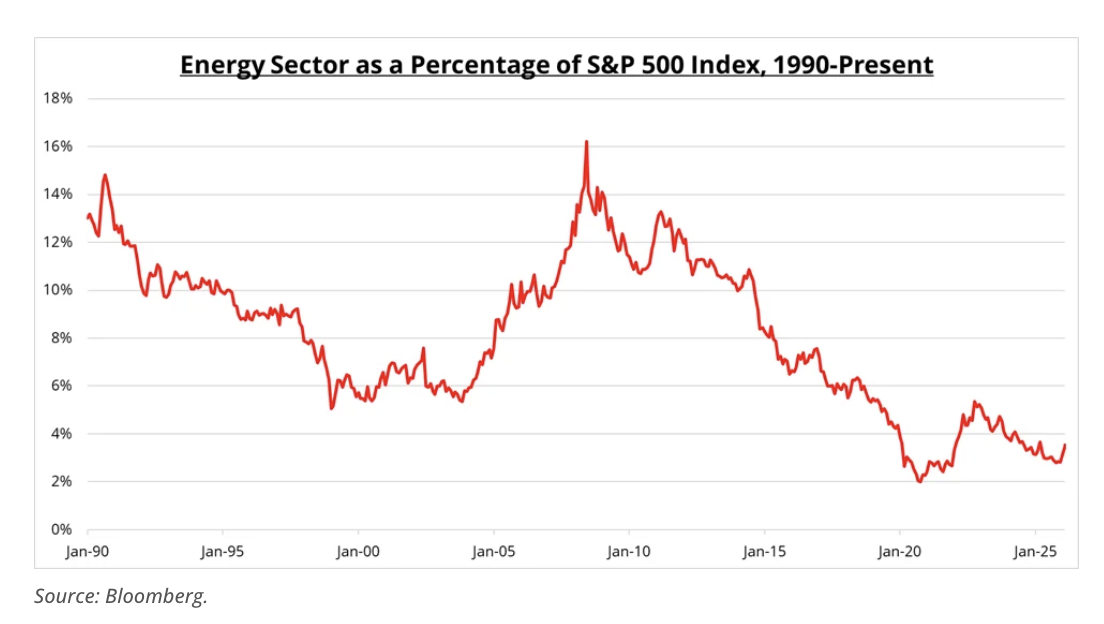
Another good two-strike pitch comes from expecting 25–45-year-old Americans (27% of the U.S. population) to sour on the stock market when momentum dies and their gambling urges get severely punished. When that happens, buying a brand-new home with a 30-year mortgage with tax-deductible interest will make home builders DR Horton (DHI) and Lennar (LEN) look quite attractive. When tech stocks and growth stocks go sour, mortgage rates should decline as investors run to guaranteed interest over capital gains.
