Kitty Hawk, North Carolina is known as the birthplace of aviation. Success did not come overnight. The Wright Brothers spent three years on the Outer Banks experimenting. While they ultimately took flight, the potential downsides of their endeavor were of constant concern.
I was thinking about this historical precedent recently, as debate over the trajectory of AI escalates. We saw a gauge of the tension around AI in the recent attention paid to a scenario envisioning a not-too-distant future in which rapid deployment of AI dooms several prominent firms and generates mass unemployment. Even though its authors took pains to stress that their work was a thought experiment, its implications resonated with those concerned about the downsides of the new technology.
Those who use artificial intelligence (AI) avidly are raving about rapid advancements. The landmark date for the technology was ChatGPT’s public debut on November 30, 2022. The product was the gateway for most users to enjoy their first taste of a large language model (LLM). Many tried it and concluded that it was a novelty, not ready for actual work. The early models guessed and didn’t know their limitations. But newer models are proving to be vastly more capable and accurate.

Software developers report a tremendous change in their experiences. Early LLMs could help to write snippets of code. Today’s models can design databases, launch web servers and take an entire new app online. Early AI could help entrepreneurs write a business plan; today’s models can build whole prototypes of a future business. And if this still seems far from home, consider that prominent holiday and Super Bowl television advertisements were AI-generated.
Despite these exciting developments, general perceptions of AI are apprehensive. Last year was marked by considerable enthusiasm around AI expansion and adoption. In the year to date, there is more worry that AI could disrupt sectors like software, transportation and financial services.
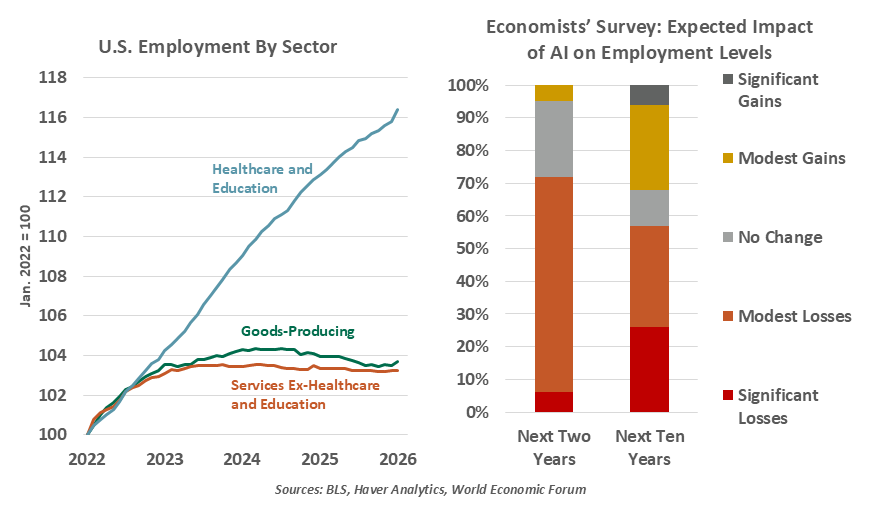
Further, some think that the potential impacts of AI on labor market conditions are becoming more apparent. AI is likely a component of the current low-hire, low-fire labor dynamic, and a reason for the challenges faced by younger workers. Hiring managers face pressure to do more with their existing teams rather than bring on new, junior workers. Business investment in equipment and intellectual property show no decline in appetite for expanding the application of technology.
Workers are wondering if AI might replace their roles. The fears are understandable. Since the Industrial Revolution, new technologies have supplanted workers; spare a thought for the horse carriage coachmen, elevator operators, newsies and typists. AI could automate the workload of a set knowledge workers who had previously considered their careers secure.
All of this raises the question of whether AI will put the economy on a worse trajectory. The research paper takes this to an extreme, and clearly struck a nerve. Observers are highly attuned to the risk of an AI reckoning.
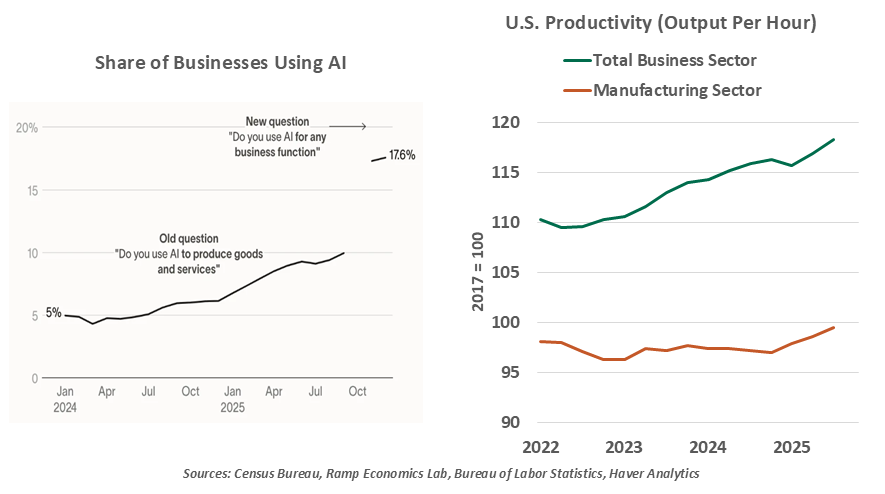
But a close examination of current trends suggests that the alarm may be overdone. Evidence of AI replacement of workers is indirect and anecdotal. Hiring trends have been slower, but this may simply be a reversal of overstaffing which occurred during the period of post-pandemic labor scarcity. This has contributed to some impressive recent productivity gains, but ascribing this progress to AI alone is not consistent with the evidence.
The U.S. Census Bureau found only 10% of firms were using AI in production in 2025; fewer than 20% are now using it for any function. These broad estimates reflect a wide range of experience. The service sector leads: software developers’ workloads have been upended; attorneys can speed document review; consultants may have fewer opportunities to pitch their problem-solving expertise. But sectors requiring hands-on work, from construction to hospitality, have not seen productivity gains from AI-driven automation. A more gradual pace of adoption will offer more opportunity for adaptation.
Critics of the controversial paper noted that technology adoption is rarely so rapid as to cause a shock. Higher productivity should fuel wage gains that would maintain consumption, and new technologies have historically created new jobs. As the legendary economist Joseph Schumpeter observed long ago: creative destruction doesn’t only destroy.
Still, fears of rapid and substantial AI disruption are setting in. If sentiment sours around AI, it may move from a technical to a political challenge. Beyond growing risks to ongoing employment, AI can be felt in higher electricity prices and water shortages. Voters may see more negatives than positives and demand policy remedies.
Already, the European Union has adopted the AI Act, which requires warnings to workers and human oversight of AI deployment to monitor for bias. Nations including Germany, France and Belgium further require worker councils to be consulted in major technology changes. The U.K. is exploring options to retrain displaced workers. While no nation is barring AI or preserving jobs explicitly, these policies are a further reflection of rising anxiety.
The concept of a crash had a very literal meaning for the Wright Brothers. But through extensive trial and error, they were able to stabilize their trajectory and reach higher altitudes. The course of AI remains unclear, but predictions of economic catastrophe are unfounded.
Information is not intended to be and should not be construed as an offer, solicitation or recommendation with respect to any transaction and should not be treated as legal advice, investment advice or tax advice. Under no circumstances should you rely upon this information as a substitute for obtaining specific legal or tax advice from your own professional legal or tax advisors. Information is subject to change based on market or other conditions and is not intended to influence your investment decisions.
© 2025 Northern Trust Corporation. Head Office: 50 South La Salle Street, Chicago, Illinois 60603 U.S.A. Incorporated with limited liability in the U.S. Products and services provided by subsidiaries of Northern Trust Corporation may vary in different markets and are offered in accordance with local regulation. For legal and regulatory information about individual market offices, visit northerntrust.com/terms-and-conditions.
A message from Advisor Perspectives and VettaFi: Discover something new! Click here to register for our upcoming webcasts.
© Northern Trust
Read more commentaries by Northern Trust