A disciplined multi-asset income strategy should draw from a broad range of asset classes, including a healthy mix of equities. But investors who limit their equity exposure to high-dividend stocks may miss out on important growth potential.
A Shrinking Pool of Dividend Payers Could Lead to Concentration
The universe of high-yielding stocks is getting smaller and more concentrated. Many equity markets, especially the US, are dominated by growth companies that usually reinvest profits rather than distribute them to shareholders. Dividend levels are falling as a result, with only a minority of firms now paying 3% yields or higher.
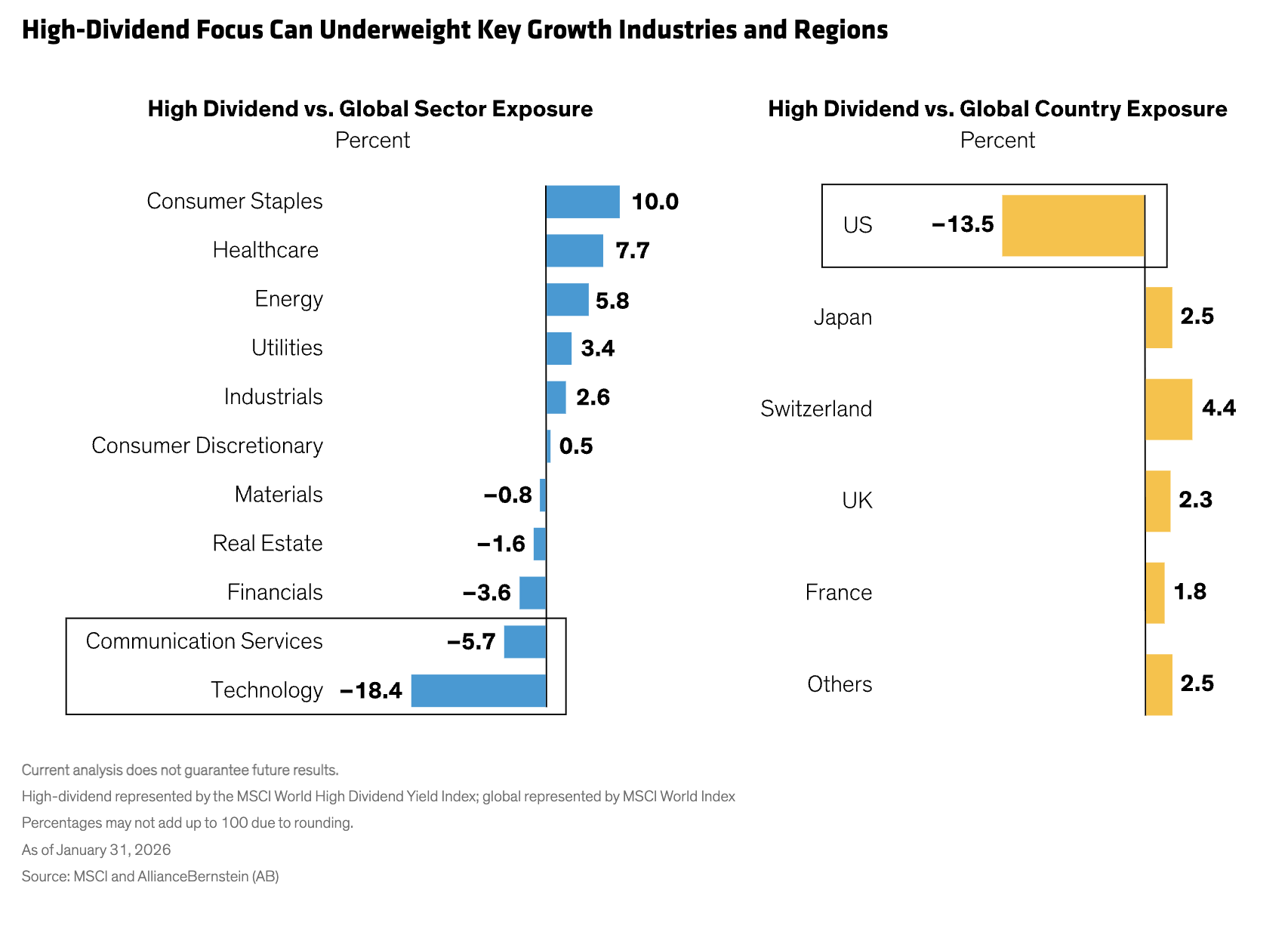
This may lead investors focused solely on income to create unintended biases and miss growth potential. For example, today’s high-dividend universe is underweight both technology and communications, which offer robust growth prospects. It’s also underweight the US equity market (Display); we don’t think investors—even income investors—should ignore what we see as US exceptionalism and AI-driven growth.

By contrast, high-dividend strategies tilt more toward Europe and lean hard into consumer staples, healthcare, energy and other “old economy” sectors known more for high payouts than growth potential. Traditional high-dividend approaches also tend to prioritize defensive sectors, which may be less volatile but also less likely to fully capture market upside.
In our view, this reinforces the principle that multi-asset income investing should harness both dividend generation and growth potential.
Quality Is a Key Ingredient in Income Investing
Whether investors are tapping stocks for dividend or growth potential, we think it’s critical to zero in on the right ones.
Sometimes, high dividends are accompanied by weak fundamentals, whether it’s from the headwinds of declining industries or payouts that are unsustainable. Active quality filters may help avoid such traps by identifying stocks with stable or growing dividends. Based on our research, dividend growers and firms returning cash via both dividends and share buybacks have fared better than those paying high but static dividends.
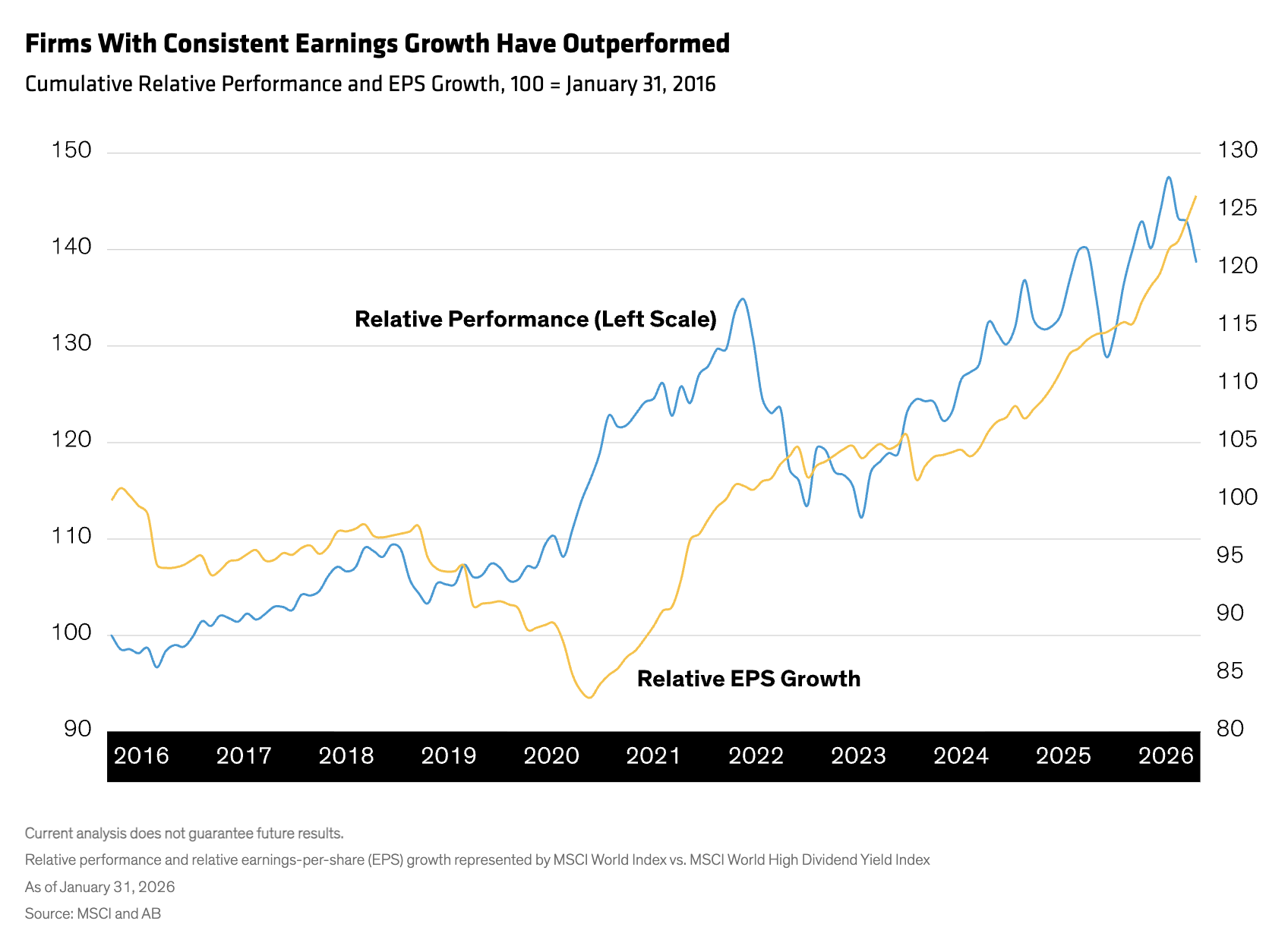
Prioritizing the selection of high dividends at the expense of identifying quality growth could leave a lot of return on the table, as we can see by comparing the earnings growth between global and high-dividend stocks (Display). Over the past decade, quality sources of corporate earnings growth have historically had better upside than purely dividend-focused stocks.
Benefitting from Exposure to Secular Growth Trends
Investing early in select growth companies helps investors tap into today’s secular growth trends like AI, cloud computing, healthcare innovation and others. As we see it, if US equity exceptionalism continues, all the better for income investors who own a share of it through their diversified income strategy. Over time, that exposure has the potential to deliver attractive total returns that outpace inflation, even if it’s not generated directly from dividend income.
In our view, a multi-asset income strategy needs both growth and income to fire on all cylinders. Today’s historically high bond yields means investors don’t have to lean heavily into dividend payers for income on the equity side, leaving room for select growth names that might otherwise be missed, along with their attractive upside potential.
The views expressed herein do not constitute research, investment advice or trade recommendations, do not necessarily represent the views of all AB portfolio-management teams and are subject to change over time.
MSCI makes no express or implied warranties or representations, and shall have no liability whatsoever with respect to any MSCI data contained herein. The MSCI data may not be further redistributed or used as a basis for other indices or any securities or financial products. This report is not approved, reviewed or produced by MSCI.
Daniel Loewy is Chief Investment Officer and Head of Multi-Asset and Hedge Fund Solutions. He oversees the research and product design of the firm’s multi-asset strategies, as well as their implementation.
Karen Watkin is a Senior Vice President and Portfolio Manager for the Multi-Asset Solutions business in EMEA.
Fahd Malik is a Senior Vice President, Co-Head of Multi-Sector Fixed Income and Multi-Asset Portfolio Manager at AB.
A message from Advisor Perspectives and VettaFi: Discover something new! Click here to register for our upcoming webcasts.
© AllianceBernstein
Read more commentaries by AllianceBernstein