The ongoing Middle East war has once again underscored oil’s strategic importance. Vital resources warrant buffers against disruptions in the form of a strategic reserve. These stockpiles are designed not to manage prices day to day, but to insure against sudden or temporary supply disruptions. Unfortunately, not every nation can create this kind of insurance.
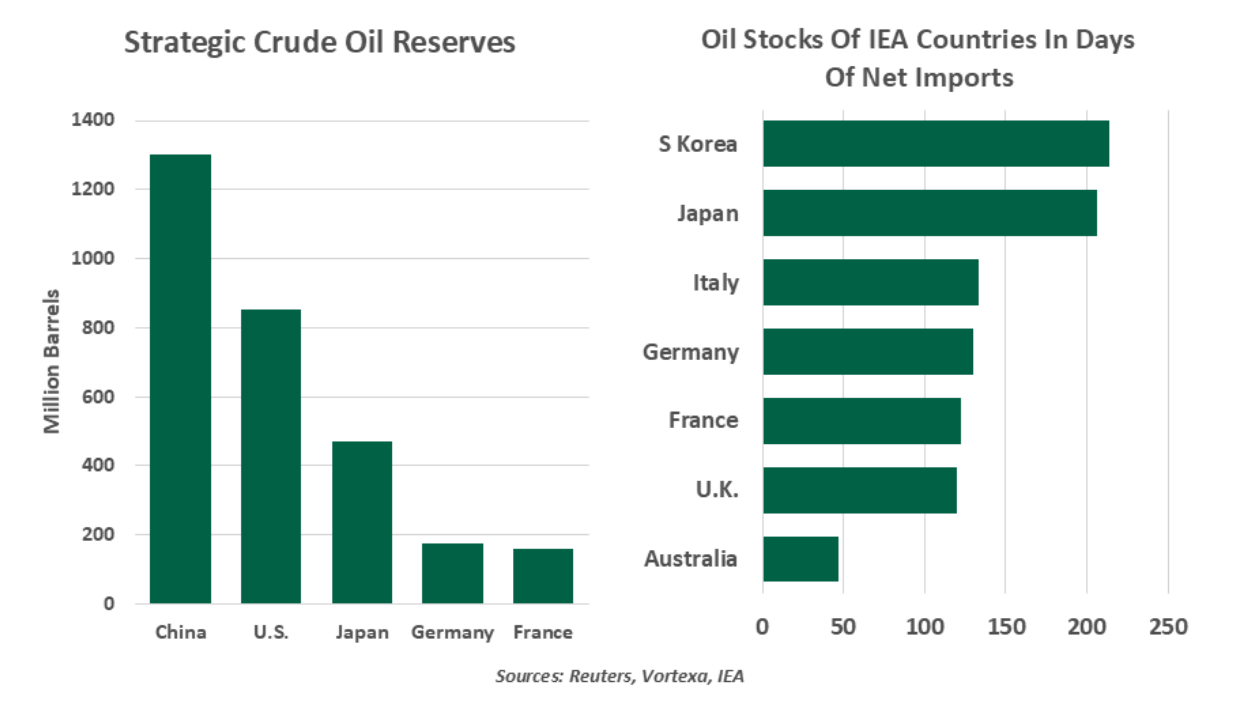
China is estimated to hold the world’s largest strategic oil reserves at roughly 1.3 billion barrels. While China is not a member of the International Energy Agency (IEA), the combined emergency stockpiles of the IEA’s 32 member countries are broadly comparable in size. In addition, around 600 million barrels are held by private industrial firms, which are under government obligation across IEA nations.
Within the IEA bloc, the United States maintains the largest public backstop. The Strategic Petroleum Reserve (SPR) currently holds about 415 million barrels, around 60% of capacity, after heavy drawdowns following Russia’s invasion of Ukraine. This is supplemented by roughly 439 million barrels in commercial inventories. Japan, South Korea and some European economies maintain public and industry-held stocks calibrated to meet the IEA’s 90‑day import coverage requirement. India, the world’s third-largest oil consumer, holds about 100 million barrels in strategic and commercial petroleum reserves, enough to cover roughly 45 days of import volume.
With energy flows severely disrupted by an effective blockade of the Strait of Hormuz, attention has turned to coordinated releases. IEA members have agreed to release roughly 400 million barrels from emergency stockpiles, the largest drawdown in the agency’s history. The U.S. is expected to lead with around 172 million barrels, while Japan plans to release roughly 80 million.
A 400 million barrel release sounds large, but it would replace only about 20 days of the 20 million barrel per day disruption tied to the conflict. Even at maximum capacity, the U.S. SPR can release about 4.4 million barrels per day, with oil reaching markets about two weeks after authorization.












