In the mid-19th century, the Unted States, Spain, Peru, Chile and Bolivia found themselves in a web of hostile negotiations, leading to armed conflict. The disputes all centered on gaining and protecting access to the richest fertilizer then known to the world: dried seabird droppings, or guano. While agricultural best practices have moved on to other resources, the Guano Wars teach us that nations are willing to go to great lengths to sustain their crops.
Modern chemical processes can readily create synthetic fertilizers at scale to provide the three core nutrients that plants require: nitrogen, phosphorus and potassium. Each component plays a part in raising healthy crops. Nitrogen is most important for developing strong stems and healthy leaves, especially for grains.
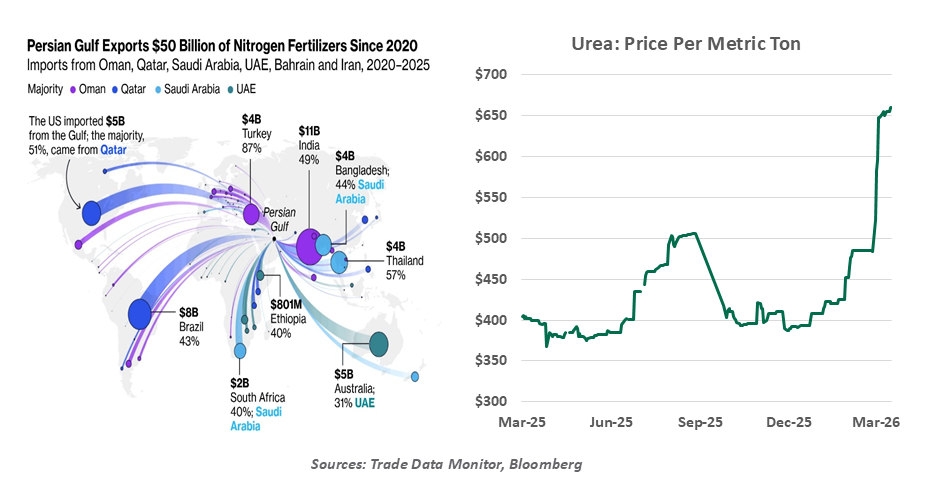
However, those advancements have created a chokepoint. Nitrogen is captured as a byproduct of natural gas extraction. Under high pressure, methane gas reacts with atmospheric nitrogen to produce ammonia, which is then dehydrated into solid urea. This process is only economical to perform where natural gas is abundant; nations in the hydrocarbon-rich Middle East have grown to represent roughly 45% of the world’s supply of urea, exporting nitrogen to farms worldwide.
The timing of the attack on Iran has disrupted the global supply chain for fertilizer. Most farms grow one crop per year. Fertilizer is most effective when applied early in the growing season, which is starting now across the northern hemisphere. Chemicals are not reaching the farms that need them today; once plants are established, fertilizers will not be as beneficial. While urea is a stable compound, bulk fertilizers are low in value and costly to store out of the elements. And producers cannot immediately generate alternative nitrogen compounds at the speed and scale required by the planting cycle.

The disruption is similar to the stress seen in 2022 as sanctions were applied to Russian exports. At that time, Russia supplied about 13% of the world’s fertilizers, and the announcement of sanctions quickly led the prices of phosphate and potash to rise over 35% each. But the market was already realigning. Sanctions on Belarus a year before had reduced its exports, while China had recently restricted its own fertilizer exports to prioritize its domestic farms. Pragmatism won over principle, as the U.S. carved out fertilizer from its Russian sanctions. The European Union did the same soon after. Today’s supply disruption cannot be ameliorated with a simple policy exemption.
While Qatar, Saudi Arabia and the UAE are significant exporters, firms in India, Pakistan, Norway and the U.S. are also among the top producers of urea. Nations that have a domestic supply will thus have some buffer against shortages. Fertilizer supply chains will not be sufficiently nimble or well-supplied to re-route shipments to all nations that need them. Crops and growers in import-dependent nations like Brazil, Australia, France and Indonesia may suffer the worst effects of this crisis. Some nations are now appealing to China to reconsider its fertilizer export ban.
The food economy – indeed, the size of the human population – depends on ready availability of fertilizers. A shortage will not halt farmers from sowing seeds, but crop yields are likely to be lower than normal. We will set our expectations for higher food prices in the year ahead. The Iran attack will add to food and energy prices just as policymakers are struggling to tame a rising cost of living.
The Guano Wars reached their nadir in 1865. Following attacks on U.S. guano-mining vessels, Congress authorized a deployment of the U.S. Navy to protect U.S. claims over uninhabited, fertilizer-rich islands. Gradual de-escalation came through a series of treaties negotiated over a span of decades. History may soon repeat itself, through military protection for agricultural cargo ships…or renewed interest in some unconventional fertilizers.
Information is not intended to be and should not be construed as an offer, solicitation or recommendation with respect to any transaction and should not be treated as legal advice, investment advice or tax advice. Under no circumstances should you rely upon this information as a substitute for obtaining specific legal or tax advice from your own professional legal or tax advisors. Information is subject to change based on market or other conditions and is not intended to influence your investment decisions.
© 2026 Northern Trust Corporation. Head Office: 50 South La Salle Street, Chicago, Illinois 60603 U.S.A. Incorporated with limited liability in the U.S. Products and services provided by subsidiaries of Northern Trust Corporation may vary in different markets and are offered in accordance with local regulation. For legal and regulatory information about individual market offices, visit northerntrust.com/terms-and-conditions.
A message from Advisor Perspectives and VettaFi: Discover something new! Click here to register for our upcoming webcasts.
© Northern Trust
Read more commentaries by Northern Trust