If you’re not sure what direct indexing means, you’re not alone. Even after the recent growth, direct indexing remains relatively unknown. As our risk review team never fails to remind us, you can’t invest directly in an index. So what exactly is direct indexing?
The first thing to note is that the name may be relatively new, but the strategy isn’t. In fact, direct indexing describes what Parametric has been doing for over 30 years: providing an alternative to index mutual funds and passive exchange-traded funds (ETFs) for investors who want more choice, greater flexibility and the potential tax advantages that those commingled investments simply can’t offer.
Direct indexing has been in the news a lot more in recent years. Larger industry players have strategically acquired a number of providers—including Parametric. And many new entrants have entered the space, looking to build on its success.
I’ve written many blogs over the years highlighting some use cases of direct indexing, diving into the details of tax management and risk. But I want to use this opportunity to take a step back, to define direct indexing, to answer some common questions and to help advisors and their clients understand who may stand to benefit the most from it.
What is direct indexing?
Most of us are familiar with mutual funds and passive ETFs, which package underlying securities into a single vehicle accessible to investors. Anyone who purchases shares in a passive index-tracking ETF can gain broad market exposure to the benchmark of their choice— for example, the S&P 500®, the Russell 3000® and so on.
Direct indexing takes this idea in a different direction. Instead of owning shares in a commingled fund, the investor owns the individual securities in the portfolio directly, in a separately managed account (SMA). The investor gets the same kind of broad market exposure but with compelling advantages, including the potential to improve after-tax outcomes. For example, unlike an ETF, direct indexing allows investors to customize their portfolios to actively harvest capital losses from individual securities. We’ll talk more about this below.
What are some advantages of customization?
Direct indexing, done right, also unlocks other powers of customization that allow investors who want broad market exposure to step outside what an index provider decides should be in their portfolios. For instance:
- If the investor has social or environmental principles they’d like to express, they can adjust their holdings to screen out certain industries or companies whose business practices they object to.
- If they have a concentrated position in a particular company’s stock, they can avoid redundant or risk-compounding holdings in their portfolio.
- If they have convictions about certain types of securities—those considered value or momentum stocks, say—they can employ direct indexing to tilt their allocation to favor those characteristics or factors.
- If they need to combine multiple benchmarks to achieve the precise exposure they seek, they aren’t limited to a single benchmark.
In other words, direct indexing takes the one-size-fits-all approach of commingled investing and turns it on its head. This helps advisors add compelling value to a passive portfolio and tailor it to each individual client’s circumstances and values.
What’s more, direct indexing’s direct ownership of individual securities offers powerful flexibility around charitable giving and estate planning. And direct indexing isn’t limited to equities. You can build a direct indexing custom SMA using fixed income, too.
Does all this customization mean direct indexing isn’t truly a passive form of investing? Some subscribe to this reasonable point of view, arguing instead that direct indexing is a unique form of active investing. Regardless of what label we apply, it’s clear that investors increasingly seek ways to capture market-like or beta returns on their own terms—an index of sorts that they can build and control.
Why is tax loss harvesting such an important part of direct indexing?
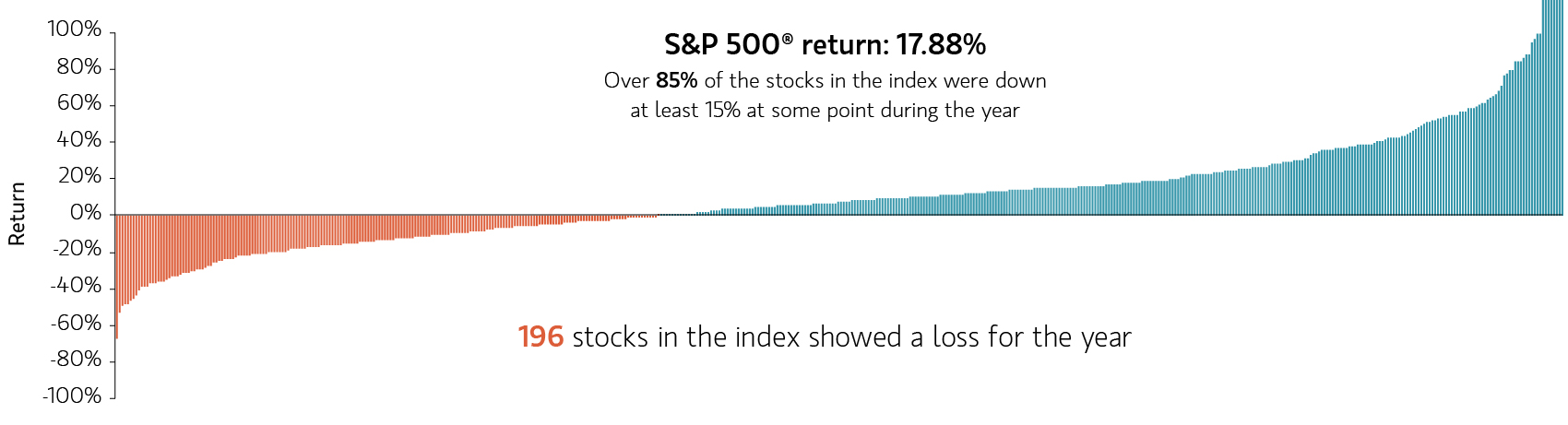
Losses aren’t the goal of any portfolio, and investors generally don’t like to see negative signs in monthly statements—no matter how inevitable they might be in a broadly diversified allocation to stocks or bonds. Even during periods when the broad market and many individual stocks rise in value, quite a few others fall. Here’s an example from 2025, using the S&P 500® Index as a benchmark.
S&P 500® performance in 2025

Overall, 2025 was another strong year for equity markets. Markets navigated volatility around tariff concerns, shifting Federal Reserve policy and economic data, but resilient corporate earnings and broad investor optimism drove overall growth. The S&P 500® finished the year up almost 18%. Despite the positive market, 196 stocks in the index showed a loss for 2025, and over 85% of the stocks in the index were down at least 15% at some point during the year.
Index fund and passive ETF investors in 2025 couldn’t take advantage of the potential losses in their holdings because they couldn’t access them. The losses were locked in the fund. And investors who sold shares would be on the hook for any required capital gains taxes resulting from that fund unit sale.
By contrast, when investors own securities directly rather than indirectly, via owning shares in a fund, they can put those individual losses to work. The SMA portfolio manager can harvest a loss in a given security, and the investor can bank the loss to use in current or future tax years. Then the manager can reinvest the sale proceeds in a similar security—taking care to avoid IRS wash sale1 rules—to preserve the investor’s exposure and risk-return profile.
We think a lot about taxes because investors think a lot about taxes, as recent research by Cerulli Associates has revealed. But many investors and their advisors may not be aware that taxes can be a bigger drag on portfolio performance than fees or trading costs. That’s why we don’t wait for the end of the year to begin harvesting losses. To make sure our clients aren’t missing out on opportunities, we harvest losses systematically, throughout the year. Third-party research has shown that tax management can add 1%–2% in after-tax excess returns.2
Is direct indexing right for all investors?
Direct indexing’s benefits can vary depending on an investor’s profile, but the types of investors who may see the greatest value from it include those who:
- Are in a higher tax bracket, so they may have more taxes to save
- Have a long-term investment focus, so they may reap more benefits from tax deferral
- Express convictions about responsible investing, so they may appreciate values-related customization
- Fund a portfolio with existing securities, so they may see real tax savings over selling all positions and reinvesting in a commingled fund
Those whose profiles don’t align with one or more of these traits might not see as many benefits to direct indexing—especially after taking costs into account. Compared with commingled vehicles such as ETFs, custom passive SMAs have higher fees and more operational complexity. And because direct indexing involves customizing the broad market allocation, performance can deviate from the investor’s chosen benchmark returns—often referred to as tracking error. Investors seeking to take advantage of direct indexing’s benefits must be willing to tolerate some carefully managed tracking error.
For these reasons, many investors who don’t naturally benefit from customization may continue to get market exposure through funds and passive ETFs. But we would stress that funds, passive ETFs, direct indexing and even active management aren’t mutually exclusive: All have important roles to play in the investment ecosystem.
The bottom line
Direct indexing continues to grow in popularity and expand its range of use cases. More and more investors are beginning to see the potential benefits of direct indexing, which can be a powerful tool to help them take greater control of their broad market holdings, while seeking to realize more after-tax value from them. The hype has been fun to watch, but at Parametric we’re just happy that a strategy we pioneered and refined over the past 30 years is increasingly being discovered.
1 In a wash sale, the same security sold for a loss is purchased 30 days before or after the sale. If a transaction violates the rule against wash sales, the IRS can disallow the loss deduction and add the loss to the cost basis of the repurchased security, which can effectively defer the benefit of the loss.
2 Shomesh E. Chaudhuri, Terence C. Burnham and Andrew W. Lo, “An Empirical Evaluation of Tax-Loss-Harvesting Alpha.” Financial Analysts Journal, Q3 2020, 76:3, 99–108. This study did not involve Parametric or its clients. There is no guarantee that a tax-management strategy will result in increased after-tax returns. Results will differ based on an individual investor’s circumstances.
A message from Advisor Perspectives and VettaFi: Discover something new! Click here to register for our upcoming webcasts.
Parametric and Morgan Stanley do not provide legal, tax or accounting advice or services. Clients should consult with their own tax or legal advisor prior to entering into any transaction or strategy.
The views expressed in these posts are those of the authors and are current only through the date stated. These views are subject to change at any time based upon market or other conditions, and Parametric and its affiliates disclaim any responsibility to update such views. These views may not be relied upon as investment advice and, because investment decisions for Parametric are based on many factors, may not be relied upon as an indication of trading intent on behalf of any Parametric strategy. The discussion herein is general in nature and is provided for informational purposes only. There is no guarantee as to its accuracy or completeness. Past performance is no guarantee of future results. All investments are subject to the risk of loss. Prospective investors should consult with a tax or legal advisor before making any investment decision. Please refer to the Disclosure page on our website for important information about investments and risks.
03.24.2028 | RO 5331554
Investment advisory services offered through Parametric Portfolio Associates LLC ("Parametric"), an investment advisor registered with the US Securities and Exchange Commission (CRD #114310). Parametric is also registered as a portfolio manager with the securities regulatory authorities in certain provinces of Canada (National Registration Database No. 42850) with regard to specific products and strategies. Parametric provides advisory services directly to institutional investors and indirectly to individual investors through financial intermediaries. The information on this website does not constitute an offer to sell, or a solicitation of an offer to purchase, securities in any jurisdiction to any person to whom it is not lawful to make such an offer. Investing entails risks, and there can be no assurance that Parametric (and its affiliates) will achieve profits or avoid incurring losses. All investments are subject to potential loss of principal. Parametric does not provide tax or legal advice. Prospective investors should consult with a tax or legal advisor before making any investment decision. Please refer to the disclosure page for important information about investments and risks.
S&P Dow Jones Indices are a product of S&P Dow Jones Indices LLC (“S&P DJI”) and have been licensed for use. S&P® indexes are registered trademarks of S&P DJI; Dow Jones® is a registered trademark of Dow Jones Trademark Holdings LLC (“Dow Jones”); S&P DJI, Dow Jones, and their respective affiliates do not sponsor, endorse, sell, or promote Parametric and its strategies, will not have any liability with respect thereto, and do not have any liability for any errors, omissions, or interruptions of the S&P Dow Jones Indices.©2026 Parametric Portfolio Associates LLC. All rights reserved. 800 Fifth Avenue, Suite 2800, Seattle, WA 98104.
© Parametric
Read more commentaries by Parametric