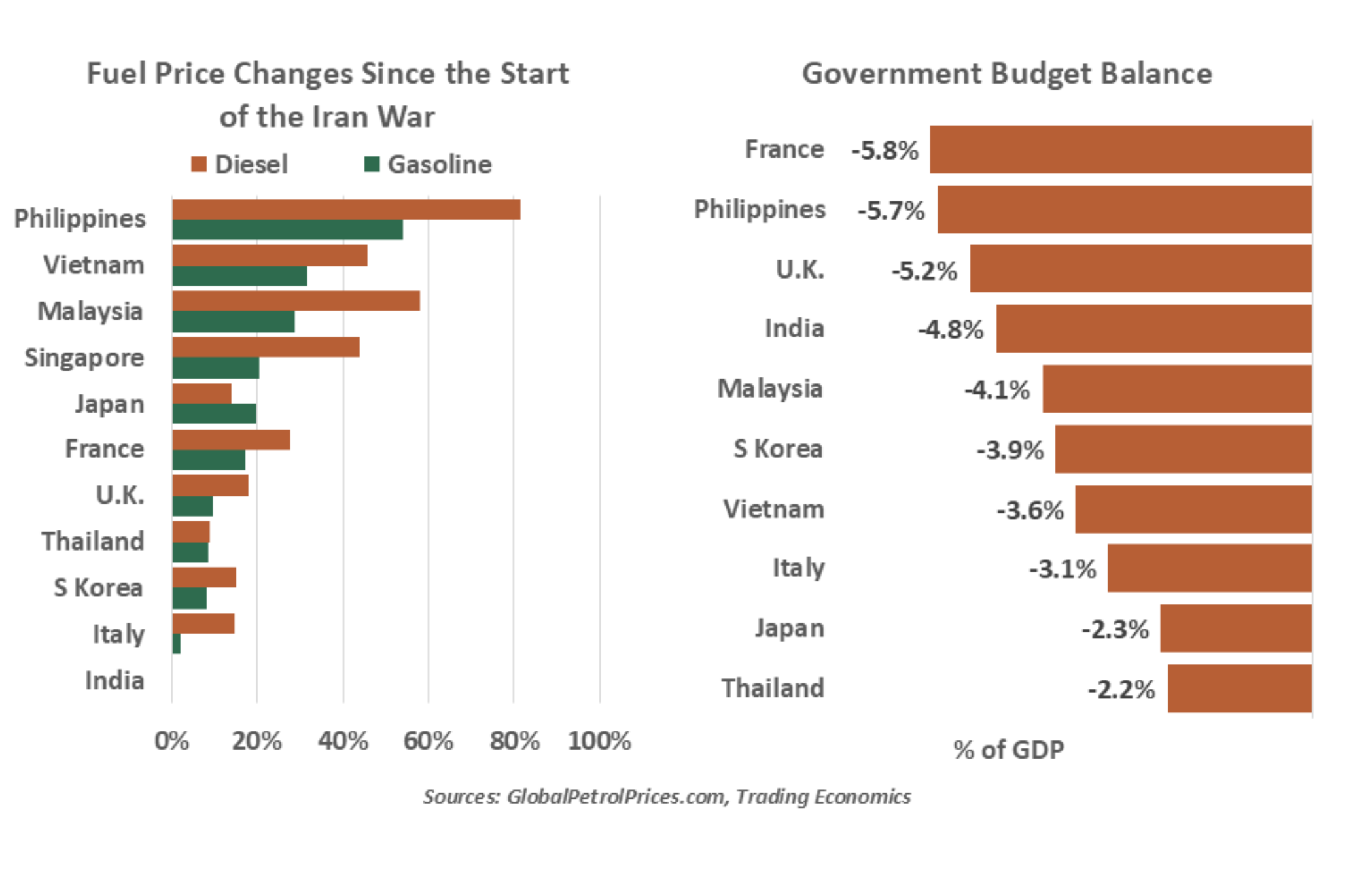
Sharp moves in energy prices rarely arrive at a convenient moment for policymakers. When shocks occur, governments are left juggling two competing imperatives: cushioning households from rising costs while preserving fiscal credibility. The latest energy crisis has once again forced governments to step in, absorbing a blow that consumers neither caused nor can easily manage.
Across much of Asia and Europe, the policy response to the war’s economic impact is following a familiar arc: early intervention to smooth the inflation hit, followed by growing concern over how long supportive measures can be sustained before the fiscal commitment becomes too great.
The policy toolkit across the globe ranges from subsidies and price caps to direct cash support. The goal is to limit the immediate impact on household budgets and inflation expectations, even if it means pushing costs onto public balance sheets.

That trade‑off is particularly stark in Asia, where inflation is far more sensitive to energy costs than it is in most developed economies. Fuel costs pass through quickly to consumer prices, not only via transport and utilities, but also through food due to higher fertilizer costs. Energy and food account for as much as half of consumer inflation baskets in parts of emerging Asia, compared with roughly 30% in Europe. As a result, a 10% increase in oil prices can raise headline inflation by around half a percentage point in some Asian economies.
Large swings in the costs of essentials tend to have a disproportionate impact on public sentiment. This explains why governments in the region have been among the most proactive. The Philippines is leaning on targeted cash transfers to cushion transport workers. South Korea has introduced a nationwide cap on gasoline and diesel rates, its first such intervention in nearly three decades. Vietnam is relying on the use of its fuel price stabilization fund and adjustments to taxes and fees. India has limited cost adjustments mainly to cooking gas, with state‑owned oil marketing companies absorbing higher oil prices by compressing margins.
In the developed world, the Japanese government has introduced subsidies to cap gasoline costs. Germany has limited the frequency of fuel price changes at the pump to curb volatility. Italy has cut excise duties and has asked oil companies to limit pump rates. In the U.K., the government has pledged £53 million in targeted support to vulnerable households reliant on heating oil.
These measures provide relief, but they have limits. Temporary payments help ameliorate consumers and reduce the risk of unrest, but they cannot offset persistently higher fuel costs. Subsidies and price controls are costly to sustain: budget pressures are already evident in places where subsidy bills are rising rapidly. The Thailand government has abandoned its price cap on gasoline after less than a month, a stark sign of how surging global crude costs are threatening fiscal limits. Fiscal subsidies are expected to cost 0.2%-0.5% of gross domestic product this year in a number of Asian economies.
European governments entered this shock with fiscal balances already stretched by pandemic support and the earlier energy crisis following Russia’s invasion of Ukraine. The challenges are compounded by the desire to find fiscal balance and raise spending on national security, especially for France and the U.K. While Europe’s fiscal rules could once again be suspended if the conflict proves prolonged, many governments may be reluctant to borrow more aggressively at a time of already strained public finances.
The longer energy prices remain elevated, the harder it becomes to sustain broad‑based support. Governments may be able to buy time, but markets will be sensitive to how that time is financed.
Information is not intended to be and should not be construed as an offer, solicitation or recommendation with respect to any transaction and should not be treated as legal advice, investment advice or tax advice. Under no circumstances should you rely upon this information as a substitute for obtaining specific legal or tax advice from your own professional legal or tax advisors. Information is subject to change based on market or other conditions and is not intended to influence your investment decisions.
© 2026 Northern Trust Corporation. Head Office: 50 South La Salle Street, Chicago, Illinois 60603 U.S.A. Incorporated with limited liability in the U.S. Products and services provided by subsidiaries of Northern Trust Corporation may vary in different markets and are offered in accordance with local regulation. For legal and regulatory information about individual market offices, visit northerntrust.com/terms-and-conditions.
A message from Advisor Perspectives and VettaFi: Discover something new! Click here to register for our upcoming webcasts.
© Northern Trust
Read more commentaries by Northern Trust