The Energy Tax
Membership required
Membership is now required to use this feature. To learn more:
View Membership BenefitsAs noted a few weeks ago, we get conflicting data that must not be extrapolated. The motto of the US Marines is a good one for all of us for the coming years: improvise, adapt and overcome. I would add, then adapt again.
Today let’s look at some of the week’s conflicting data, then end on a positive note about adapting. Easter Weekend is always a good time for reflection and in that spirit adapting can be its own form of redemption.
But first, I want to offer my sincere thanks to all of you, in a world where we are overwhelmed with information, you choose to give me what is quickly becoming one of the most precious commodities in the world: your attention. I strive to be worthy.
This letter has been free for 26 years and is in your inbox every weekend. The biggest source of my readers is from referrals. I don’t do this very often, but I would really appreciate it if you would send a note to some of your friends and offer them an opportunity to join you. You can cut-and-paste (and of course, improvise) this paragraph if you like.
I have been reading John Mauldin and his weekly Thoughts from the Frontline for many years. He is one of my best sources of information on economics and finance, and has a steady, balanced approach. His letter is free and you can subscribe at https://www.mauldineconomics.com/frontlinethoughts. Then let’s talk about what it means and what we can do as we navigate the current rapids of history.
Thanks ever so much. I appreciate it more than you can know. Now let’s look at the data: first on energy which we all know is a problem, and then at unemployment, which had a great headline number of 178,000 new jobs but when we look under the hood it is more of a mixed bag.
The Energy Tax
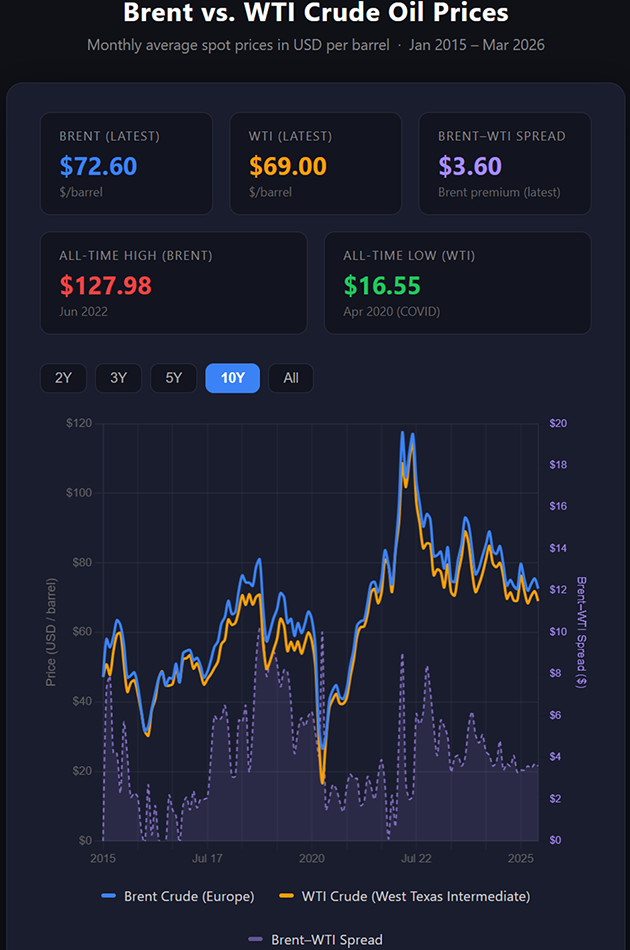
As I write Friday morning, there is a strange phenomenon in the energy markets. Typically the price of Brent oil is about five dollars higher than the price of oil as measured by WTI (West Texas Intermediate). Right now WTI is $111.54 and Brent is $109.24. While rare, it has happened but it is always corrected in the near term. The graph below comes from Claude and is not updated through the last week but you can get a sense of the price comparison. They obviously track together but Brent is typically higher.
I have written for years that oil prices act like a tax on the economy, both in the US and globally. It is actually simply the price paid, but the effect on the economy is similar to a tax. If the price goes up, it takes more money from individual consumers that would otherwise be saved or spent somewhere else. Just like taxes.
The growth of the global economy is really the growth in energy and how we use it. When energy becomes scarce or high-priced, it is necessarily going to reduce global GDP. It will reduce GDP much more in some countries than others, depending on their need for both energy and its related products like fertilizers, plastics, and all the things that energy produces.
The Strait of Hormuz is a big deal. About 20% of the world's oil consumption, 20% of LNG and 25% of seaborne oil trade passes through the Strait of Hormuz.
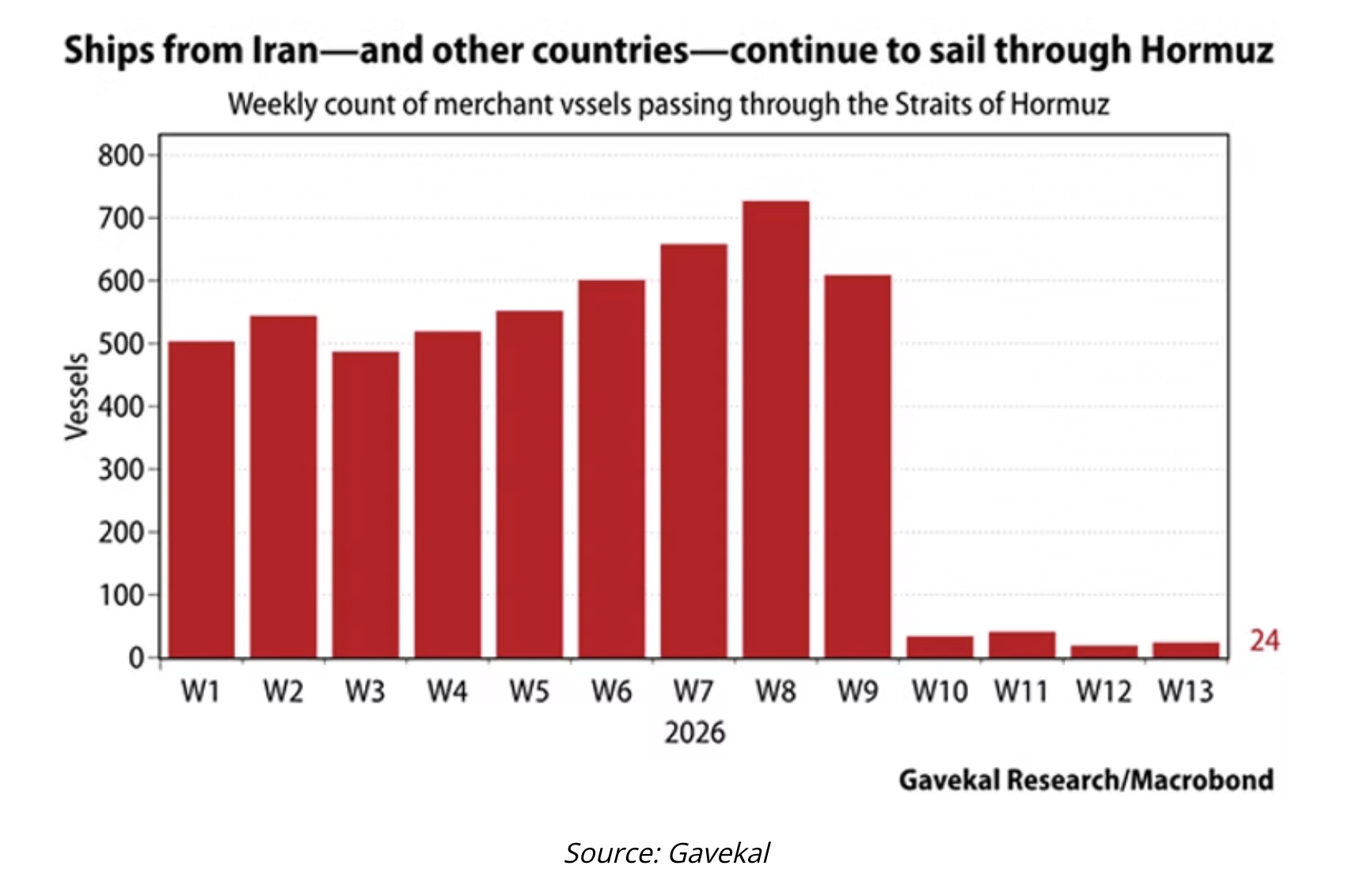
From my friends at GaveKal:
“Before the war, an average of around 25 tankers a day laden with 20mn bbl of oil exited the Gulf for the rest of the world, mostly bound for Asia. If the US$2mn fee is standard, and if Iran also levies its fee on inbound ships in ballast, the toll implies an additional US$5/bbl on the price of Gulf oil shipped out from Hormuz. Globally, this equates to an extra US$1/bbl on the prices of the main oil benchmarks. And if the fee applies to all commercial vessels, not just tankers, it implies an extra US$50bn in annual revenue for the IRGC.
“In the near term, this prospect implies the death of Dubai as a transshipment hub. It also provides a major incentive for the Gulf Arab energy producers to develop pipeline links to alternative export terminals outside the Persian Gulf.
“This will be relatively easy for Saudi Arabia which already has an export terminal on the Red Sea, and for the United Arab Emirates, which has one on the Gulf of Oman. It will be far harder and more expensive for Qatar, Kuwait, Bahrain and Iraq. And of course, it also gives hydrocarbon importers, especially in Asia, an additional incentive to develop alternative sources of energy supply.”
The UAE and Saudi Arabia have reportedly strongly opposed any control of the Strait by Iran and encourage the United States to not let up until the Strait has been opened. This is an energy tax on the world by one country denying freedom of navigation. If that $50 billion in additional revenue goes to Iran, is there any doubt that it would end up in the hands of their terrorist proxies? The mullahs are not rational actors. They are religious nut jobs. In my personal opinion, if you’re going to start a project then finish it. I agree with Newt Gingrich, that giving Iran control of the Strait of Hormuz after we have started the war and decimated the country’s military prowess would be a defeat. I hope Trump’s conflicting rhetoric is simply his way of bringing more support from both regional and European allies, not to mention China.
75% of global trade goes through 13 marine chokepoints. Not all of them are controlled by economic allies. What perhaps started out as a war to end the nuclear capabilities and terrorist activities of Iran is morphing into a freedom of navigation issue which is a much more global problem.
While toll fees would be significant, another problem is war-risk insurance. Premiums have surged from $40,000 per Very Large Crude Carrier (“VLCC”) transit before the war to $600,000 to $1.2 million today, a 30-fold increase, now running five to ten percent of hull value. A VLCC carrying $50 million in crude oil can absorb a combined $3 million in toll and insurance as a fraction of cargo value. A container ship carrying $5 million in manufactured goods cannot. The insurance premium alone exceeds the profit margin on non-oil cargo. The strait has become an oil-only VIP lane. Crude flows selectively for those who can pay the combined cost. Everything else waits, reroutes around the Cape of Good Hope, or does not move at all. … One hundred and eighty-one vessels transited in all of March. Pre-war traffic was 138 per day. Of those 181, roughly 70 percent were Iranian-affiliated. The remaining 30 percent were vetted allies or yuan-paying neutrals. The 20 percent of global oil that once flowed freely through this strait now flows selectively, conditionally, and in currencies chosen by Tehran. Source: Shanaka Anslem Perera @shanaka86 (vetted by Columbia Professor Adam Tooze)
Gulf countries are also major producers of fertilizers and fertilizer inputs, including sulfur (roughly 50 percent of global production), urea (more than 30 percent) and ammonia (roughly 25 percent), in addition to natural gas, a key component in the production of nitrogen fertilizers. As a result, prices have shot up (for example, urea futures have risen more than 70 percent since the start of the year, reaching their highest level since October 2022), fueling fears about another round of food inflation. In reality, the effect of Hormuz’s closure on fertilizer availability and food prices will not be felt immediately, but the situation will likely become severe over time. (H/T Geopolitical Futures)
Part of the reason is that the southern hemisphere is in harvesting period so they need less fertilizer. But that doesn’t mean they aren’t reacting: 11 Asian countries have already officially curtailed their energy usage, from rationing to business and school closures etc. As the war goes on, that will increase.
The reality is we have no idea what is going to happen. Will Trump use ground troops? And if so, where? What will be the response by Iran? Will they decide to take out a few energy complexes in the UAE Saudi Arabia and Qatar? With the response be to reduce theirs? That would certainly have a significant impact on future oil prices as we are told it will take five years to repair the one facility in Qatar that was damaged.
Will Iran essentially end up with control over the Strait of Hormuz and charge whatever rate they want?
Then again, the other possibility is the US and its allies open the Strait with Venezuela like precision. Right now that looks difficult but not being a general nor the son of a general I simply don’t know and frankly, no one does. The enemy gets a vote.
The longer the war goes on, the longer it will take to bring production back in line, even if there are no additional production facilities damaged or destroyed. This is a thick pea soup fog of war.
Muddle Through Unemployment Numbers
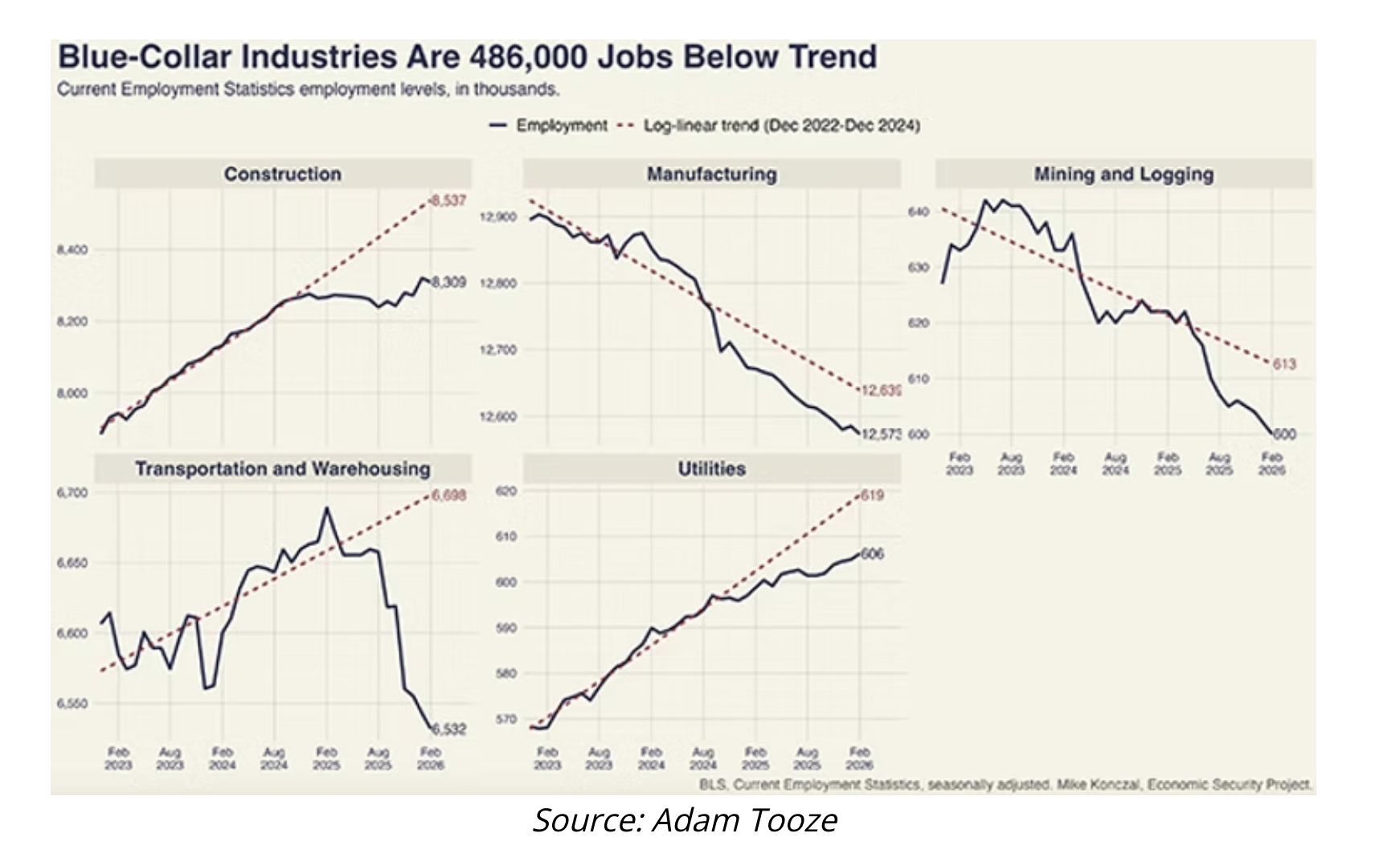
We all know that unemployment is been soft. This can be seen in the chart below from Adam Tooze. “Blue-collar industries” are 486,000 jobs below trend for the last four years. This is obviously not just AI.
But let’s look at the Friday’s employment report (from Peter Boockvar):
“In March, payrolls jumped by 178k, after falling by 133k in February, well more than the estimate of 65k and the two prior months were revised down by a total of just 7k. About all of the upside was in the private sector, including a surprise rise in manufacturing employment of 15k vs the estimate of a loss of 5k. …Smoothing out the healthcare strike impact and everything else, the 3-month job gain average is at 68k vs the 6-month average of 15k and the 12-month average of 22k. Of course, from here, everything with respect to hiring/firing depends on the length of the war and how companies absorb the higher cost of raw materials and possible shortages of things and how they manage their total cost structure around that, including labor, their biggest cost.”
There was another relatively positive, if still week, data. ADP said a net 62k private sector jobs were created in March, 22k more than forecasted and follows an increase of 66k in February. Very small businesses drove almost all the job growth, with firms with 1-19 employees adding 112k workers while those with 20-249 employees losing workers and the same with companies with more than 500 employees.
In the Challenger report, hiring plans jumped 157% in March from February and up 149% y/o/y. Though year to date, hiring is down 6% y/o/y.
The BLS Job Report Smells like Future Revisions
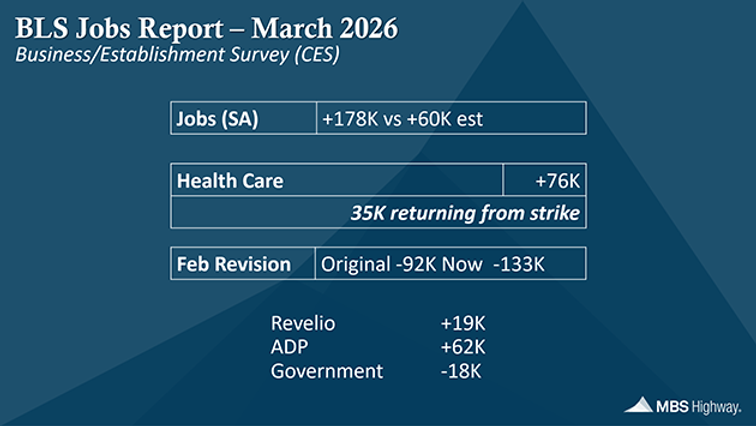
Let’s quickly jump to my friend Barry Habib’s analysis, looking at a few of his charts. This first table shows the much higher than estimated jobs report, but also notes that February’s large 92,000 job loss was increased to 133,000. Revelio and ADP, which do not count government jobs, showed far fewer jobs. As has been typical lately, for reasons I have written about, monthly job reports have been significantly revised downward for almost 2 years. The discrepancy between ADP and Revelio suggest that we will be seeing downward revisions to the March number.
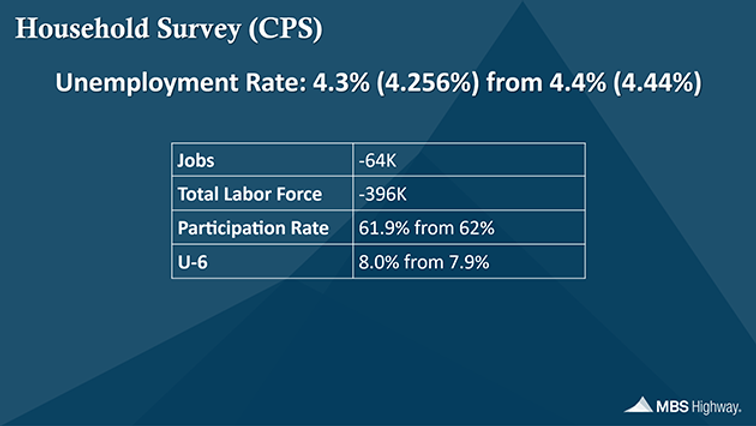
The actual unemployment rate comes from the household survey. The household survey showed a loss of 64,000 jobs. The headline shows a positive move in unemployment downward to 4.3%. The reason for the discrepancy is that 396,000 people dropped out of the labor force, dropping the participation rate slightly while the U-6 unemployment numbers rose to 8%.
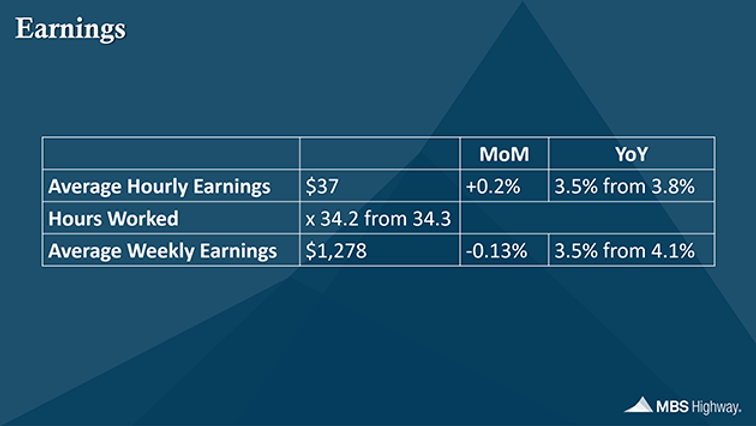
Wages and earnings softened. A 0.2% month over month increase in average hourly earnings is anemic, and dropped the year-over-year rate to a nominal 3.5%, which is roughly where inflation is. Workers are losing ground.
With inflation certain to rise due to energy and other issues, all this makes for a very difficult decision period for the Federal Reserve. Unless there is a turnaround, it’s going to be hard for them to justify an interest rate cut this summer. A lot will depend on how the war is concluded and how quickly things can return to “normal.”
Make It Easy for Me
My close friend Renè Aninao is one of the best geopolitical and economic analysts I know. His letter is in depth and there is a reason the largest funds and governments in the world pay significant fees to have access to his thinking. When I get a note from him, I try and drop everything and read.
Last night I got a special note more in keeping with the theme of Easter and redemption. Renè is a jazz enthusiast and he digs into the history of jazz to give us a lesson on not just adapting to a potential negative situation, but making it a positive. Note that when Renè says that he is “very Miles” what he means is that his letter is also free-flowing and adaptive just like the original Miles Davis who many of us enjoyed in our youth. Quoting:
Those of you who’ve been with us since Day 1 know the ethos of this firm and all of our colleagues and partners is very “Miles.”
Herbie Hancock, the pianist in the Second Great Quintet, once recounted the story of striking the wrong chord while playing a rendition of Miles Davis’ classic “So What” during a concert in Germany. But since the words are so important, it’s transcribed for you below.
***
“Right in the middle of one of Miles's amazing solos, I played the wrong chord.
A chord that just sounded completely wrong. It sounded like a big mistake.
And I put my hands around my ears.
Miles paused for a second.
And then he played some notes -- that made my chord right.
He made it correct.
Which astounded me, I couldn't believe what I heard.
Miles was able to make something that was wrong, into something that was right, with the power of his choice of notes and the feeling that he had.
What I realize now is that Miles didn't hear it as a mistake. He just heard it as something that happened, an event.
And so that was part of the reality of what was happening at that moment. And he dealt with it.
He found something. And since he didn't hear it as a mistake, he felt it was his responsibility to find something that fit. And he was able to do that.
That taught me a very big lesson -- not only about music, but about life.
We can look for the world to be as we would like it to be as individuals.
"Make it easy for me."
That sort of idea, we can look for that.
But I think the important thing is that we grow. And the only way we can grow is to have a mind that's open enough to accept and experience situations as they are.
And turn them into medicine. Turn poison into medicine. Take whatever situation you have and make something constructive happen with it.
That's what I learned from that situation with Miles.”
***
Whether it is musicians or warfighters or policymakers or market participants. It is all the same thing.
John here: what Renè means by the “same thing” is the need to adapt. Yes, improvise and overcome. I think most of us understand that the coming years are going to be a little more chaotic than most, both from positive technological change the negative economic factors. The lesson here is that we may not control the circumstances, but we can control our response and actions. And while we work to make our lives and portfolios as anti-fragile as possible, we all know that challenges will arise. How we respond makes all the difference
West Palm Beach, Washington DC, New York, and Boston
Next Friday, I will attend a very large longevity conference (A4M) in Palm Beach. The following Monday, I will open our Lifespan Edge clinic in West Palm Beach, with another to be opened soon in Columbia, Maryland (DC). Then I fly directly to DC and New York for a series of dinners and meetings. The SIC starts in early May, and then I have no trips scheduled until Boston for another Inner Circle gathering in early June.
More and more, longevity experts are telling their clients: the first part of your journey should begin with Therapeutic Plasma Exchange which deals with inflammation, Alzheimer's and dementia, and other symptoms of aging. You can learn more at Lifespan-Edge.com. If you haven't, you really need to read our main research report. The research and other information (plus our fabulous documentary) can make a real difference in your life. You can set up a discovery call to talk with our doctors about the procedure, as well as look at a lot more research. We now have clinics opened in Dallas, Dorado Beach, West Palm Beach and shortly in DC. We are in serious discussions with numerous other potential partners. It’s starting to get fun.
I had more than a few readers point out that Tony Stark’s name is not Tony Starks. I knew that. I was just making his name plural, as I talked about a number of young inventors. But thanks for all the comments, I really do appreciate them.
It’s time to hit the send button. Let me wish you a very happy Easter or Passover. In the midst of all the chaos, it is good to reflect upon the eternal. To think about what really matters. I hope you can enjoy it with family and friends. Have a great week!
Your constantly adapting analyst,
John Mauldin
A message from Advisor Perspectives and VettaFi: Discover something new! Click here to register for our upcoming webcasts.
Membership required
Membership is now required to use this feature. To learn more:
View Membership BenefitsSponsored Content
Upcoming Virtual Events View All












