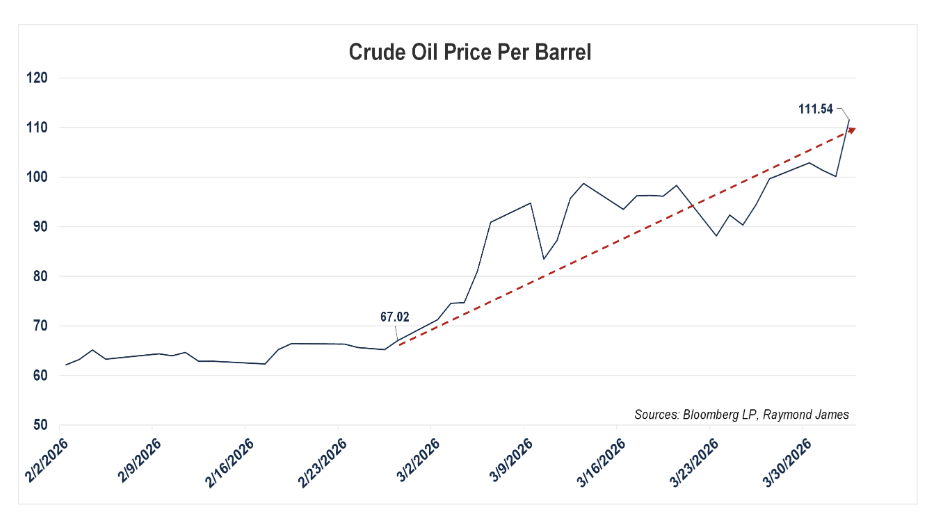
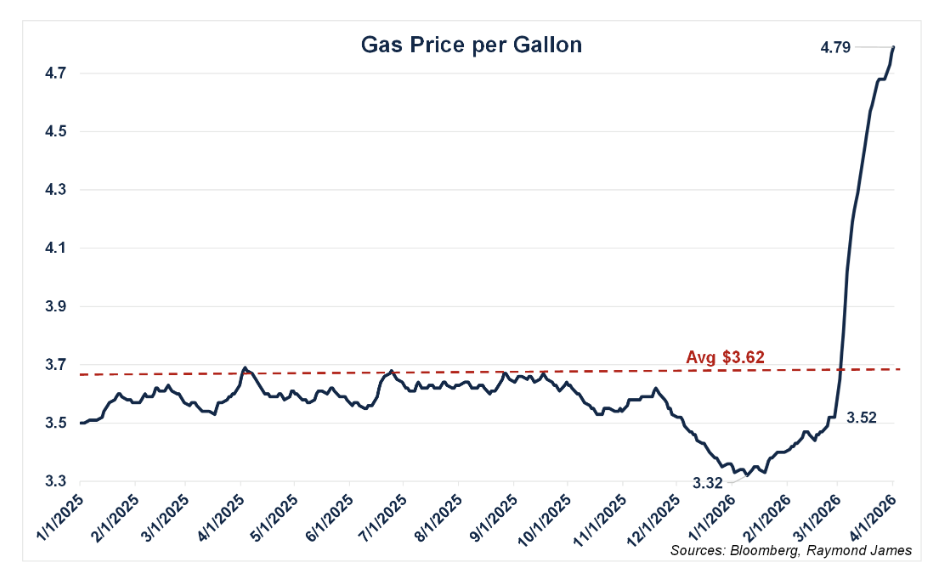
The US-Iran conflict has altered Iran’s regional influence and, more broadly, has many other consequences. It pressures government relations as well as global and financial market trading. The closure of the Strait of Hormuz has jammed the transportation route for oil consumed by more than 30 countries. This has raised the price of crude oil by nearly 83%, from $67/barrel to over $110/barrel (see chart above). On the domestic front, the average gasoline price in the US has risen from $3.52/gallon to $4.79/gallon. The consequences of each action can potentially impact the economic picture, either directly or indirectly.

One of the Fed’s mandates, maintaining price stability, is influenced by oil prices and their impact on inflation. Inflation was elevated before the conflict began, and it is unlikely to drop while it continues. The bigger question may be how long the conflict will last, and whether oil transportation will continue to be blocked. These geopolitical dynamics are helping to shape how the Fed may adjust future monetary policy.
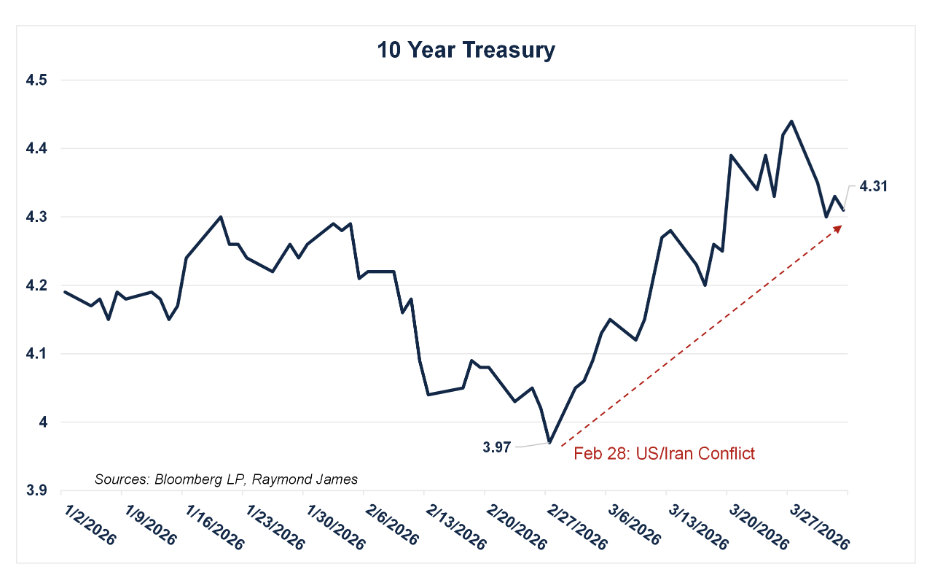
These events have pulled Treasury prices down. Thus, an unexpected positive for income-buying investors, the 10-year Treasury yield has jumped from 3.97% to 4.31% in March. The chart on the right depicts the sharp 10-year Treasury rate increase during March. At the same time, spreads have begun to widen. The take-away - yields are higher and income-buying investors are benefitting.
The author of this material is a Trader in the Fixed Income Department of Raymond James & Associates (RJA), and is not an Analyst. Any opinions expressed may differ from opinions expressed by other departments of RJA, including our Equity Research Department, and are subject to change without notice. The data and information contained herein was obtained from sources considered to be reliable, but RJA does not guarantee its accuracy and/or completeness. Neither the information nor any opinions expressed constitute a solicitation for the purchase or sale of any security referred to herein. This material may include analysis of sectors, securities and/or derivatives that RJA may have positions, long or short, held proprietarily. RJA or its affiliates may execute transactions which may not be consistent with the report’s conclusions. RJA may also have performed investment banking services for the issuers of such securities. Investors should discuss the risks inherent in bonds with their Raymond James Financial Advisor. Risks include, but are not limited to, changes in interest rates, liquidity, credit quality, volatility, and duration. Past performance is no assurance of future results.
Investment products are: not deposits, not FDIC/NCUA insured, not insured by any government agency, not bank guaranteed, subject to risk and may lose value.
To learn more about the risks and rewards of investing in fixed income, access the Financial Industry Regulatory Authority’s website at finra.org/investors/learn-to-invest/types-investments/bonds and the Municipal Securities Rulemaking Board’s (MSRB) Electronic Municipal Market Access System (EMMA) at emma.msrb.org.
© 2026 Raymond James Financial, Inc. All rights reserved.
Links are being provided for information purposes only. Raymond James is not affiliated with and does not endorse, authorize or sponsor any of the listed websites or their respective sponsors. Raymond James is not responsible for the content of any website or the collection or use of information regarding any website's users and/or members.
Raymond James & Associates, Inc., member New York Stock Exchange / SIPC, and Raymond James Financial Services, Inc., member FINRA / SIPC, are subsidiaries of Raymond James Financial, Inc.
Raymond James® and Raymond James Financial® and power of personal® are registered trademarks of Raymond James Financial, Inc.
Raymond James & Associates Statement of Financial Condition - September 2025 (PDF)
A message from Advisor Perspectives and VettaFi: Discover something new! Click here to register for our upcoming webcasts.
© Raymond James
Read more commentaries by Raymond James