Jet Fuel Has Doubled. Here’s Why I’m Still Bullish on Airlines
Membership required
Membership is now required to use this feature. To learn more:
View Membership BenefitsSince the U.S. and Israel launched strikes on Iran on February 28, jet fuel prices in the U.S. have more than doubled. According to data from the Energy Information Administration (EIA), the year-to-date percent change in U.S. jet fuel prices stood above 120% as of the end of March.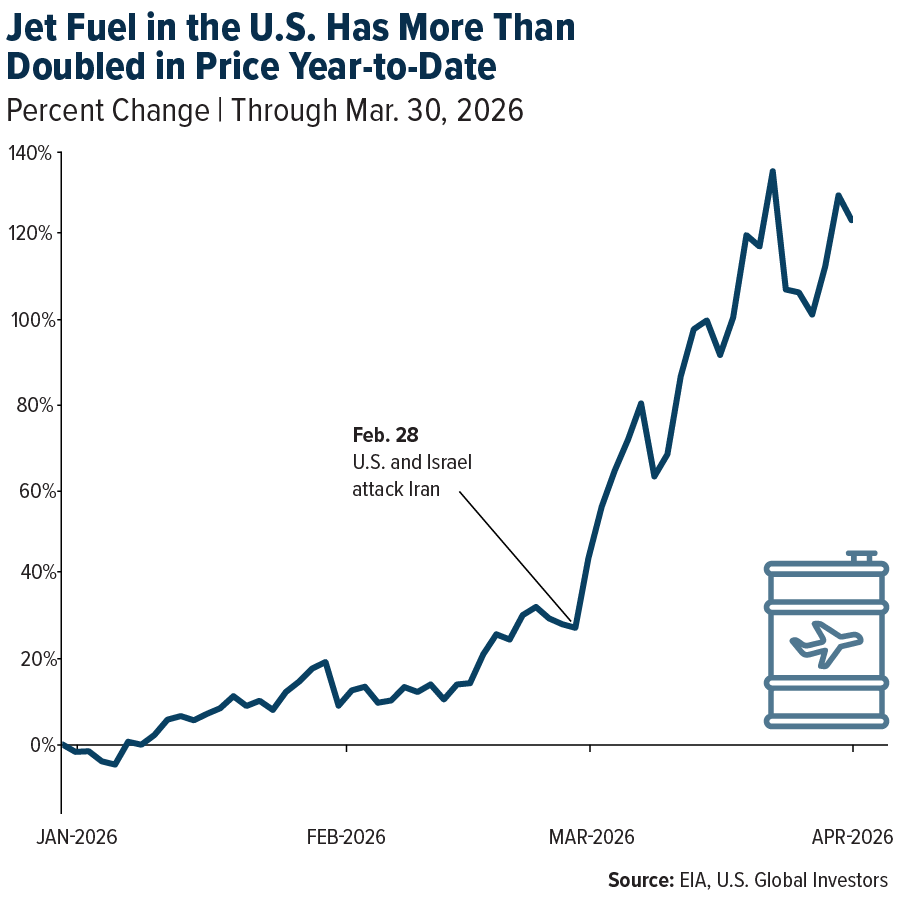
Oil markets reacted swiftly to President Donald Trump’s address to the nation this week, with U.S. crude surging 12% to over $113 per barrel and Brent jumping 8% above $109. The national average for a gallon of gasoline crossed $4.00, the highest since Russia’s invasion of Ukraine in 2022.
There’s no sugarcoating it: for the aviation industry, which was on track for a record $41 billion in global profits in 2026, this is a serious headwind.
But it’s important that I point out that this isn’t the first shock airlines have had to face. As I see it, the industry’s long-term investment case remains firmly intact.
The Fuel Problem
Jet fuel typically accounts for somewhere between 20% and 40% of an airline’s total operating costs, depending on the carrier, its routes and the efficiency of its fleets. Unlike labor costs or lease payments, fuel prices are set by global commodity markets. They’re beyond any single airline’s control, and they can change very fast, as we saw in March.
What makes the current situation particularly impactful, of course, is the closure of the Strait of Hormuz, which handles an enormous share of the world’s seaborne oil trade. Looking just at China, the world’s number one oil importer, about 38% of its supply originates in the Persian Gulf, according to CLSA research.
Meanwhile, the UK, which relies on Kuwait for roughly 25% of its jet fuel, is among the most exposed.
The U.S., by contrast, is in a far stronger position than the headlines suggest, as I mentioned in a previous post.
Record U.S. Oil Production
The number I want you to remember is 13.6 million barrels per day.
That’s the new record for U.S. crude oil production in 2025, up 3%—or 350,000 barrels per day—from the year prior, according to the EIA. The U.S. is the world’s largest oil producer, and it’s operating at full strength.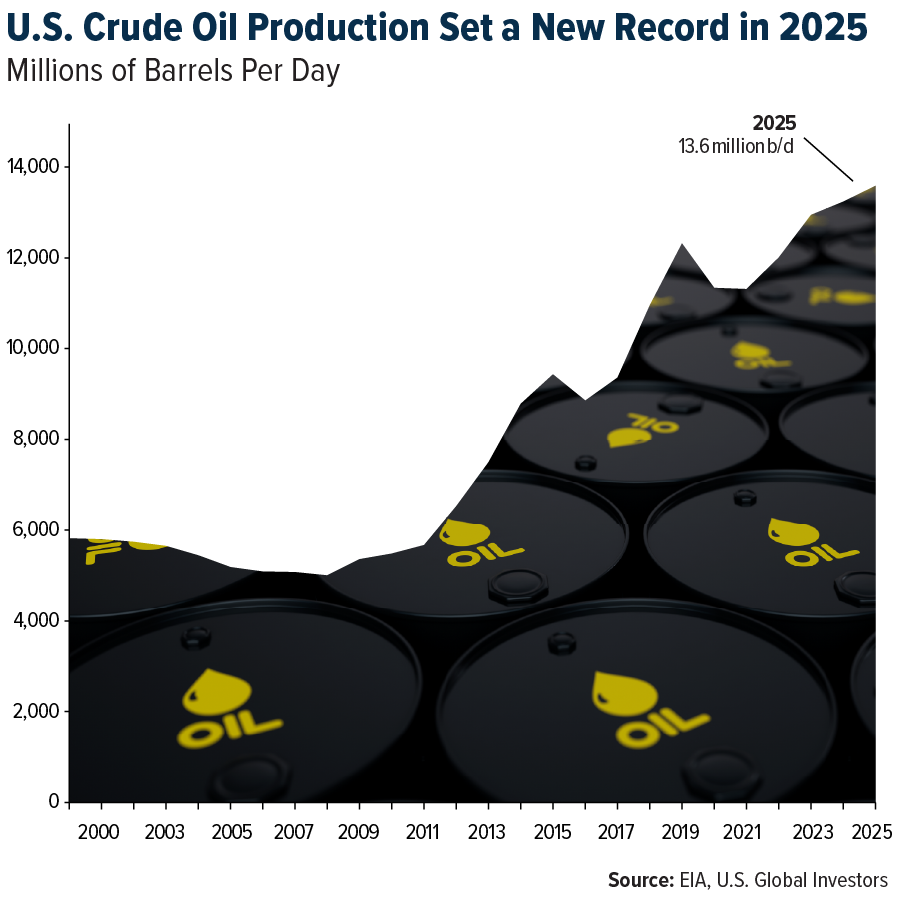
U.S. refiners are already churning out approximately 1.9 million barrels of jet fuel daily, a record for this time of year. With domestic airlines consuming about 1.6 million barrels a day, that leaves roughly 300,000 barrels available for export.
CLSA developed an equally weighted “vulnerability score” across six indicators, including direct and indirect oil import reliance on the Gulf, reserve levels, energy’s weight in consumer inflation baskets and balance of payments strength. The firm found that the U.S. ranked as the least vulnerable country to a Persian Gulf supply disruption, with a z-score of 4.31. China and Hong Kong were close behind.
Thailand, the Philippines and Vietnam were the most exposed.
In other words, while this conflict is genuinely disruptive for global aviation, the American market has a strong buffer that most of the world doesn’t.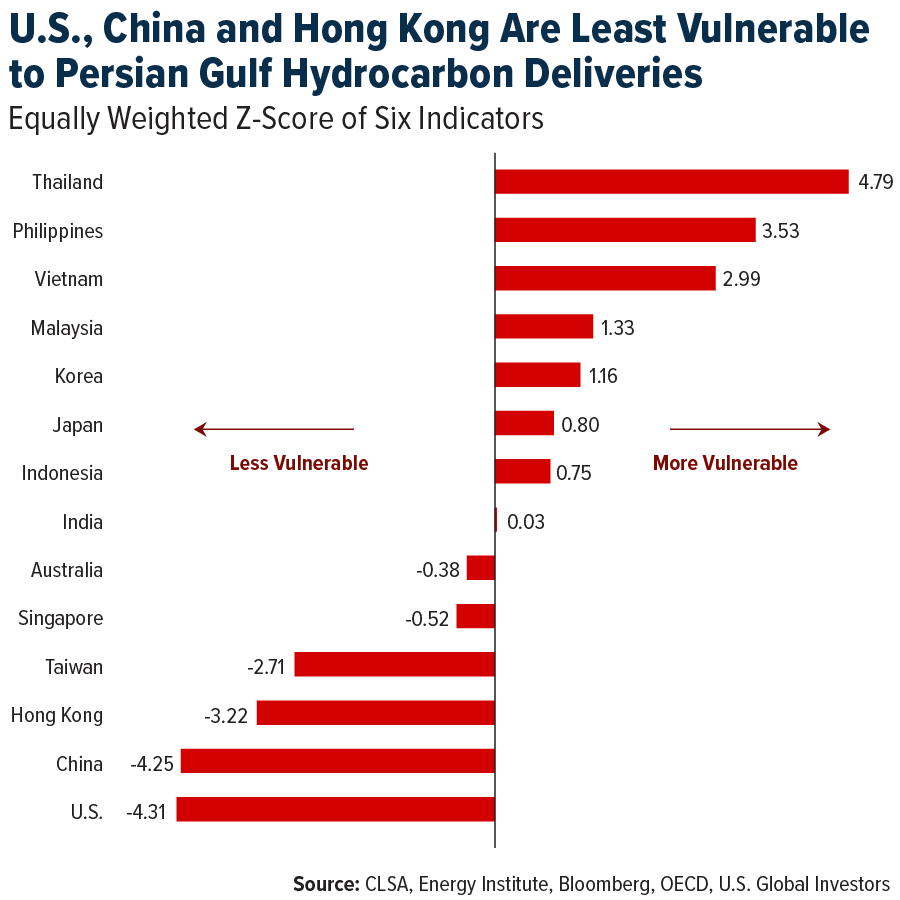
To Hedge or Not to Hedge
Like countries, not all airlines are equally exposed to the spike in fuel prices.
European carriers entered this crisis far better projected. According to Aerospace Global News, easyJet hedged 84% of its fuel for the first half of 2026. Air France, IAG and Ryanair all carry solid hedging positions through most of the year.
U.S. carriers, by contrast, have collectively walked away from fuel hedging over the past few years. As of the end of 2024, three of the four largest U.S. airlines maintained zero hedging positions. Southwest, once considered the gold standard for airline fuel hedging—saving an estimated $3.5 billion between 1998 and 2008—officially discontinued its program in December 2024.
Delta retains some protection through its Monroe Energy refinery in Pennsylvania. The refinery covers a large share of its fuel consumption. But it’s not shielded from swings in crude prices.
When this shock resolves itself—and it will, eventually—unhedged carriers will benefit from lower spot prices immediately. They won’t be locked into above-market contracts the way some of their European rivals may find themselves if prices fall.
Demand Is Holding
Global passenger traffic expanded 6.1% year-over-year in February, according to a new report by the International Air Transport Association (IATA). That’s up from January’s 4.0% gain.
United Airlines CEO Scott Kirby told reporters this week that customers are still booking, even as carriers pass higher fuel costs along in the form of fare increases. Airfares have jumped, particularly on long-haul and last-minute bookings, but the fundamental demand for travel has not collapsed.
This tracks with what we’ve seen in past fuel crises. Think of the oil shock of 2008, the aftermath of September 11, the covid pandemic. Each time, the sector faced what looked like an existential threat, and each time, it recovered. The industry’s ability to adjust capacity, focus on profitable routes and work through supply-side shocks has been proven repeatedly.
Airlines are doing this now, cutting unprofitable routes and grounding less fuel-efficient aircraft.
The Road Ahead
I believe the market is pricing in a prolonged crisis. The Pentagon is reportedly preparing for additional operations, while Trump has signaled he may be willing to end U.S. involvement without fully reopening the Strait of Hormuz. Public support for the conflict is declining sharply, with 59% of Americans now opposing the war, according to a YouGov poll conducted March 27-30.
In the meantime, the U.S. sits on record domestic oil production, and global passenger demand, while under pressure, has not broken.
Again, the commercial aviation sector has survived oil embargoes, terrorist attacks, financial crises and global pandemics. It’s not going to be grounded by a fuel spike, however severe. I believe the smart money will be watching for the moment when fear peaks, because in the past, that’s often represented the best opportunity.
Airlines and Shipping
Strengths
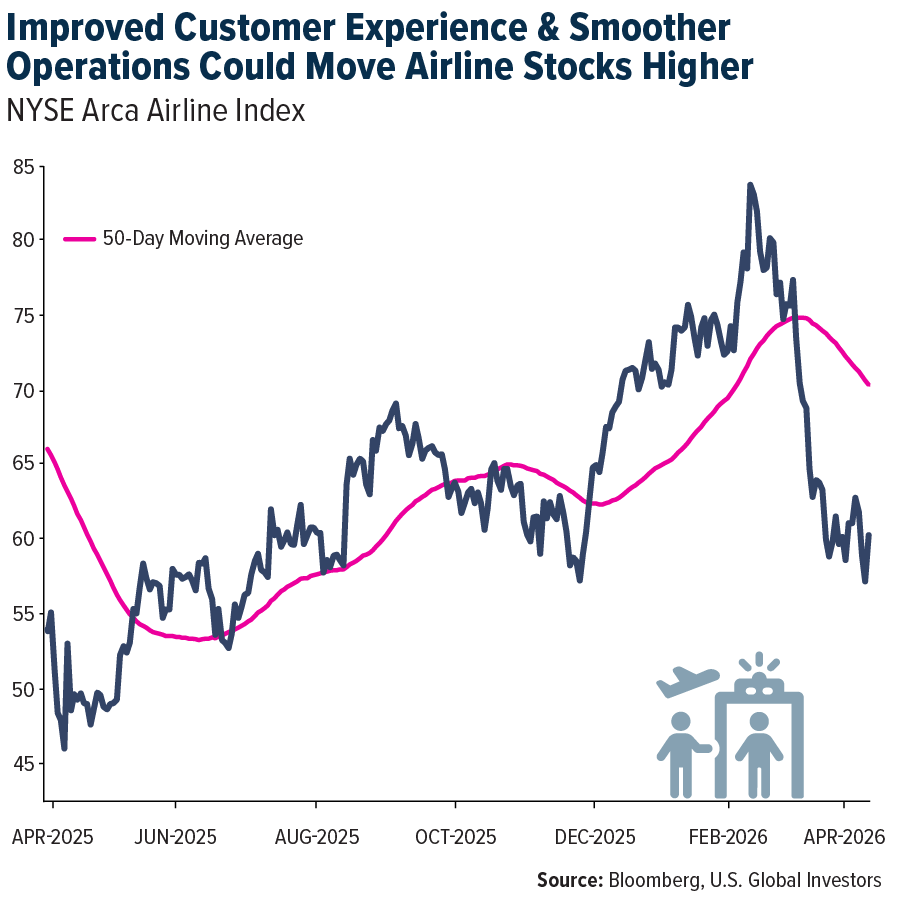
- The best performing airline stock for the week was Embraer, up 9.9%. President Trump directed federal officials to use other available funds, with paychecks for TSA workers restarted on Monday. The long lines seen at select airports have been falling, which should lead to reduced flight cancellations by passengers to avoid these lines. This should be positive for airline ticket demand in 2-3 weeks, based on history.

- According to Bank of America, spot rates spiked in March (up 37%), with Asia–Europe and Asia–USWC up 20% and 27%, respectively. While underlying supply-demand fundamentals point to softer container markets, Red Sea rerouting delays and ongoing geopolitical risk are supporting the near-term outlook. Higher bunker costs continue to be passed through via emergency fuel surcharges, with futures implying a further 38% increase by the end of June.
- Airline cancellations finally began to normalize following several weeks of disruptions. Over the past week, airline cancellations came in at 0.8% of scheduled flights (compared to 3.6% last week and 3% the week before that), according to Morgan Stanley.
Weaknesses
- The worst-performing airline stock for the week was Cathay, down 7.5%. Alaska now sees first quarter earnings per share (EPS) of -$1.50 to -$2.00 (previously -$0.50 to -$1.50). This is a negative surprise; UBS thinks the buy side was expecting the first quarter to come in toward the lower end of guidance. Alaska expects a -$0.70 fuel drag to first quarter EPS. For the second quarter, it noted May and June bookings are seeing significant strength.
- According to Bank of America, Strait of Hormuz transits remain low at around 3% of normal, with transits led by bulkers or ships linked to Iran. President Trump has indicated a potential end to the Iran war in the coming weeks, but all eyes are on Hormuz and whether it reopens with or without tolling.
- Visibility on jet fuel availability is limited to the next 4–5 weeks, raising the risk of capacity adjustments and reduced Europe–Asia traffic should supply constraints persist, particularly where aircraft may be unable to refuel for return legs. The UK market remains structurally tight, having sourced at least half of its jet fuel from the Middle East in recent months. Lufthansa has reportedly acknowledged contingency plans to temporarily ground up to 20 aircraft, with potential for further cuts, according to Morgan Stanley.
Opportunities
- Qantas’s Sunrise Project will drive international earnings: JP Morgan forecasts a gradual expansion to an 8% EBIT margin for international by FY30 as Project Sunrise reaches full run rate, driving an 80% uplift in EBIT. Project Sunrise adds 21% capacity relative to an FY26 baseline, and they expect Sunrise flights to deliver above-average divisional margins; their initial analysis indicates that price/mix effects should underpin a 20–30% RASK premium.
- Global newbuild ship demand has recovered since last October, leading to rapid growth in global shipyards’ backlog. UBS expects subsequent tanker and bulker renewal demand to continue, thus underpinning newbuild price recovery.
- IndiGo appointed William Walsh as the new CEO. Walsh brings leadership experience from IATA, IAG, BA, and Aer Lingus. UBS expects strategy to remain unchanged, focused on long-haul growth and cost control. They view this as a positive sign given Walsh’s track record in driving airline turnarounds.
Threats
- The Board of Directors of Air Canada announced that Michael Rousseau has informed the Board that he will retire by the end of the third quarter of 2026. UBS thinks the retirement announcement, without a successor being identified, could be an overhang on the stock in the near term. Michael spent two decades at Air Canada, transitioning to CEO in February ’21.
- Hapag-Lloyd confirmed Hormuz and Suez remain suspended, with disruptions adding $40–50m per week in extra fuel, insurance, storage, and rerouting costs, which surcharges cannot fully offset in the near term and may take months to recover.
- Bank of America card data shows that airline transaction growth sped up toward the middle of March, peaking at around 9% YoY, before falling to -1% YoY on March 28. It’s possible that some consumers might be delaying their travel plans, considering the recent rise in gas prices and airport staffing shortages. And given that airline spending per transaction growth remained elevated toward the end of March, it might be that recent fuel price increases are factoring into airfare prices as well.
Luxury Goods and International Markets
Strengths
- The world’s three largest economies—the United States, China, and the Eurozone—are all reporting Manufacturing PMI readings above 50, signaling expansionary activity across global manufacturing. This broad-based improvement suggests strengthening industrial momentum and eases recession concerns.
- Viking Holdings’ shares held up better than those of other cruise lines during March’s oil price spike. The company is less exposed to oil price fluctuations and demand volatility. It operates smaller, more fuel-efficient ships, targets a wealthier and less price-sensitive customer base, and has greater booking visibility.
- Melco International, a hotel and casino operator, was the best-performing stock in the S&P Global Luxury Index over the past five days. Shares jumped as much as 15% on Wednesday after the casino operator reported a full-year net profit, compared with a loss a year earlier.
Weaknesses
- Tesla posted one of its worst sales quarters in years, missing Wall Street expectations. The company delivered 358,023 vehicles worldwide in the first quarter, marking the second consecutive quarter that Tesla has fallen short of projections.
- The final March EU consumer confidence reading confirmed a sharp deterioration in sentiment, with confidence falling to its lowest level since October 2023. The decline reflected growing pessimism about household finances, as rising energy prices weighed on consumers across the euro area.
- RH, a high-end home furnishings company, was the worst-performing stock in the S&P Global Luxury Index over the past five days. Shares declined after the company reported weaker-than-expected earnings and revenue, cited tariff-related costs as a factor in the miss, and provided a cautious near-term outlook for sales and margins, which rattled investors.
Opportunities
- Global stocks rebounded at the beginning of the week from oversold levels, as investors took comfort in hopes that the Middle East conflict may conclude within the coming weeks, broadly in line with earlier expectations that it would be relatively short-lived. With the conflict having begun in late February, any further de-escalation could push equities higher.
- Marriott International has announced a joint venture with the Leali family, founders of Lefay, to bring Lefay into Marriott’s portfolio as its first brand dedicated exclusively to luxury wellness. Lefay currently includes two award-winning resorts in Lago di Garda and the Dolomiti in Italy, plus three properties under development in Tuscany, Southern Italy, and the Swiss Alps. Marriott’s new deal with Lefay adds a luxury wellness brand to its portfolio.
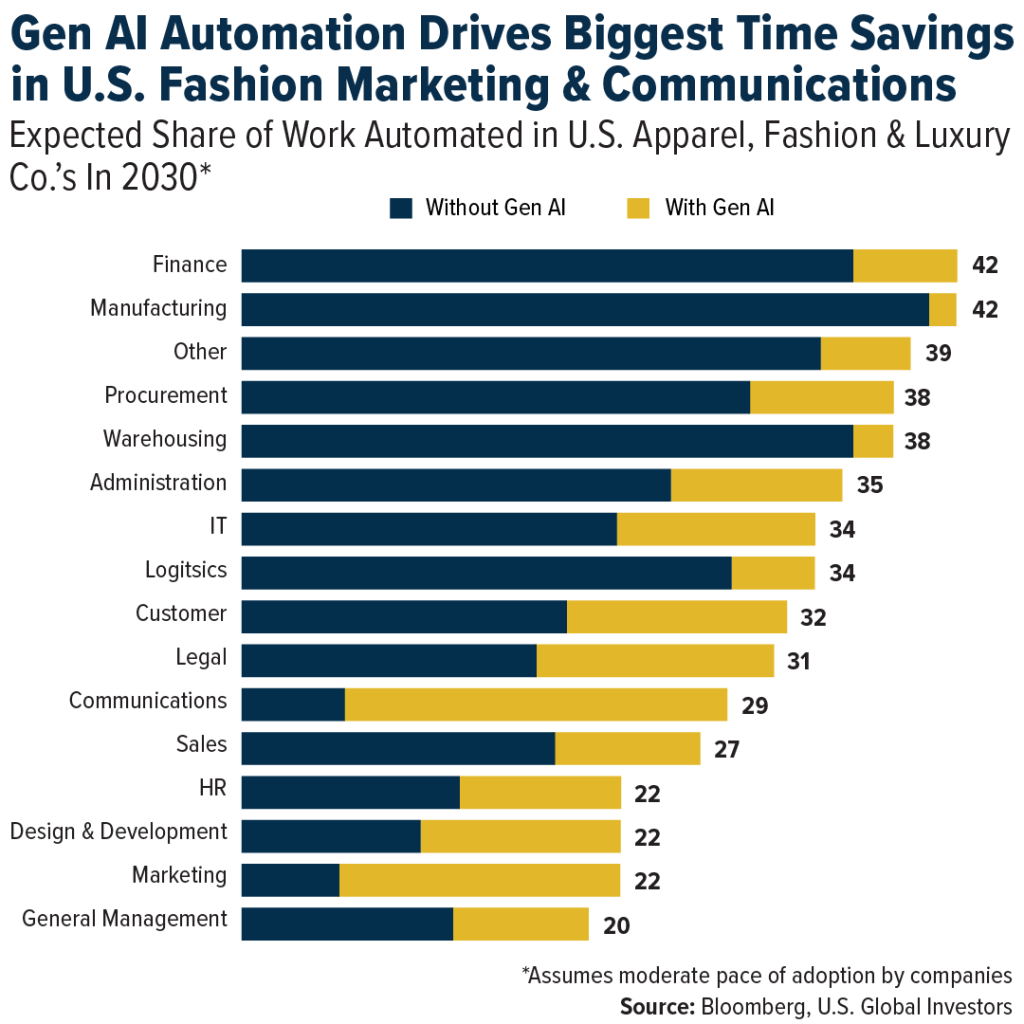
- Luxury companies are actively adopting AI to increase productivity and reduce operational costs. According to McKinsey research, more than 35 percent of executives report using AI in areas such as online customer service, image creation, copywriting, consumer search, or product delivery. AI could lead to significant productivity gains among fashion companies, particularly in marketing and sales functions.
Threats
- Luxury stocks may see a softer first quarter, as the Middle East accounts for about 6% of global luxury sales, and recent conflict-related disruptions have hurt demand in the region. Ferrari briefly paused most Middle East shipments last week, but deliveries have now resumed, with the option to use sea or air freight if needed. The first company to report sales and revenue will be Brunello Cucinelli on April 9, followed by Louis Vuitton (LVMH) on April 13.
- The ongoing Middle East war is reducing tourism and foot traffic in key Gulf markets such as Dubai. Luxury brands rely on the Middle East for roughly 6–8% of global revenues, and sales in the region are estimated to have fallen by about half in March due to flight disruptions and security concerns. While local clients remain, the collapse in tourist spending risks dragging on sector growth.
- On Thursday, oil prices rose while equities sold off following President Trump’s speech Wednesday night, in which he warned that Iran would be hit hard in the coming days but did not provide a concrete timeline for resolving the Middle East conflict. Markets have been volatile over the past month due to escalating tensions in the region and are likely to remain so as the outcome of the conflict remains uncertain.
Energy and Natural Resources
Strengths
- The best performing commodity for the week was WTI crude oil, which rose approximately 18.04% as President Trump’s prime-time address vowed military escalation in Iran over the next two to three weeks, with European diesel futures simultaneously surging above $200 a barrel for the first time since 2022. The IEA’s Executive Director warned that energy rationing may be coming to some countries as the supply shock deepens, while Goldman Sachs estimates a $14–18/barrel war premium is now embedded in Brent, Bloomberg reports.
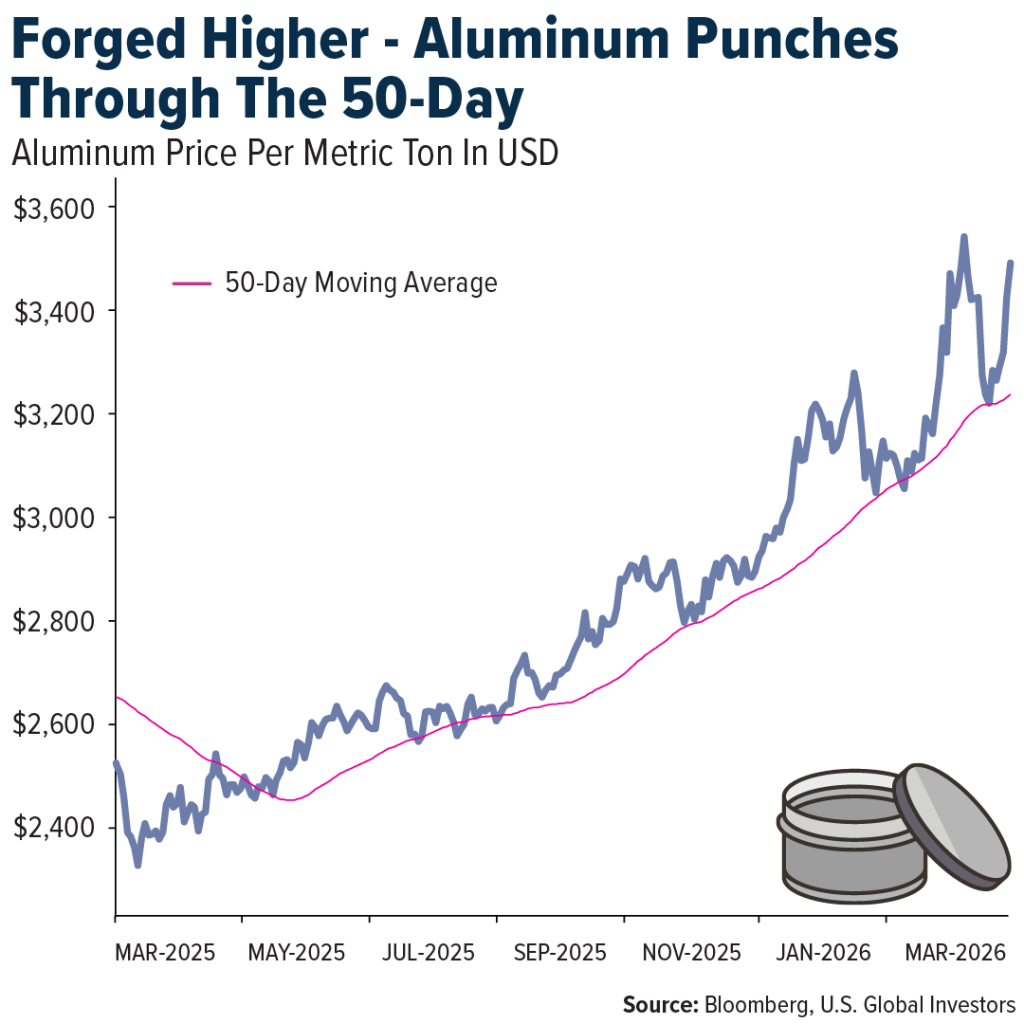
- Aluminum prices surged toward $3,500 per ton on the LME, on track for a 10% monthly gain, the biggest since April 2024, as the conflict disrupted Gulf Cooperation Council smelters accounting for roughly 9 to 10% of global output, pushing LME premiums over Chinese prices to their highest since April 2022, with major Chinese fabricators now running at full capacity to fill the supply gap.
- Energy stocks are beating the broader market by the widest margin ever, with the S&P 500 Energy Index up 39% in Q1 versus a 7% decline in the S&P 500, as the Iran war drives a rotation into HALO plays, hard assets, low obsolescence, with Exxon, ConocoPhillips, and Suncor posting more than 40% quarterly gains on improved capital discipline that makes the rally durable even at lower oil prices.
Weaknesses
- Sugar was the weakest-performing commodity of the week, declining approximately 5.48%. Raw sugar fell to a two-week low as declining oil prices reduced the incentive for Brazilian mills to divert cane toward ethanol production, with the most-active contract retreating as much as 3% to 15.05 cents a pound. Trader positioning has also weakened, with aggregate open interest near its lowest since early January as market participants step back amid volatile price swings tied to uncertainty over the Middle East conflict’s trajectory, Bloomberg reports.
- Ivanhoe Mines shares plunged as much as 11% after cutting Kamoa-Kakula copper guidance to 290,000 to 330,000 tons for 2026, down sharply from a December forecast of 380,000 to 420,000 tons, after seismic triggered flooding pushed the recovery timeline out by roughly a year, a reduction BMO Capital Markets called a likely market surprise given the targets were set just four months ago, Bloomberg reports.
- The Iran conflict has triggered a second major global gas supply shock in four years, forcing Europe and Asia to reverse coal phase-outs as LNG prices soar, with Japan expanding coal plant usage, Germany considering reactivating mothballed facilities, and India running coal plants at full capacity, with analysts warning 2026 coal demand will likely exceed pre-war projections despite years of climate policy efforts.
Opportunities
- The Iran war is unexpectedly accelerating the global nuclear renaissance, prompting Asian nations, including South Korea, Japan, and Southeast Asian states, to fast track nuclear programs and revisit enrichment capabilities, while geopolitical urgency reinforces Western utilities’ push to accelerate long term uranium contracting with producers like Cameco, where ceiling prices of $130 to $150 per pound signal strong confidence in the direction of prices, per the Council on Foreign Relations.
- Australia is leveraging its LNG export position to secure reciprocal fuel supplies as record pump prices and widespread service station shortages reshape regional energy diplomacy, with Japan, South Korea, and China reconsidering Qatar sourced LNG after an Iranian strike shuttered Qatar’s largest facility, directly benefiting producers like Woodside Energy and reinforcing the Pacific Basin LNG investment case.
- Albemarle launched the environmental review in Chile for a $3.1 billion direct lithium extraction project designed to recover nearly twice as much lithium while cutting brine extraction by over 65%, addressing native community concerns about Atacama water depletion and signaling that major producers are investing in next generation technology to secure long term supply while managing ESG permitting risks.
Threats
- China’s state backed CMRG has escalated its confrontation with BHP to its most intense level in nearly two decades, banning multiple iron ore products, pressuring mills to reject dollar denominated cargoes, and deploying port inspections to force pricing away from international benchmarks, with Rio Tinto and Fortescue already dropping the Platts index for 2026 shipments, while CMRG signals ambitions beyond iron ore into copper, Bloomberg reports.
- The Trump administration’s tiered steel and aluminum tariff overhaul, maintaining 50% duties on commodity grade products and 25% on most derivatives, landed on the same day traders pushed Fed rate hike odds above 50% for the first time, as oil above $110 per barrel and the OECD’s 4.2% U.S. inflation forecast create a stagflationary backdrop, with CME FedWatch now pricing zero rate cuts for 2026, per CNBC.
- The Strait of Hormuz crisis has severed roughly 20% of global urea trade, with 21 vessels carrying 919,000 tons stranded, while U.S. fertilizer traders simultaneously exported over 100,000 short tons of phosphate abroad to capitalize on a 21% surge in Indian DAP prices, a reversal that risks tightening domestic supplies ahead of the next planting season at a time when farm input costs are already elevated, per Argus Media and Bloomberg.
Bitcoin and Digital Assets
Strengths
- Blockchain is proving its real-world utility in traditional finance, as France’s Lightning Stock Exchange (LISE), a blockchain-based exchange for tokenized securities, prepares what could be Europe’s first fully onchain IPO, planning to take aerospace supplier ST Group public under the EU’s DLT pilot regime, highlighting how tokenization is moving into capital raising.
- Tokenization is reinforcing digital assets’ strength in bringing real-world financial assets onto blockchain, with tokenized assets at roughly $27 billion today and projected to reach nearly $19 trillion by 2033, as institutions focus on practical blockchain use cases beyond trading.
- The Uniswap Foundation, supporting the decentralized exchange Uniswap, ended 2025 with $85.8 million in assets, committed $26 million in grants, and maintained runway through January 2027, reflecting continued ecosystem growth with Uniswap v4, Unichain, and onboarding over 1,500 developers despite market volatility.
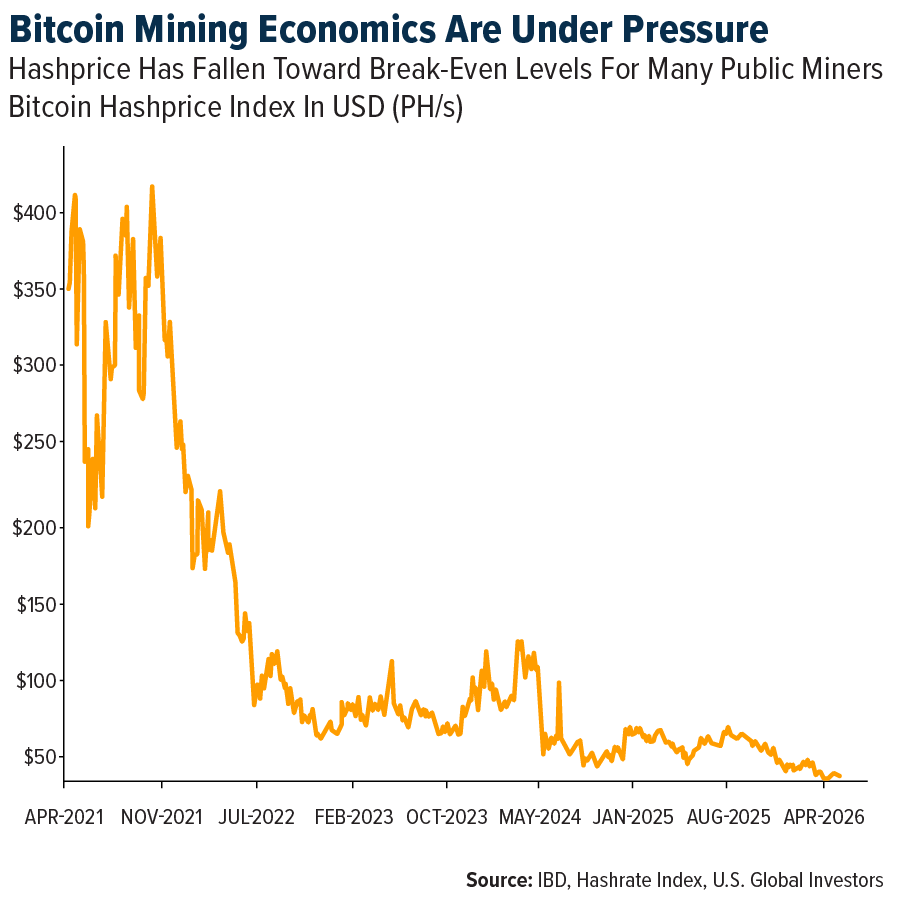
- Bitcoin miners continue to face profitability pressure, highlighting a weakness in the digital asset ecosystem even as many firms pivot toward AI infrastructure. According to CoinShares, the average cost to produce one bitcoin among public miners rose to nearly $80,000 in Q4, while hashprice fell to just $36–$38 per PH/s per day, leaving many operators near break-even. Publicly traded miners have already reduced their bitcoin treasuries by more than 15,000 BTC from peak levels, suggesting that unless bitcoin prices recover materially, further miner capitulation could continue weighing on sentiment.
- Spot Bitcoin ETF flows show uneven institutional demand, with U.S.-listed ETFs recording net outflows of $366.7 million from March 17–30, despite occasional inflow days, suggesting institutional participation remains fragile.
- Smaller bitcoin miners face mounting financial stress, as exemplified by Cango, which risks losing its NYSE listing after shares fell below $1, down 70% YTD, raising $10 million via a convertible note and $65 million in insider financing, highlighting reliance on fresh capital and pivots to remain viable.
Opportunities
- The rise of AI-driven commerce could create a major new opportunity for blockchain-based payments as Coinbase’s x402 protocol, a payment system designed to let AI agents send and receive small, high-frequency transactions over blockchain rails, gains backing from some of the world’s largest technology and financial infrastructure firms. The protocol is moving under the Linux Foundation with support from companies including Google Cloud, Stripe, AWS, Visa, and Mastercard. It aims to solve a growing need for open payment infrastructure that can handle microtransactions more efficiently than traditional financial networks.
- Franklin Templeton’s decision to expand its cryptocurrency business highlights a growing opportunity for digital assets as traditional finance deepens its involvement in the space. The firm, which manages more than $1.7 trillion in assets and was among the first issuers of U.S. spot bitcoin ETFs in 2024, is now building out Franklin Crypto to serve pensions, sovereign wealth funds, and other institutional investors.
- SoFi, a U.S. fintech and digital banking company, is underscoring a growing opportunity for digital assets as traditional banking and blockchain infrastructure continue to converge. The company launched a new business banking platform that allows firms to hold U.S. dollars, convert them into stablecoins, and move funds 24/7 within a regulated bank environment. By combining fiat, crypto, and settlement tools into a single system, SoFi aims to reduce reliance on fragmented providers and outdated payment rails, making digital assets a more practical component of modern financial infrastructure.
Threats
- Geopolitical volatility is becoming a more direct threat to digital asset markets as tokenized macro products gain traction on crypto-native trading venues. This week, tokenized Brent oil futures on Hyperliquid, a decentralized trading platform offering leveraged, 24/7 access to crypto and tokenized assets, generated $46.6 million in liquidations, making oil the third-most liquidated asset behind ether and bitcoin, with the single largest liquidation a $17.17 million oil trade. Rising Middle East tensions pushed Brent crude above $106, catching traders offside and amplifying volatility across crypto markets.
- Regulatory uncertainty remains a key threat to the digital asset market, as the head of the Commodity Futures Trading Commission (CFTC) said it is prepared to regulate the entire $3 trillion crypto industry, highlighting unresolved questions around jurisdiction, oversight, and enforcement while lawmakers continue debating the stalled CLARITY Act.
- Stablecoin adoption still faces regulatory friction, highlighting a threat to one of the digital asset market’s most important growth narratives. Hong Kong, which has positioned itself as a major crypto and fintech hub, failed to meet its March target for issuing its first stablecoin licenses, with no approved issuers listed so far. The delay shows regulators remain cautious around reserve quality, anti-money laundering controls, and redemption requirements, potentially slowing broader adoption.
Defense and Cybersecurity
Strengths
- Lockheed Martin is strengthening its role in strategic missile defense under a multi-year US$4.5 billion U.S. Army contract to supply 870 PAC 3 MSE interceptors and related hardware, alongside a new framework to lift Precision Strike Missile capacity to roughly 550 missiles per year.
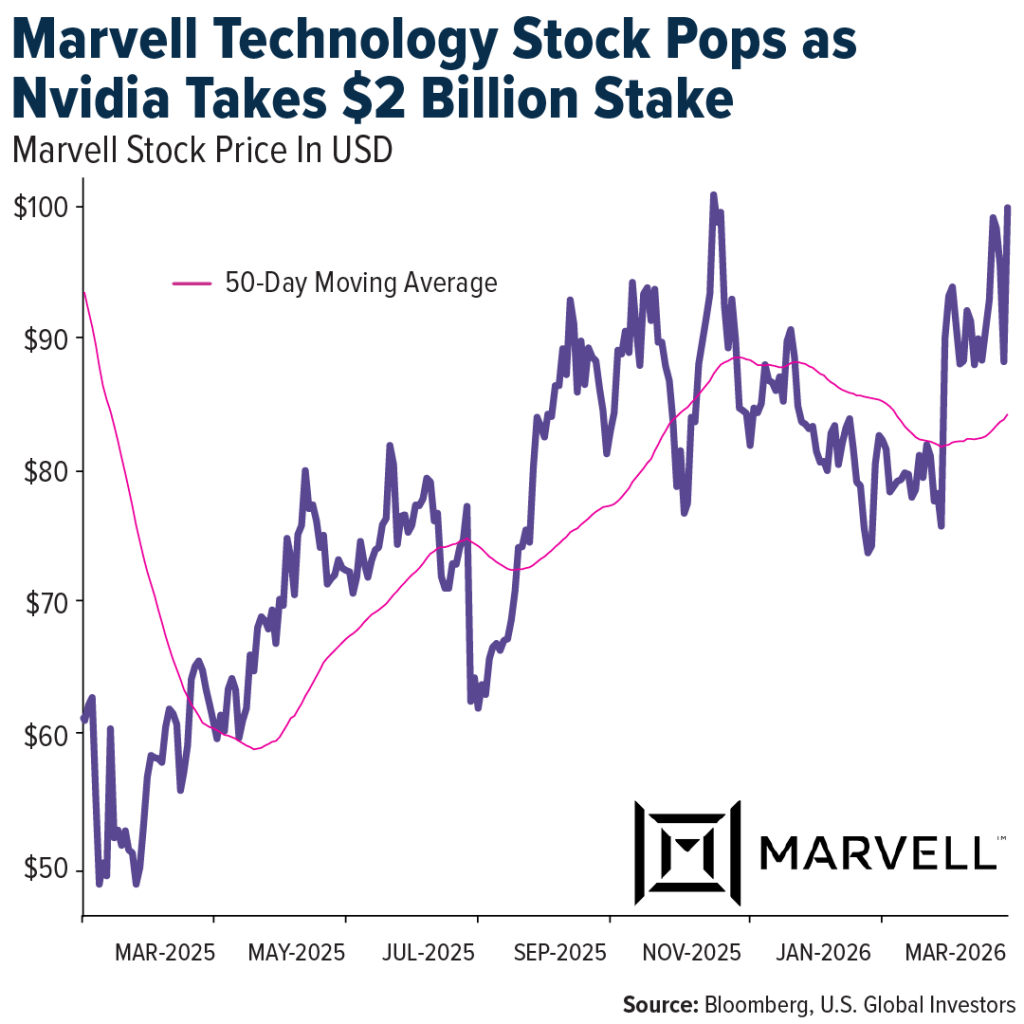
- Marvell is emerging as a core beneficiary of the AI infrastructure buildout, as optical interconnect, switching, and XPU attach drive growth well above cloud capex, reducing reliance on any single custom ramp. Nvidia’s roughly $2 billion strategic investment and silicon photonics partnership validate Marvell’s scale up roadmap and strengthen confidence in a durable, multi engine AI growth trajectory into 2027 to 2028.
- The U.S. has awarded the RTX segment Pratt & Whitney a $3.8-billion contract to produce F135 engines for the F-35 Lightning II combat aircraft. The deal is part of the ongoing Joint Strike Fighter program, which supplies, repairs, and maintains the international fleet of the American-built fifth-generation jet.
Weaknesses
- The European Commission has opened an investigation into a breach of its Amazon Web Services cloud environment after a threat actor claimed to have stolen more than 350 GB of data, including employee information and internal databases. The attacker has said they plan to leak the data publicly rather than seek a ransom, marking the Commission’s second major cybersecurity incident in less than three months.
- Iran struck an AWS data center in Bahrain and an Oracle data facility in Dubai, directly hitting U.S. hyperscale cloud infrastructure in the Middle East. The attacks mark a clear escalation toward targeting commercial digital assets.
- The intensity of combat between Russia and Ukraine has risen markedly in recent days. Escalation includes heavier missile and drone attacks alongside broader ground operations across several fronts.
Opportunities
- Northrop Grumman and the U.S. Air Force are prototyping a modular Sentinel missile launch silo to speed deployment, cut costs, and improve maintainability as part of the Minuteman III replacement effort. The test aims to compress a traditionally multi year infrastructure timeline as the delayed Sentinel program targets initial operations in the early 2030s.
- The Pentagon is seeking rapid industry options to deliver transportable, blast resistant bunkers to the Middle East within 3 to 30 days as Iranian missile and drone attacks expose the vulnerability and obsolescence of existing U.S. base shelters.
- Rheinmetall and Boeing Australia have signed a strategic partnership to offer the MQ 28 Ghost Bat to the German Air Force as part of the Bundeswehr’s collaborative combat aircraft program, targeting deployment by 2029. Under the agreement, Rheinmetall will act as system integrator in Germany, handling localization, integration, and lifecycle support, with revenue potential in the hundreds of millions of euros.
Threats
- Iran’s Islamic Revolutionary Guard Corps has publicly threatened to target Cisco, raising concerns over cyber and infrastructure risks in the Middle East region.
- Military escalation around Iran continues to intensify, with conditions increasingly aligned for a potential ground operation. There are no observable signals of de escalation as strikes expand and the conflict broadens.
-
This week, disruptions to global helium supply, critical for semiconductor manufacturing, were reported, raising near term risk to chip availability used across advanced defense electronics, sensors, and guidance systems.
Gold Market
This week gold futures closed the week at $4,696.60, up $172.30 per ounce, or 3.81%. Gold stocks, as measured by the NYSE Arca Gold Miners Index, ended the week higher by 3.81%. The S&P/TSX Venture Index came up 6.82%. The U.S. Trade-Weighted Dollar fell 0.13%.
Strengths
- The best performing precious metal for the week was palladium, up 7.67%, followed next by platinum which rose 6.00%. The precious metal rallied this week on President Trump’s comments that the war could be winding down soon. Palladium was down 24% by March 26th, the worst of the precious metals performance since the war began and simply had more the most chance to torque higher with the change in sentiment.
- It was a strong week for precious metals. The gains reflect that there is still positive sentiment toward owning gold, with investors waiting for some kind of resolution in the war with Iran. In general, investors stepped in to take advantage of prices that had been dragged down by the war over the past month as inflation worries rose and prospects for interest rate cuts faded, according to Bloomberg.
- Endeavour Mining delivered solid results for 2025 in Canaccord’s view, with production above the midpoint of guidance and costs in line when adjusted for the increase in the gold price. The company produced 1.21 million ounces of gold in 2025, up 10% year over year, driven by a full year of production at Lafigué. Endeavour announced a record H2 2025 dividend of $200 million and reiterated 2026 production guidance of 1.09 to 1.27 million ounces. Endeavour performed in line with the GDXJ for the week.
Weaknesses
- Gold and silver were neck in neck for finishing as the worst performing precious metals for the week, though they both finished up still up 3.81% and 4.41%, respectively. Falling interest rates by nearly 20 basis points for the 2-year treasury and almost 10 basis points for the 10-year treasury were the key drivers of lift in precious metal prices this week.
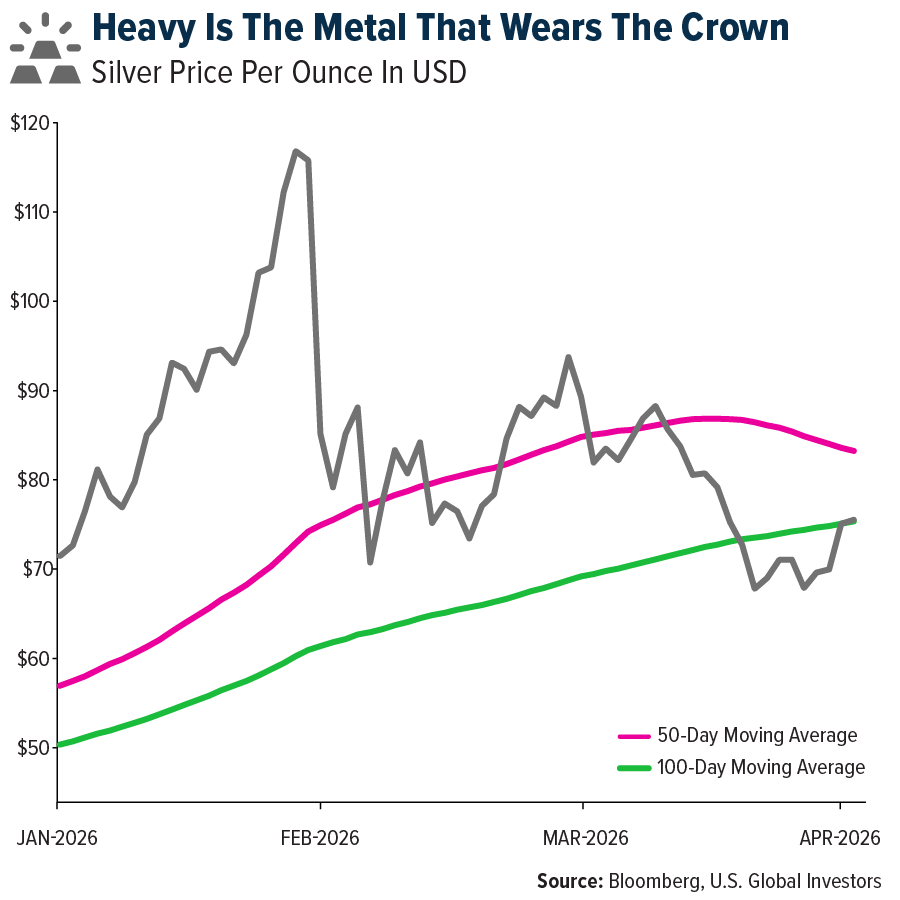
- Turkey sold or swapped nearly 70 tons of gold in the week to March 27, according to data published by its central bank, Bloomberg reported. The transactions come as Turkey intensifies its defense of the lira amid the ongoing war with Iran. Turkey has been one of the world’s most aggressive buyers of gold over the past decade. Since the start of the war, it has sold about 120 tons, lowering its holdings to approximately 702 tons.
- Gunmen killed more than 70 people in South Sudan over a gold mining dispute on the outskirts of the capital. The attack occurred at the Jebel Iraq mining site in Central Equatoria State, highlighting the violence linked to unregulated resource extraction. The site has been the scene of violent clashes in the past between illegal miners and mining companies, according to the Associated Press.
Opportunities
- Barrick Mining has formed an executive leadership team for its North American operations as the gold producer advances plans to pursue an initial public offering for the business. The new management team will oversee Barrick’s mines in Nevada and the Dominican Republic and consists of seven positions, according to a Tuesday memo seen by Bloomberg News. Tim Cribb will serve as COO and Wessel Hamman as CFO. The spinoff, which could be worth more than $60 billion, is expected to be completed by late 2026.
- PGM miners are increasingly constructive on brownfield investments. Compared to three to six months ago, Bank of America believes the willingness to invest has increased, which is understandable given buoyant PGM prices. For now, it believes the supply response will not be excessive, but rather just enough to keep the market balanced. Platinum remains in a structural deficit, with lease rates elevated.
- Gold has not been much of a haven during the Iran war and the resulting energy shock, but its March slump may be a temporary blip, according to a Wall Street strategist. Mark Haefele, chief investment officer for UBS Global Wealth Management, stood by his bullish estimates for gold in a research note this week. UBS forecasts the precious metal will rise 35% to $6,200 an ounce by the end of June, before scaling back to $5,900 an ounce by year end, citing rising U.S. debt, de dollarization trends, and geopolitical tensions as structural drivers.
Threats
- The market is currently pricing in no change in Fed rates this year, which means gold prices face reduced tailwinds from monetary easing. UBS’s forecast for gold to rise to $6,200 per ounce by June assumes a quick end to the current conflict, however, a protracted Iran conflict and continued high oil prices, which fuel inflation and push out rate cut expectations, could limit gold’s near term upside. Goldman Sachs maintains a $5,400 year end target, contingent on Fed rate cuts materializing.
- Ghana sovereign risk remains a growing headwind for gold miners, as the government increasingly seeks bilateral agreements on lease extensions, royalties, and taxes, with Gold Fields facing a best case scenario of renewing its Tarkwa lease at a higher royalty rate and a worst case of losing Tarkwa entirely as Damang transitions to government ownership in April, while a new requirement that any Gold Fields mine sale must go to a local miner further constrains strategic options and depresses potential transaction valuations.
- The magnitude and duration of soaring logistics and energy costs due to rising diesel fuel will be a threat to the historically wide margins that the gold industry has enjoyed over the past year. In addition to rising diesel costs, disruptions to urea and ammonia shipments are tightening the supply of ammonium nitrate based explosives used by miners to blast ore.
U.S. Global Investors, Inc. is an investment adviser registered with the Securities and Exchange Commission (“SEC”). This does not mean that we are sponsored, recommended, or approved by the SEC, or that our abilities or qualifications in any respect have been passed upon by the SEC or any officer of the SEC.
This commentary should not be considered a solicitation or offering of any investment product. Certain materials in this commentary may contain dated information. The information provided was current at the time of publication. Some links above may be directed to third-party websites. U.S. Global Investors does not endorse all information supplied by these websites and is not responsible for their content. All opinions expressed and data provided are subject to change without notice. Some of these opinions may not be appropriate to every investor.
Holdings may change daily. Holdings are reported as of the most recent quarter-end. The following securities mentioned in the article were held by one or more accounts managed by U.S. Global Investors as of (03/31/2026):
Alaska Air Group
Deutsche Lufthansa
Qantas Airways
Air Canada
Brunello Cucinelli
Louis Vuitton
Marriot International
Tesla
Viking Holdings
easyJet PLC
Air France-KLM
Ryanair Holdings PLC
Southwest Airlines Co.
Delta Air Lines Inc.
United Airlines Holdings Inc.
Exxon
Ivanhoe Electric
Cameco
Woodside Energy Group
Endeavor Silver
Barrick Mining
Gold Fields
Lockheed Martin
Marvell Technology
Nvidia
Boeing
*The above-mentioned indices are not total returns. These returns reflect simple appreciation only and do not reflect dividend reinvestment.
The Dow Jones Industrial Average is a price-weighted average of 30 blue chip stocks that are generally leaders in their industry. The S&P 500 Stock Index is a widely recognized capitalization-weighted index of 500 common stock prices in U.S. companies. The Nasdaq Composite Index is a capitalization-weighted index of all Nasdaq National Market and SmallCap stocks. The Russell 2000 Index® is a U.S. equity index measuring the performance of the 2,000 smallest companies in the Russell 3000®, a widely recognized small-cap index.
The Hang Seng Composite Index is a market capitalization-weighted index that comprises the top 200 companies listed on Stock Exchange of Hong Kong, based on average market cap for the 12 months. The Taiwan Stock Exchange Index is a capitalization-weighted index of all listed common shares traded on the Taiwan Stock Exchange. The Korea Stock Price Index is a capitalization-weighted index of all common shares and preferred shares on the Korean Stock Exchanges.
The Philadelphia Stock Exchange Gold and Silver Index (XAU) is a capitalization-weighted index that includes the leading companies involved in the mining of gold and silver. The U.S. Trade Weighted Dollar Index provides a general indication of the international value of the U.S. dollar. The S&P/TSX Canadian Gold Capped Sector Index is a modified capitalization-weighted index, whose equity weights are capped 25 percent and index constituents are derived from a subset stock pool of S&P/TSX Composite Index stocks. The NYSE Arca Gold Miners Index is a modified market capitalization weighted index comprised of publicly traded companies involved primarily in the mining for gold and silver. The S&P/TSX Venture Composite Index is a broad market indicator for the Canadian venture capital market. The index is market capitalization weighted and, at its inception, included 531 companies. A quarterly revision process is used to remove companies that comprise less than 0.05% of the weight of the index, and add companies whose weight, when included, will be greater than 0.05% of the index.
The S&P 500 Energy Index is a capitalization-weighted index that tracks the companies in the energy sector as a subset of the S&P 500. The S&P 500 Materials Index is a capitalization-weighted index that tracks the companies in the material sector as a subset of the S&P 500. The S&P 500 Financials Index is a capitalization-weighted index. The index was developed with a base level of 10 for the 1941-43 base period. The S&P 500 Industrials Index is a Materials Index is a capitalization-weighted index that tracks the companies in the industrial sector as a subset of the S&P 500. The S&P 500 Consumer Discretionary Index is a capitalization-weighted index that tracks the companies in the consumer discretionary sector as a subset of the S&P 500. The S&P 500 Information Technology Index is a capitalization-weighted index that tracks the companies in the information technology sector as a subset of the S&P 500. The S&P 500 Consumer Staples Index is a Materials Index is a capitalization-weighted index that tracks the companies in the consumer staples sector as a subset of the S&P 500. The S&P 500 Utilities Index is a capitalization-weighted index that tracks the companies in the utilities sector as a subset of the S&P 500. The S&P 500 Healthcare Index is a capitalization-weighted index that tracks the companies in the healthcare sector as a subset of the S&P 500. The S&P 500 Telecom Index is a Materials Index is a capitalization-weighted index that tracks the companies in the telecom sector as a subset of the S&P 500.
The Consumer Price Index (CPI) is one of the most widely recognized price measures for tracking the price of a market basket of goods and services purchased by individuals. The weights of components are based on consumer spending patterns. The Purchasing Manager’s Index is an indicator of the economic health of the manufacturing sector. The PMI index is based on five major indicators: new orders, inventory levels, production, supplier deliveries and the employment environment. Gross domestic product (GDP) is the monetary value of all the finished goods and services produced within a country’s borders in a specific time period, though GDP is usually calculated on an annual basis. It includes all private and public consumption, government outlays, investments and exports less imports that occur within a defined territory.
The S&P Global Luxury Index is comprised of 80 of the largest publicly traded companies engaged in the production or distribution of luxury goods or the provision of luxury services that meet specific investibility requirements.
Membership required
Membership is now required to use this feature. To learn more:
View Membership BenefitsSponsored Content
Upcoming Virtual Events View All












