While Wall Street obsesses over the Magnificent Seven, a handful of under-the-radar forces may shape the next leg of this market, for better and for worse.
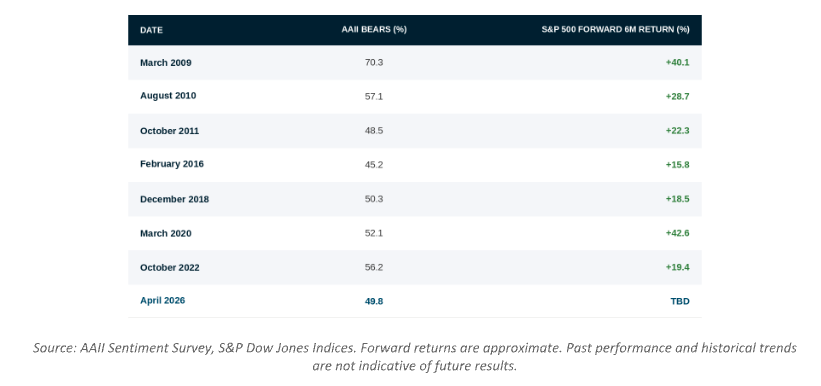
As of April 1, 2026, nearly half of individual investors (49.8%, according to the AAII Sentiment Survey) believe the stock market will be lower six months from now. That is a striking number. Beneath the headline doom, though, catalysts are brewing on both sides of the ledger that most market participants are not tracking. Some could push stocks to the upside. Others could blow up portfolios. This piece examines the tailwinds, the landmines, and the forces that deserve far more attention than they are getting.
The S&P 500 has been largely flat in 2026, caught between sticky inflation, elevated valuations (the CAPE ratio sits around 37, placing it in the top 10% of readings since 1988), and a policy environment that is shifting fast. Most commentary focuses on the usual suspects: Fed rate decisions, Big Tech earnings, and the Iran conflict. The real movers may be hiding in plain sight.
The Bull Case: Catalysts That Could Push Stocks Higher
Extreme Bearishness Is Actually Historically Bullish
When nearly half of retail investors are convinced the market is headed lower, history suggests the opposite tends to happen. The AAII Sentiment Survey 49.8% bearish reading is not just noise. It is a
level of pessimism that has historically been associated with stronger subsequent market returns in some periods. Elevated bearish readings like this have preceded meaningful rallies in certain historical periods, not because sentiment causes rallies, but potentially because excessive pessimism means there is a wall of sidelined cash ready to flow back in at the first sign of stabilization.
Historical AAII Bearish Sentiment vs. S$P 500 Forward Returns

The gap between sentiment and actual corporate fundamentals remains wide. Earnings, while not spectacular, have not collapsed. If they hold up even modestly through the next reporting season, the snap-back could be sharp and swift. The most dangerous position in a market this pessimistic may not be being invested. It may be being out. Contrarian investors are paying very close attention.
Defense: The Stealth Compounder Nobodys Watching
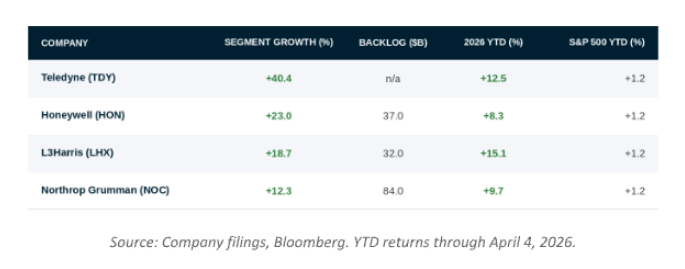
While the financial media remains fixated on AI and the Magnificent Seven, a quieter story is playing out in defense and aerospace. Structural increases in global defense spending, driven by ongoing geopolitical tensions, NATO commitments, and modernization programs, are creating a multi-year tailwind for a sector that most growth-oriented investors have ignored for a good decade or more.
Defense Sector Performance Comparison
The numbers speak for themselves. Teledyne Technologies has posted a 40.4% surge in its Aerospace and Defense Electronics segment, marking a fourth consecutive quarter of accelerating growth. Honeywell is preparing to split its aerospace and automation businesses into two separate entities by Q3 2026, a corporate action that historically unlocks shareholder value. Defense backlogs are at record levels; Honeywell alone sits on over $37 billion in orders, providing unusual earnings visibility in a market starved for certainty.
These companies are generally considered more established businesses relative to earlier-stage growth investments. They are cash-generating businesses with government-backed revenue streams, and they are quietly beating the broader market while nobody talks about them. For investors looking beyond the AI hype cycle, defense may represent a potentially compelling risk-reward allocation relative to other sectors, hiding in plain sight.
Tariff Revenue Could Become Stimulus, and That Changes Everything
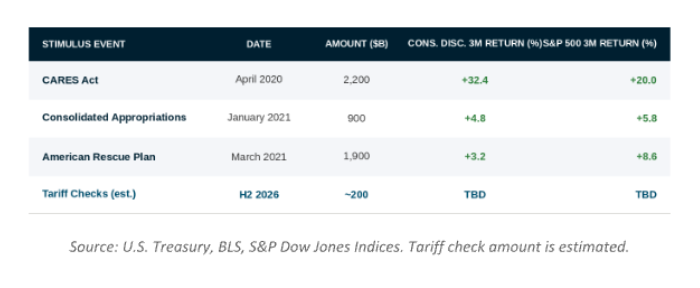
This is perhaps the most unconventional catalyst on the list. With midterm elections approaching, there is growing speculation that the administration could distribute tariff-related bonus checks to voters, effectively converting trade policy into a fiscal stimulus. On the surface, this sounds inflationary (and it is, more on that in the risks section below). But from a pure equity standpoint, a jolt of consumer spending power could potentially support retail, consumer discretionary, and housing-related sectors in the near term, although outcomes are uncertain.
Historical Stimulus Impact on Consumer Discretionary Sector
The sequence here may resemble the 2020 to 2021 stimulus checks, which coincided with consumer spending and sent certain sectors soaring. The difference this time is that the money would come from tariff revenue rather than deficit spending, giving it a different political narrative even if the economic effect is similar and the scale potentially smaller. If it materializes, sectors linked to consumer spending could catch a bid that few are positioned for. It is the kind of catalyst that sounds far-fetched until it is not, and by the time the market prices it in, the move may already be underway.
The Bear Case: Risks Lurking Beneath the Surface
The Consumer Credit Crack-Up
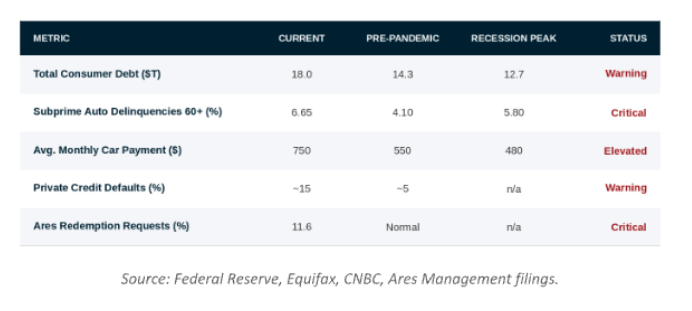
Beneath the surface of a still-functioning economy, the consumer credit picture is deteriorating faster than most realize (see abysmal Consumer Confidence surveys). Total U.S. consumer debt has surpassed
$18 trillion. Subprime auto delinquencies have hit 6.65%, a level that surpasses what we saw during the Great Recession. The average monthly car payment has surged to $750, requiring the average consumer to work 38 weeks of the year just to afford a new vehicle. These trends may indicate increasing financial strain among some households.
Consumer Credit Stress Indicators
It is not just autos. Private credit markets, the $1.7 trillion shadow lending system that fueled much of the post-pandemic corporate expansion, are showing signs of potential distress. Both Ares Management and Apollo Global Management have moved to cap investor redemptions from major funds, with Ares limiting withdrawals at 5% after redemption requests surged to 11.6%. Roughly 15% of borrowers in
private credit are no longer generating enough cash to fully cover their interest payments.
Jamie Dimon's warning about "cockroaches" in the credit markets is starting to look prescient. If defaults accelerate, regional banks with heavy auto and commercial real estate exposure could face real asset quality challenges, and that kind of stress has a way of metastasizing into broader equity weakness. Credit cycles do not announce themselves with headlines. They build quietly, then arrive all at once.
The Earnings Bar Is Too High, and AI May Not Save It
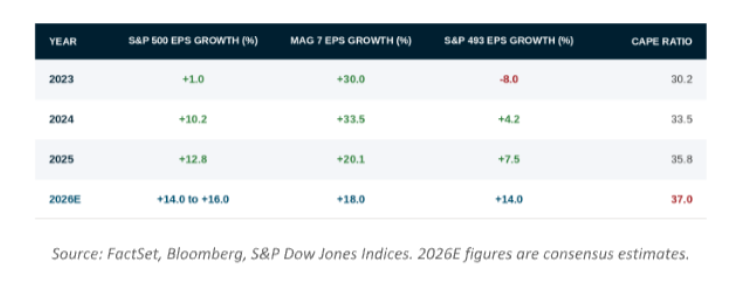
The market is priced for a very specific outcome: 14% to 16% earnings growth across the S&P 500 in 2026. For the 493 stocks outside the Magnificent Seven, that estimate represents a doubling in the pace of earnings growth compared to 2025. That is an extraordinarily high bar, and it leaves almost no margin for error. The CAPE ratio sits at approximately 37, placing current valuations in the top 10% of readings since 1988. Valuations at these levels may leave less margin for error; outcomes below expectations could result in increased market volatility or downside risk.
S&P 500 Earnings Growth and Valuation Metrics
What makes this especially precarious is that one of the key pillars of the bull thesis, AI-driven productivity and revenue growth, is facing its own reckoning. Hundreds of billions have been poured into AI infrastructure by the hyperscalers, but the market is beginning to ask a dangerous question: where are the returns? If companies like Microsoft, Google, or Amazon signal in upcoming earnings that AI capital expenditures are being pulled back, or that return timelines are being pushed out, it does not
just affect their stocks; it could challenge key elements of the current growth narrative.
The combination of stretched valuations, unrealistic earnings expectations for the broader market, and a potential crack in the AI thesis creates a scenario where even modest disappointments could trigger outsized selling. This is the kind of risk that does not show up until it shows up all at once, and by then, it is too late to reposition.
The USMCA Review: A Trade Shock Hiding in Plain Sight
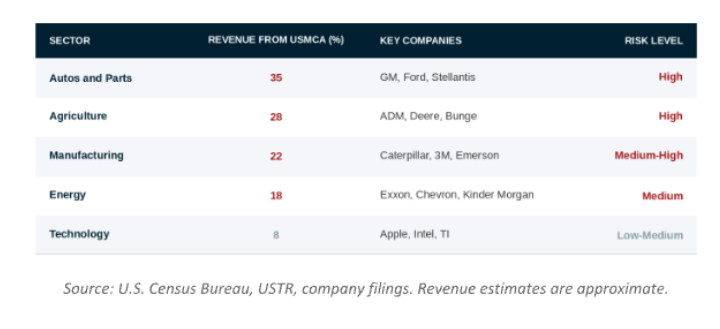
On July 1, 2026, the United States-Mexico-Canada Agreement undergoes its mandatory six-year review, and almost nobody in the equity market is talking about it. This is not a routine formality. The White House is widely expected to use the review as leverage, potentially threatening to scrap the trilateral pact in favor of bilateral agreements as a negotiating tactic. The sectors most directly exposed (autos, agriculture, manufacturing, and energy) represent a significant portion of the S&P 500's industrial base.
Sectors Most Exposed to USMCA Disruption
North American supply chains have been built around USMCA's framework for years. Any disruption, even temporary uncertainty during negotiations, could ripple through corporate guidance, inventory planning, and capital expenditure decisions for quarters to come. The base case from most analysts is that the agreement gets extended, but with painful concessions and negotiations that could stretch into late 2026 or beyond.
The problem is that base case scenarios tend to be priced in; it is the tail risks that blindside investors. A breakdown in talks, retaliatory measures from Canada or Mexico, or sector-specific carve-outs could introduce volatility if outcomes differ from current expectations. For an index already trading at elevated multiples with thin margin for error, a USMCA disruption is exactly the kind of exogenous shock that could catalyze a broader repricing. And right now, almost no one is hedging for it.
Looking Ahead
The point of this piece is not to predict whether the market goes up or down. It is that there is a raft of catalysts likely to move the market, and these are not the ones dominating the headlines. On the positive side, extreme bearish sentiment, a stealth defense rally, and potential stimulus from tariff revenue could all surprise to the upside. On the negative side, consumer credit deterioration, unrealistic earnings expectations compounded by AI capital expenditure uncertainty, and a largely ignored trade agreement review could deliver the kind of shocks that valuations this stretched simply cannot absorb.Frankly, we have no idea which, if any, of these forces may play out. Investors may consider maintaining diversified positioning and staying informed about potential risks and opportunities as market conditions evolve.
For more news, information, and analysis, visit the ETF Strategist Content Hub.
Originally published on ETF Trends
A message from Advisor Perspectives and VettaFi: Discover something new! Click here to register for our upcoming webcasts.
Disclosure
This material is provided for informational and educational purposes only and is intended solely for use by financial professionals and institutional counterparties. It should not be construed as investment advice, a recommendation, or an offer to buy or sell any security.
Modelist Inc. provides non-discretionary investment models, research, and related commentary. Modelist does not manage client assets, does not have trading discretion, and does not implement investment strategies on behalf of clients. Any investment decisions, including the implementation of Modelist’s models or insights, are made independently by the receiving adviser or platform.
Modelist does not have direct relationships with individual or retail investors, and this material is not intended for distribution to, or reliance by, retail clients.
The views expressed herein are those of the author as of the date indicated and are subject to change without notice. Certain statements may reflect forward-looking views, including expectations regarding market conditions, economic trends, and potential outcomes. These views are inherently uncertain and actual results may differ materially.
Any references to historical data, market performance, or sentiment indicators (including AAII survey data and S&P 500 returns) are provided for illustrative purposes only. Past performance is not indicative of future results.
Information contained herein has been obtained from sources believed to be reliable; however, its accuracy and completeness cannot be guaranteed.
References to indices are for illustrative purposes only. Indices are unmanaged and not available for direct investment.
All investing involves risk, including the possible loss of principal. There can be no assurance that any market scenario, expectation, or projection discussed will be realized.
Modelist Inc. is a registered investment adviser. Registration does not imply a certain level of skill or training. Additional information about Modelist, including its Form ADV Part 2A, is available upon request or at www.adviserinfo.sec.gov.
© Modelist
Read more commentaries by Modelist