In environments of geopolitical stress, diversification* is tested, and investors may need to think more wholistically about the assets included in their portfolio.
Diversification is supposed to be an investor’s first line of defense. The logic is familiar: If stocks provide growth, and bonds provide stability, then together they should help a portfolio weather most market environments.
But that relationship has never been guaranteed, and the escalation of hostilities in the Middle East is a timely reminder. As geopolitical tensions rose, markets quickly focused on the risk of disrupted energy flows, higher oil prices and a broader stagflationary impulse. We’ve seen that an oil story is rarely just about oil, and a sustained energy shock tends to reshape the entire macroeconomic backdrop—increasing the odds that stocks and bonds move together again.
Historically, one asset class that has behaved differently during geopolitical stress is commodities. The case for commodities is about owning a diversified basket of raw materials—not just oil—that may respond to global economic and geopolitical shifts unlike traditional assets.
Limits of the traditional core portfolio
The military conflict with Iran illustrates how quickly geopolitical events can ripple through financial markets. Fighting in the Middle East immediately raised concerns about global energy supply—particularly around critical transit points such as the Strait of Hormuz. Oil prices may have reacted first, but the economic effects don’t stop there.
Higher energy prices can push inflation higher while simultaneously weighing on economic growth—a combination commonly referred to as stagflation. When that happens, the traditional relationship between stocks and bonds can break down.
Historically, the negative correlation between equities and bonds depends on a relatively stable macro environment where growth and inflation move together. When growth accelerates, inflation often rises modestly, and equities perform well while bonds weaken.
But oil shocks may disrupt that dynamic by pushing inflation higher while slowing economic activity—a potential shift that markets have begun to fear in recent weeks. Rising energy prices tied to geopolitical instability have increased the risk of both slower growth and higher inflation, raising the possibility that stocks and bonds could once again move in the same direction.
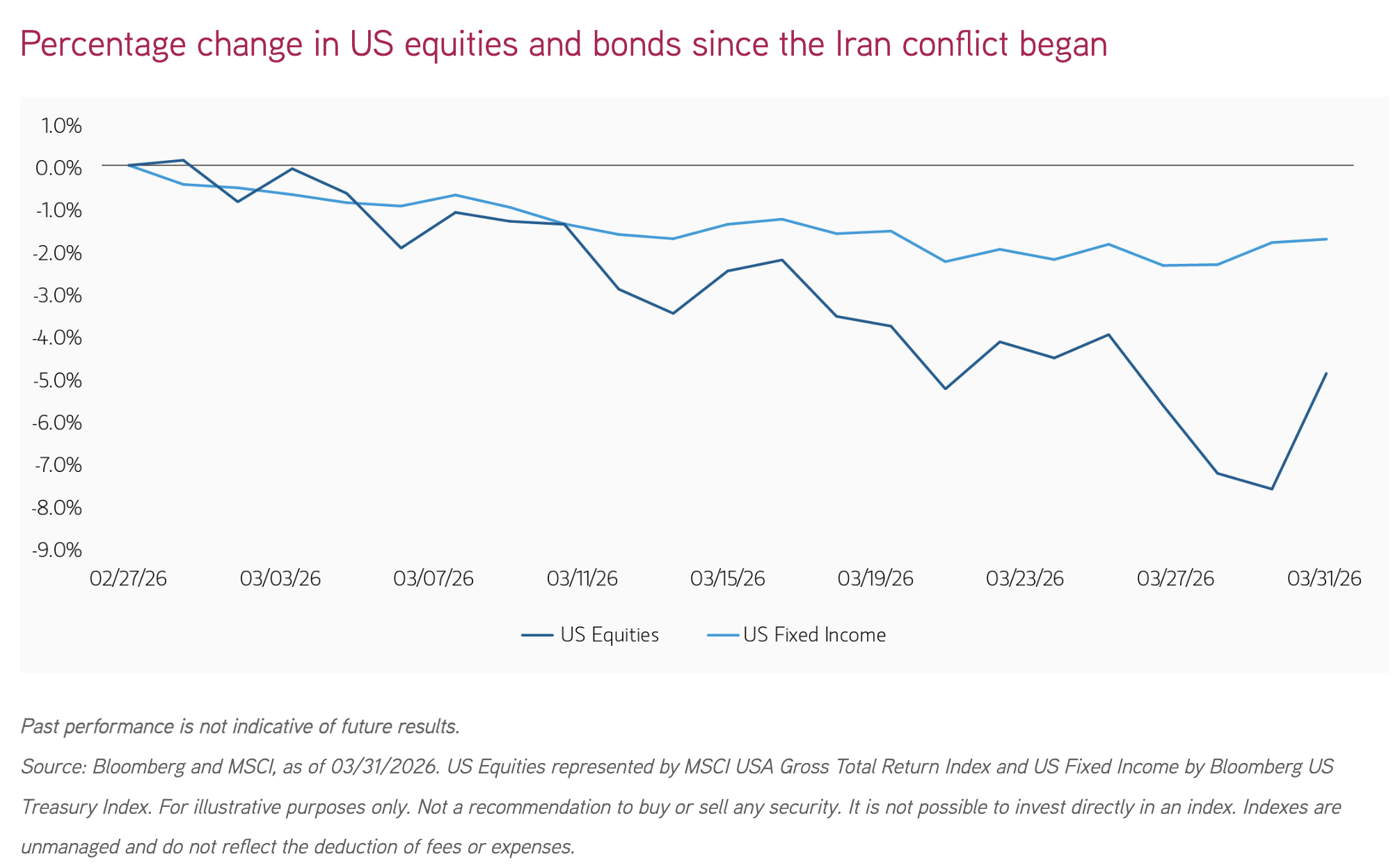
We already see evidence of this dynamic. As the Iran conflict intensified, both equity and bond prices declined in unison, eroding the protective role fixed income has typically played in a diversified portfolio.

For investors relying exclusively on stocks and bonds, this scenario poses a serious threat. If both assets struggle simultaneously, the portfolio loses its primary source of diversification. This is where we think commodities could enter the discussion.
Why diversified commodities may improve portfolio resilience
Commodities have historically provided a diversification benefit when held in combination with traditional assets, such as stocks and bonds. That benefit is realized through the relatively high volatility and low correlation that commodities have exhibited with other risky assets.
A key distinction of commodities relative to other financial assets is that they represent the raw materials underpinning the global economy. Because supply disruptions, geopolitical rifts and shifts in real economic demand drive their prices, they often respond positively to the same shocks that can challenge stock and bond performance. Stocks are claims on future earnings, which are vulnerable to weaker demand and higher input costs. Bonds are claims on nominal cash flows, which are vulnerable when inflation expectations rise. Commodities, by contrast, tend to reprice in the opposite direction when scarcity becomes the market’s dominant concern, and that may work in the investor’s favor.
This helps explain why commodities may outperform traditional assets during geopolitical stress. In a sense, commodities could be described as carrying a positive geopolitical risk premium. In other words, investors are compensated for owning assets whose prices tend to rise when the world becomes more resource-constrained, less predictable or more fragile.
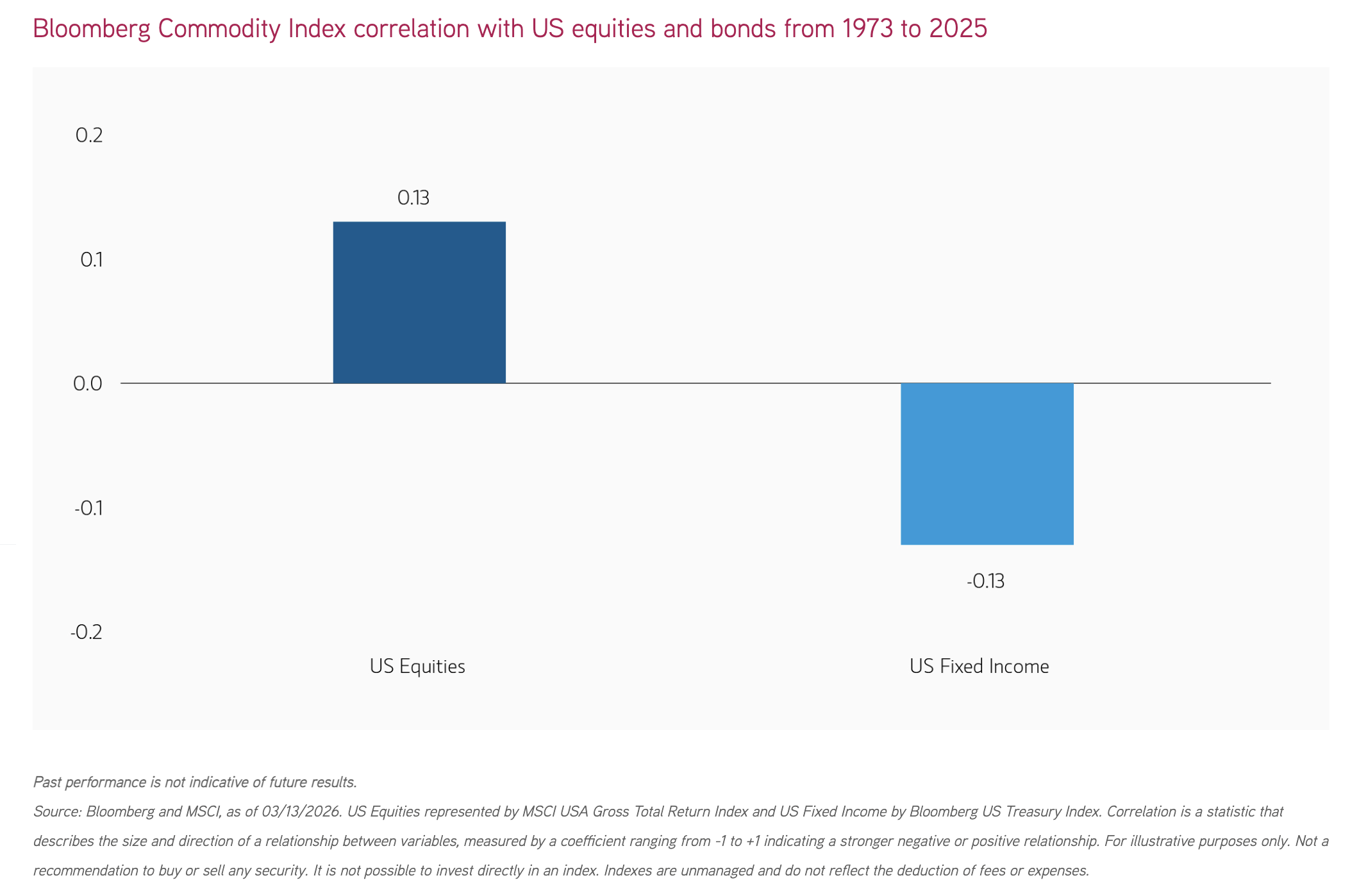
Over the last half-century, a commodity index such as the Bloomberg Commodity Index had a 0.13 correlation with US equities represented by MSCI USA Gross Total Return Index and -0.13 with US fixed income represented by the Bloomberg US Treasury Index. As an asset class that tends to zig while others zag, commodities may help lower expected volatility versus a portfolio that doesn’t contain them, potentially improving resilience.
The lesson here is not replacing a portfolio with oil—in fact, it’s the opposite. Geopolitical events are inherently unpredictable, so investors would be hard pressed to know in advance which part of the commodity complex could feel the strain most acutely. One episode may center on crude oil and refined products. Another may hit grains through disruptions in the Black Sea region. Yet another may move industrial metals through sanctions, shipping bottlenecks or power shortages. We believe a broad basket of commodities helps provide more robust diversification because it may improve the odds of capturing the impact of the next shock—whatever form that takes.
The bottom line
Recent geopolitical events involving Iran highlight a challenge for investors: Diversification may falter when inflation and growth move in opposite directions. In these moments, traditional stock and bond portfolios may struggle to provide the balance investors seek. Commodities may offer an additional source of diversification. Their performance tends to improve during geopolitical stress—precisely the environment where traditional assets can face pressure.
For investors thinking about long-term portfolio resilience, the idea isn’t to abandon stocks or bonds, but rather to consider a modest allocation to commodities. A diversified basket of commodities may provide exposure to a unique opportunity set that stocks and bonds alone cannot capture.
* Diversification does not eliminate the risk of loss.
The value of commodity investments will generally be affected by overall market movements and factors specific to a particular industry or commodity, which may include weather, embargoes, tariffs, health, political, international and regulatory developments. Economic events and other events (whether real or perceived) can reduce the demand for commodities, which may reduce market prices and cause their value to fall. The use of derivatives can lead to losses or adverse movements in the price or value of the asset, index, rate, or instrument underlying a derivative due to failure of a counterparty or due to tax or regulatory constraints.
The views expressed in these posts are those of the authors and are current only through the date stated. These views are subject to change at any time based upon market or other conditions, and Parametric and its affiliates disclaim any responsibility to update such views. These views may not be relied upon as investment advice and, because investment decisions for Parametric are based on many factors, may not be relied upon as an indication of trading intent on behalf of any Parametric strategy. The discussion herein is general in nature and is provided for informational purposes only. There is no guarantee as to its accuracy or completeness. Past performance is no guarantee of future results. All investments are subject to the risk of loss. Prospective investors should consult with a tax or legal advisor before making any investment decision. Please refer to the Disclosure page on our website for important information about investments and risks.
04.05.2028 | RO 5359269
Investment advisory services offered through Parametric Portfolio Associates LLC ("Parametric"), an investment advisor registered with the US Securities and Exchange Commission (CRD #114310). Parametric is also registered as a portfolio manager with the securities regulatory authorities in certain provinces of Canada (National Registration Database No. 42850) with regard to specific products and strategies. Parametric provides advisory services directly to institutional investors and indirectly to individual investors through financial intermediaries. The information on this website does not constitute an offer to sell, or a solicitation of an offer to purchase, securities in any jurisdiction to any person to whom it is not lawful to make such an offer. Investing entails risks, and there can be no assurance that Parametric (and its affiliates) will achieve profits or avoid incurring losses. All investments are subject to potential loss of principal. Parametric does not provide tax or legal advice. Prospective investors should consult with a tax or legal advisor before making any investment decision. Please refer to the disclosure page for important information about investments and risks.
S&P Dow Jones Indices are a product of S&P Dow Jones Indices LLC (“S&P DJI”) and have been licensed for use. S&P® indexes are registered trademarks of S&P DJI; Dow Jones® is a registered trademark of Dow Jones Trademark Holdings LLC (“Dow Jones”); S&P DJI, Dow Jones, and their respective affiliates do not sponsor, endorse, sell, or promote Parametric and its strategies, will not have any liability with respect thereto, and do not have any liability for any errors, omissions, or interruptions of the S&P Dow Jones Indices.
©2026 Parametric Portfolio Associates LLC. All rights reserved. 800 Fifth Avenue, Suite 2800, Seattle, WA 98104.
NOT FDIC INSURED. OFFER NOT A BANK GUARANTEE. MAY LOSE VALUE. NOT INSURED BY ANY FEDERAL GOVERNMENT AGENCY. NOT A DEPOSIT.
A message from Advisor Perspectives and VettaFi: Discover something new! Click here to register for our upcoming webcasts.
© Parametric
Read more commentaries by Parametric