Bear Market in Diversification
Membership required
Membership is now required to use this feature. To learn more:
View Membership BenefitsWhy rising inflation broke traditional diversifiers and why tactical management matters now more than ever.
The U.S. stock market hit a record high on January 27, 2026, as investors prepared for additional Fed rate cuts, fiscal stimulus, and fading inflation. Just two months later investors now see a rate hike almost as likely as a rate cut and are expecting inflation to surge past 3% as the closure of the Strait of Hormuz brings back the specter of rising prices and the S&P 500 approaches a potential 10% correction.
We do not expect another Fed rate hiking cycle or 9% inflation, but market performance in 2022 taught investors an important lesson about diversification. Advisors who worked to maintain globally diversified and risk-balanced portfolios learned an uncomfortable truth. Traditional diversifiers such as bonds, gold, commodities, and managed futures not only lagged equities, but often failed during the exact periods when clients needed protection.
When Traditional Diversifiers Fail
Market history shows that clients rarely abandon a strategy due to missed upside. They abandon it because of fear. Deep and extended drawdowns overwhelm even the most disciplined investors.
Advisors have long relied on diversifiers to soften that emotional burden. Recent cycles revealed the fragility of that assumption. Correlations shifted, performance became inconsistent, and many diversifiers failed to provide support when volatility surged
Many of these diversifiers also carried high volatility and significant maximum drawdowns, which made them difficult for clients to stay invested in over full market cycles.
Why Diversification Failed
1. Rolling returns reached historical extremes
Rolling ten-year S&P 500 returns going back to 1881 have historically cycled between high and low ranges. After extreme readings, they typically reverted. Prior periods of unusually strong returns earned memorable labels such as the Roaring Twenties, the Nifty Fifty, and the Dot-com Boom.
We are once again at an extreme. History shows that diversified investors significantly underperformed during similar cycles. Many eventually abandoned diversifiers because they felt pressure to chase equity returns.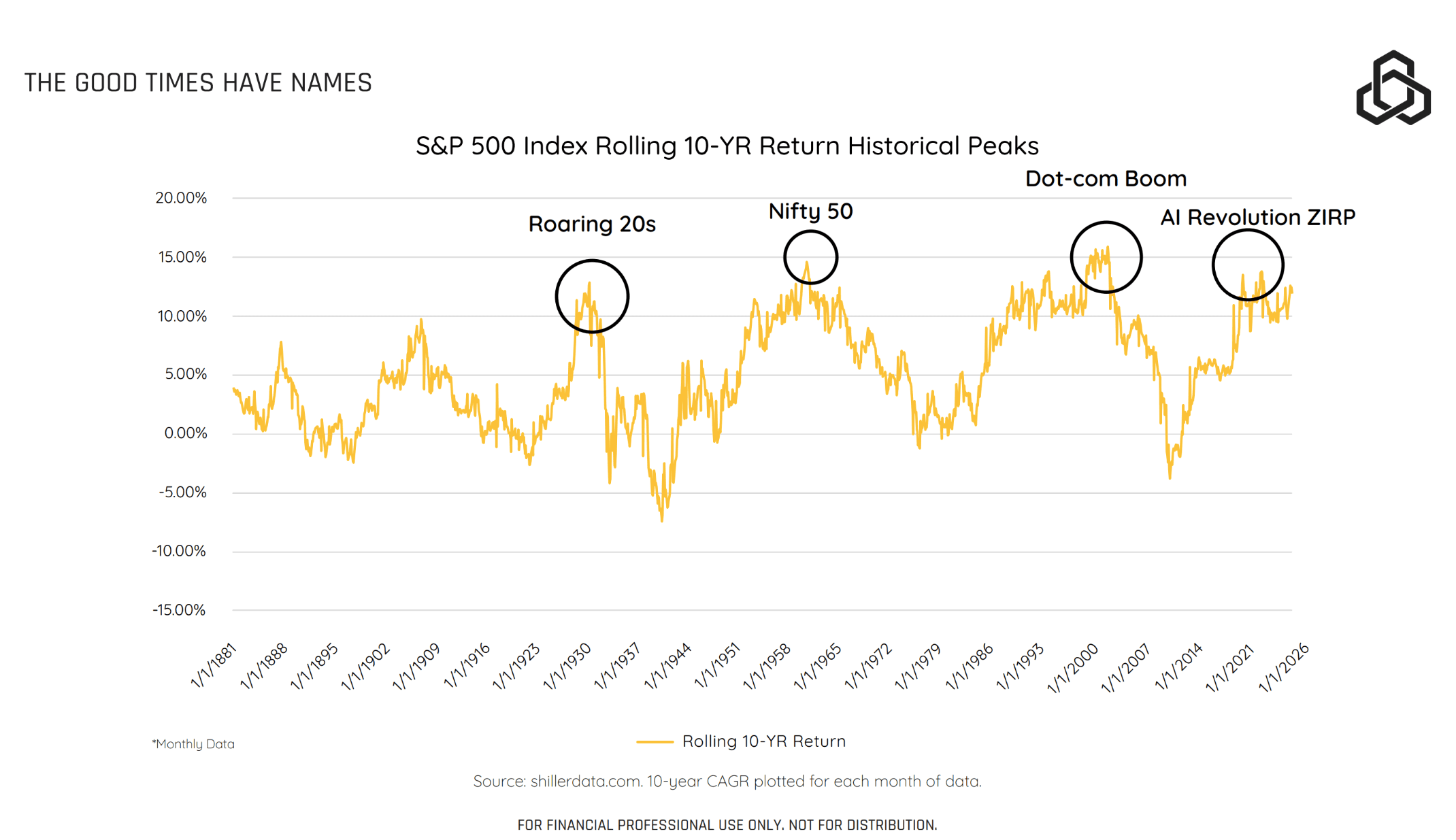
2. Traditional diversifiers broke down at the same time
For decades, advisors relied on the mix of stocks and bonds. Falling interest rates supported bond prices and kept correlations negative until 2022. That year served as a wake-up call as stocks and bonds declined together.
Other common diversifiers also struggled:
-
Bonds failed during the period when they were most expected to help.
-
Gold, commodities, managed futures showed high volatility and experienced deep drawdowns.
-
Global equities failed to keep pace with U.S. large-caps.
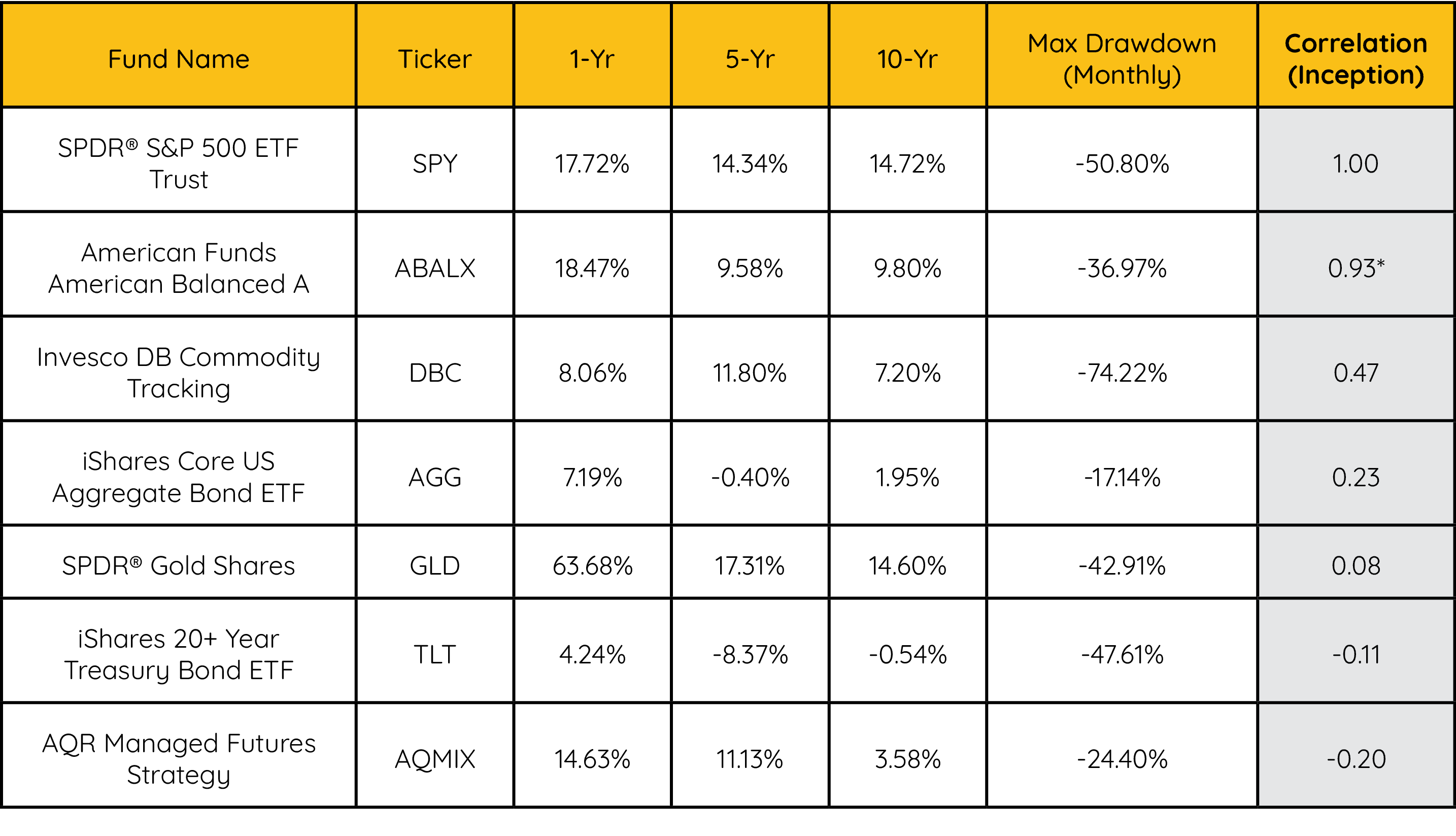
Meanwhile, the cheap, passive SPDR S&P 500 ETF Trust (SPY) compounded at roughly 14.72% per year over the past 10 years, which has made the gap between equities and diversifiers even more difficult for investors to accept.
There has been a major tradeoff. Assets that offer “return” tend to have higher drawdowns (Gold) and/or higher correlations (American Funds) to the S&P 500. Assets that offer lower correlation and/or drawdown usually come with lower returns. See the table below.

Moving Beyond Traditional Diversification
Traditional diversification depends heavily on correlations remaining stable. However, correlations shift over time. A quick look at the rolling one-year correlation between stocks and bonds shows that the relationship changes over time with inflation often serving as a catalyst for positive correlation and loss of traditional portfolio diversification.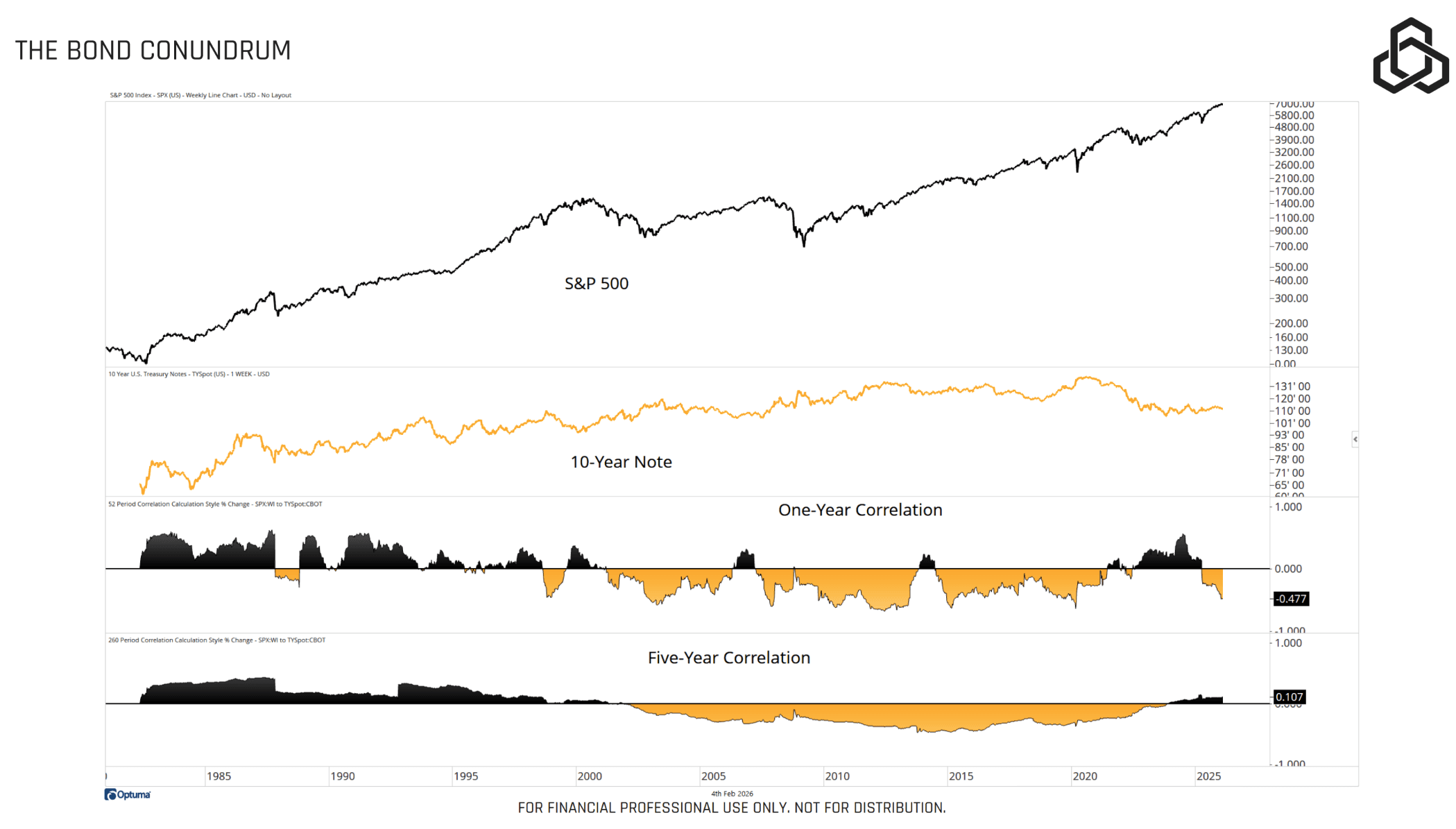

Tactical risk management uses a different approach.
-
It does not attempt to predict market tops or bottoms.
-
It reduces exposure when risk builds and increases exposure when conditions improve.
-
It seeks to create a smoother investment experience that clients can follow over time.
Reducing deep drawdowns makes long-term compounding more realistic and client behavior more stable.
Tactical as a Diversifier
Potomac’s Bull Bear strategy aims to offer competitive long-term returns, lower correlation to the S&P 500, and controlled drawdowns. These qualities are essential for any investment seeking to serve as a true diversifier.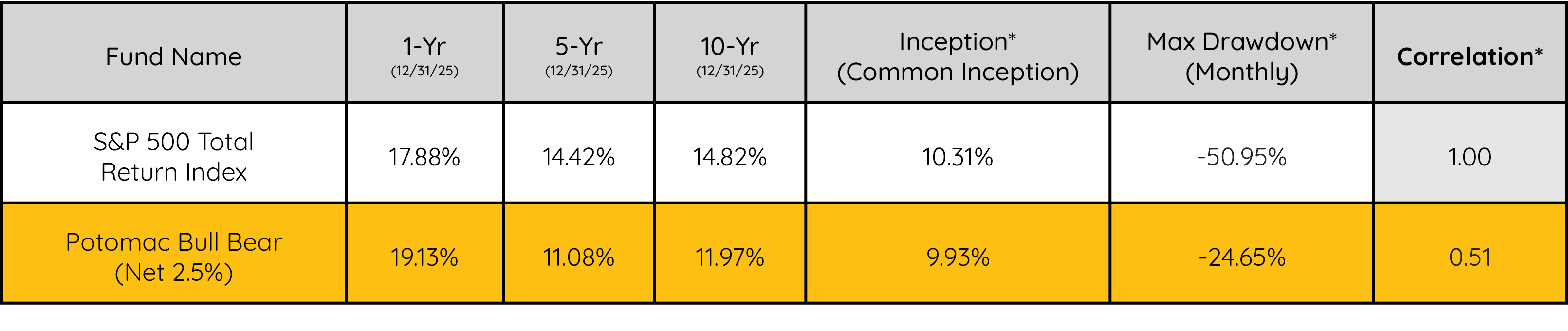

As the table above shows, Bull Bear demonstrates:
-
Competitive one-year, five-year, and ten-year returns.
-
Maximum drawdown that is meaningfully lower than the S&P 500.
-
Correlation low enough to function as a genuine diversifier rather than a diluted equity position.
Potomac strategies rely on quantitatively tested systems to manage risk, not on hope that an asset becomes negatively correlated during a bear market.
Why This Matters for Advisors
Investors do not fire advisors because bonds underperformed or commodities were volatile. They fire advisors because they experience drawdowns they cannot emotionally tolerate.
A long bull market hid the structural weaknesses of traditional diversifiers. When correlations broke and volatility rose, traditional approaches proved insufficient.
Advisors now need tools that can:
-
Manage risk intentionally rather than passively
-
Provide rules-based downside protection
-
Offer a return path that keeps clients invested
-
Build a behavioral advantage during market stress
Tactical strategies can help achieve these goals.
Final Thoughts
The bear market in diversification is not theoretical. It appears in performance data, in client conversations, and in the stress advisors face when correlations fail, and traditional diversifiers break down.
Diversification is still important. However, traditional diversification alone is no longer enough.
In a market environment defined by volatility, correlation breakdowns, and emotional decision-making, tactical risk management offers a modern solution to an old challenge. It helps advisors keep clients disciplined, engaged, and aligned with long-term objectives.
Authored by Dan Russo
Originally posted on Potomac.
For more news, information, and analysis, visit the ETF Strategist Content Hub.
Originally published on ETF Trends
A message from Advisor Perspectives and VettaFi: Discover something new! Click here to register for our upcoming webcasts.
PFM-601-20260330
Performance results of Potomac strategies reflect the composite performance of all fully discretionary portfolios managed by Potomac according to the strategy subject to policies that may require the exclusion of certain accounts. All returns are time-weighted and reflect the reinvestment of dividends and capital gain distributions. Gross performance returns do not reflect the payment of investment advisory fees but reflect the underlying fund management fees, other fund (administrative) expenses, and redemption or 12b1 (fund marketing) fees, if any. Net performance reflects the deduction of a model fee (the highest investment advisory fee charged by Potomac), underlying fund management fees, other fund (administrative) expenses and, if any, redemption or 12b1 (fund marketing) fees. Net of fee returns are calculated using a model fee of 2.5%. The model fee, applied monthly, is the highest fee that may be or has been charged to an investor in this composite. Actual investment advisory fees incurred may vary. Past performance does not guarantee future results. There is no guarantee that any investment strategy or account will be profitable or will avoid loss. Individual investors’ objectives, financial situations, their specific instructions, or restrictions on investments, or the time at which an account is opened, or additions are made may result in different trades and returns. Performance for the strategy presented may differ materially (more or less) from the performance of the comparable benchmark and other Potomac investment strategies. Market and economic conditions could change in the future producing materially different returns. Results do not reflect the impact of taxes for taxable accounts or their owners. You cannot invest directly in an index. This presentation is supplemental to the composite report. Potomac claims compliance with the Global Investment Performance Standards (GIPS®). The Annual GIPS® Report is available upon request. GIPS® is a registered trademark of CFA Institute. CFA Institute does not endorse or promote this organization, nor does it warrant the accuracy or quality of the content contained herein.
Potomac Fund Management (“Potomac”) is an SEC‑registered investment adviser located in Bethesda, Maryland. Registration does not imply a certain level of skill or training, nor is it an endorsement by the SEC. This material is for general informational purposes only and does not constitute investment advice, tax advice, or a recommendation regarding any specific product, security, strategy, or investment decision. Readers should not assume that any discussion or information applies to their individual circumstances. This communication does not constitute an offer to buy or sell any security or a solicitation to provide personalized investment advice for compensation. Nothing herein should be construed as individualized or tailored advice delivered over the internet.
Opinions expressed are current as of the date of publication and may change without notice. Information obtained from third‑party sources is believed to be reliable, but Potomac does not guarantee its accuracy or completeness and is not responsible for any third‑party content referenced or linked in this material.
Investing involves risk, including the possible loss of principal. Past performance does not guarantee future results. For additional important disclosures, please visit potomac.com/disclosures.
© Potomac
Membership required
Membership is now required to use this feature. To learn more:
View Membership BenefitsSponsored Content
Upcoming Virtual Events View All












