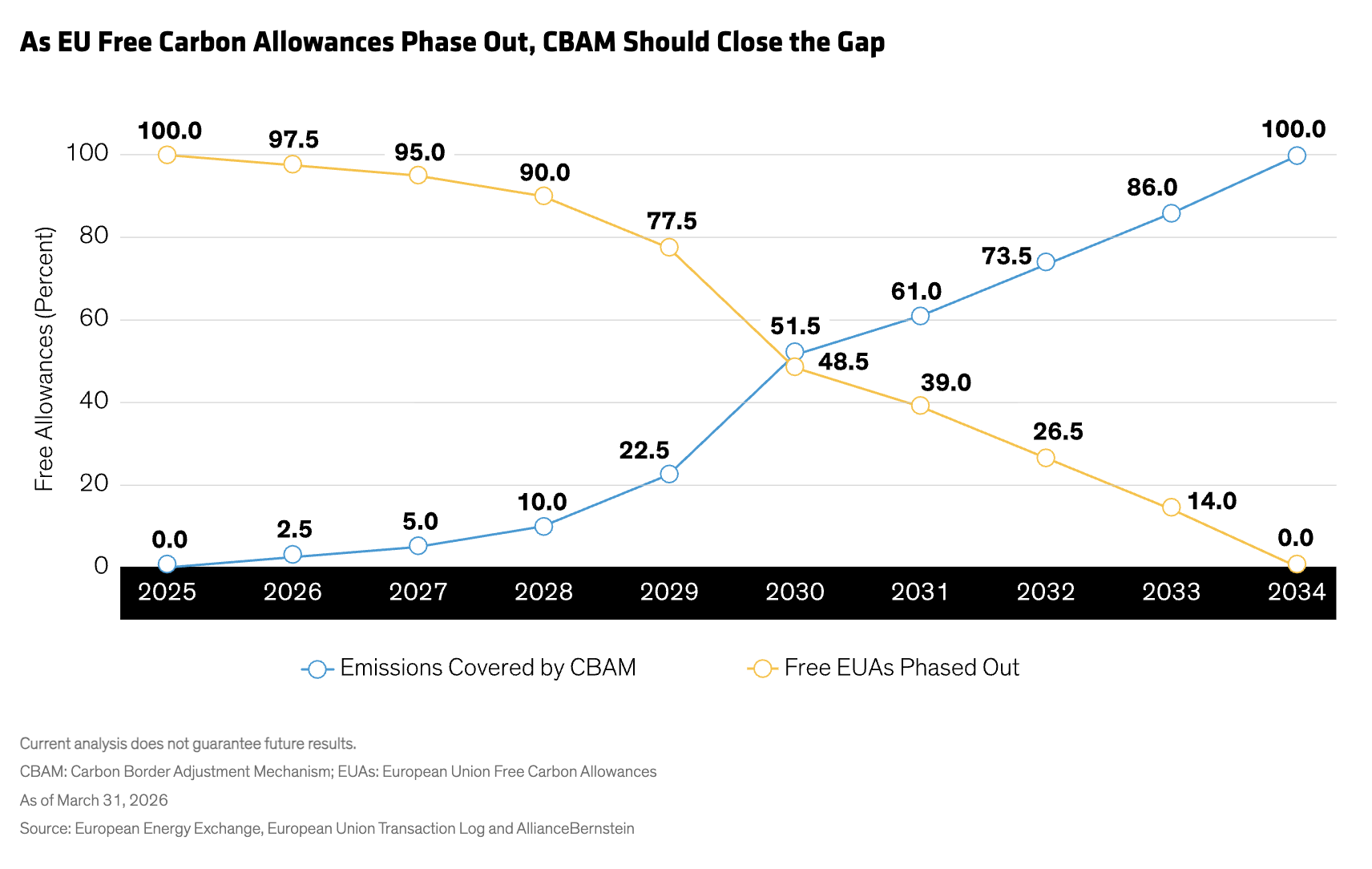
The European Union (EU), pursuing ambitious decarbonization goals, is significantly recalibrating its emissions compliance regime with the Carbon Border Adjustment Mechanism (CBAM). This new border tax intends to promote fair competition amid varying emissions rules and costs. Our research suggests it could also offer insight into profitability as the rising costs to meet carbon limits weigh on corporate financial health, creating winners and losers.
Fewer EU Carbon Allowances Could Add to Costs
CBAM will gradually tax carbon-intensive imports to ensure they cost the same as domestic goods facing rising carbon pricing at home. It’s in response to the planned phaseout of the EU’s free carbon allowances, which are a key emissions-management tool for the region’s cap-and-trade Emission Trading System (ETS).
Since 2005, the ETS has issued eligible companies—from energy to aviation—free annual allowances that they then surrender based on each’s carbon dioxide production. But the EU is gradually phasing out allowances to wean firms off them, ideally so they’ll invest in greener production methods on their own.
As allowance supplies shrink, domestic producers can be put at a competitive disadvantage compared to importers whose goods originate in countries with low or no carbon costs. To fix that, CBAM tariffs are ramping up through 2034 in lockstep with carbon allowance phaseouts (Display).

Read more: DC Sponsors Can Help Turn the Retirement Puzzle into a Plan
Balancing the Cost of Carbon Across EU Companies
CBAM should also help manage carbon leakage—when lower emissions in one area counterproductively lead to higher output elsewhere. Another is cross-border resource shuffling, as companies shift carbon-intensive product shipments to countries with weaker climate rules. This is why the tax is focused on industries where such risks are highest, namely cement, iron, steel, fertilizer, aluminum, hydrogen and electricity.
Beyond leveling the competitive playing field, we believe CBAM tariffs will offer new insights into company profitability. For one, we can already codify CBAM’s expected financial hit to certain industries. It can also inform active investors of how companies are adapting to greener production methods, which increasingly factor into assessing corporate strength.
For example, we believe companies with carbon-efficient output methods will face lower long-term carbon costs—an advantage as carbon prices are expected to soar over the next three years. Lower-emitting companies also tend to have more predictable cash flows and less perceived long-term financial risk among lenders, which potentially gives them easier access to low-interest green-financing options than high-carbon producers.
CBAM’s Projected Impact on Earnings
In the lead up to CBAM, we modeled its potential earnings impact on domestic-leaning and importer firms across two of the heaviest carbon-producing industries: steel and cement. Steel markets have started to price in the impact of both CBAM and tighter supply of free allowances. We’ve drilled down considerably further, modelling the levy’s financial hit on specific companies—and their individual plants—using orbiting satellite emissions data, EU allowance projections and geospatial mapping of local carbon emissions exposure. For example, we project a Turkish steelmaker will see a €300 million CBAM cost in the next four years, compelling it to invest some €2.8 billion in hydrogen injection, massive solar power expansion and low-combustion biochar production to avoid the tax.
Our research also isolated the financial impact of the shrinking supply of free allowances, which will be particularly hard felt by domestic producers subject to domestic carbon costs. We project, for instance, that one EU-based global steel distributor with over 33 production sites faces a €5.5 billion hit over the next six years. But producers like it that invest in low-carbon processes sooner should see future production costs shrink, which helps keep them competitive toward zero-emissions by 2050.
Our analysis of cement makers offers similar insights into strong versus weak corporate outlooks under CBAM, given carbon emissions are these companies’ top expense. In our view, EU cement makers are well positioned for the transition, with most already using low-emitting manufacturing processes compared to overseas peers. Their decarbonization strategies should also drive sustainable pricing power, which, along with lower future operating costs, can lead to organic growth in market share, in our view.
CBAM should be impactful, but it’s a work in progress and subject to change as data emerge on its broader effects. Regulators have suggested they may adjust or exempt tariffs where they believe they would do more harm than good, such as raising fertilizer prices to the extent they threaten the region’s food security.
Carbon Compliance as a Financial Driver
We believe CBAM is more than a border tax. It’s a strong financial signal that separates companies with credible decarbonization strategies from those facing rising carbon‑compliance costs.
As carbon prices climb and free allowances disappear, we believe firms with credible transition efforts will gain cost advantages and resiliency. In our view, this could change how investors view the competitive landscape as carbon efficiency rapidly becomes a core driver of long‑term profitability.
The authors would like to thank Peter Hojsteen-Ljungbeck, ESG Data Research Analyst, and Rachel Hughes, Investments Rotational Associate at AB, for their significant contributions to the research behind this blog.
The views expressed herein do not constitute research, investment advice or trade recommendations, do not necessarily represent the views of all AB portfolio-management teams and are subject to change over time.
Patrick O’Connell is a Senior Vice President and Director of Responsible Investing Portfolio Solutions and Research.
Paulina Alcantara is a Senior Research Analyst on the Emerging Markets Value team, responsible for covering Latin America.
Okan Akin is a Senior Vice President and Corporate Credit Research Analyst, focusing on European high-yield issuers.
A message from Advisor Perspectives and VettaFi: Discover something new! Click here to register for our upcoming webcasts.
© AllianceBernstein
Read more commentaries by AllianceBernstein