A Robot Economy: Who Gets Rich, Who Gets Left Behind
Membership required
Membership is now required to use this feature. To learn more:
View Membership BenefitsRobots are coming to the economy. It is inevitable, really, and there is nothing that will stop it. At some point in the not-so-distant future, robots will infiltrate every aspect of our lives, from office work and manufacturing to service work and trade skills, and even your home. Here are some numbers for you.

The real question I want to explore in today’s post is what happens to the people who don’t own the robots? Let’s dig in.
I spent the past week reading through a detailed account of what’s happening inside Figure’s robotics facility in San Jose, and I want to be direct: the humanoid robots economy is no longer a thought experiment. Figure’s latest robot ran for 67 consecutive hours of fully autonomous work, kitchen tasks, package handling, and logistics, without a single error. That’s not a demo reel, that’s a product. When you factor in a projected lease cost of roughly $10 a day, it’s a product priced to replace the single largest input cost on every corporate income statement in America: human labor.
The optimists call what’s coming the “age of abundance.” Cheaper goods, freed-up time, robots building robots until supply constraints essentially disappear. That would be incredible, and you should not dismiss that vision. Furthermore, I think it’s directionally correct over a long enough horizon. But after 35 years of watching economic cycles play out, I’ve learned that the gap between a macro promise and the lived experience of actual households is where the real story lives.
In an upcoming article, we will dig deeper into the problems plaguing the K-shaped economy. However, that bifurcated structure, in which higher-income households ascend while lower-income ones stagnate, was already a structural feature of American life before a single humanoid robot touched a factory floor. Back to our question, does the arrival of humanoid robots at scale fix that problem? Or, does it make it dramatically worse? The answer, I believe, is both, in that order, and separated by a decade of potential pain.
Read more: Government Debt: Not What The Doom Crowd Thinks It Is
The Technology Of Robots Is Not Waiting For A Policy Response
It’s worth taking the technology seriously before discussing the economics, because the economics are downstream of the hardware reality. Figure has replaced over 100,000 lines of handwritten control code with a single neural network — what they call Helix 2 — that controls the robot’s entire body in real time. The key shift is that neural networks learn from data rather than explicit instructions. Once a robot masters a task, that knowledge propagates instantly across the entire fleet. Humans don’t work that way. Robots do.
At $300 per month to lease, against a U.S. minimum wage that runs $15 to $20 per hour, a humanoid robot is already 50 times cheaper than the human it displaces, and it works around the clock without benefits, turnover, or OSHA violations. The corporate incentive to adopt is not subtle. JPMorgan’s own disclosures describe AI-driven efficiency gains of 40% to 50% in certain operations. Add a physical labor layer to that, and you have the most powerful deflationary force for corporate margins in modern history.
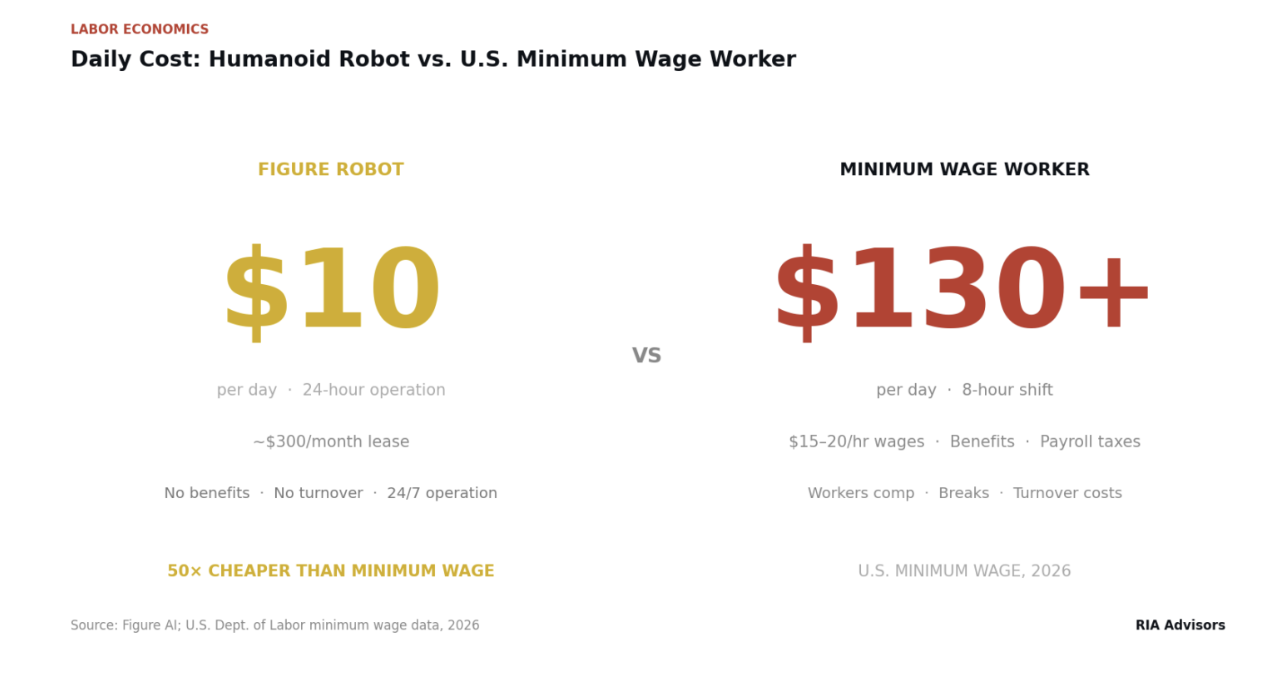
While shareholders of corporations with large labor forces will love the improvement in profit margins, workers will not. That asymmetry is not a flaw in the system; it’s a feature of who owns the system. And that ownership structure is the core issue this article is really about.
The K-Shaped Economy Was Already Broken
Here’s what makes the discussion of humanoid robots’ economy so complicated: we’re not starting from a position of broad-based prosperity. The K-shaped economy is already a structural, not cyclical, feature of modern America. The Federal Reserve’s own data shows the top 1% of households hold nearly 32% of total net worth, while the bottom 50% collectively hold 2.5%. The portion of GDP flowing to workers as compensation just hit its lowest level in over 75 years of Bureau of Labor Statistics tracking. The middle class shrank from 61% of the population in 1971 to barely 51% in 2023.
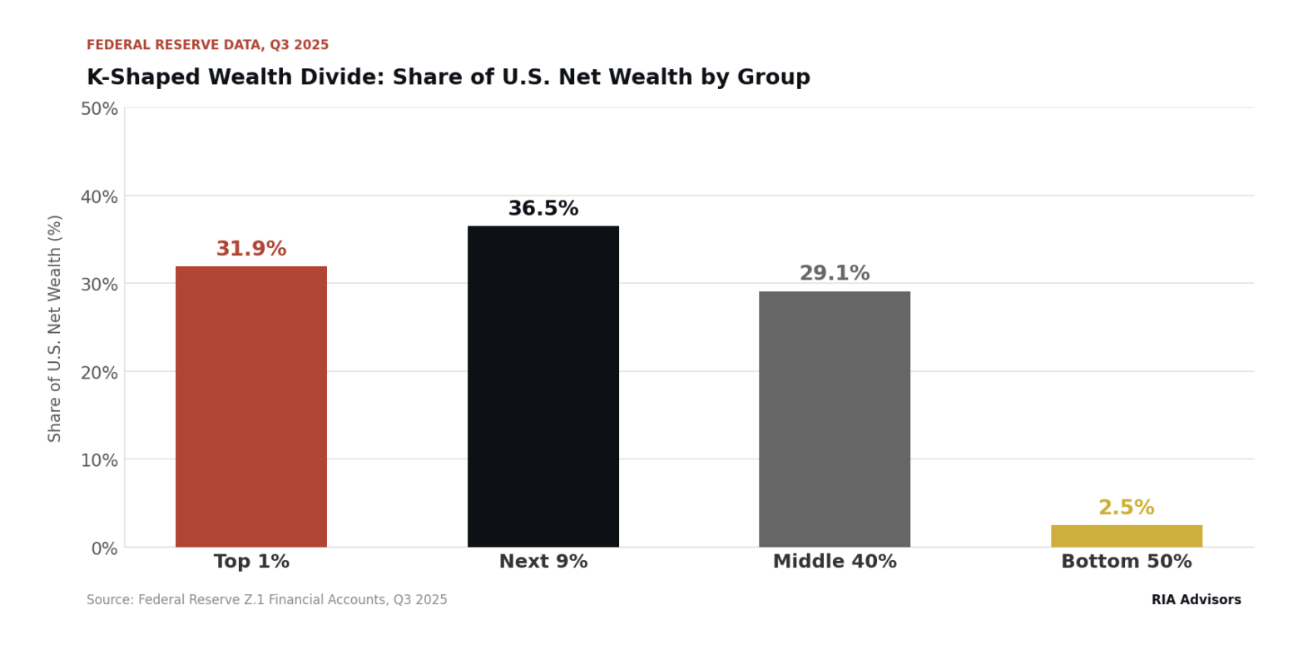
Moody’s Analytics chief economist Mark Zandi described this not as a temporary anomaly but as “a structural, fundamental issue.” U.S. Bank’s economics team concluded in their 2026 report that income concentration now exceeds its pre-pandemic peak and sits at levels not seen in 60 years. These figures predate the meaningful deployment of humanoid robots. They reflect decades of technology-driven productivity gains that have flowed disproportionately to capital owners rather than to labor.

Fortune’s analysis earlier this year captured the consensus view among economists. That view is that while AI and robots may eventually close the inequality gap, productivity gains need to first reach low-skilled workers. That must come through real wage increases at the bottom of the distribution, before that convergence happens. That process won’t complete until well into the 2030s at the earliest. In the meantime, the wealth effect continues to push the two tracks of the K further apart.
Stanford’s Erik Brynjolfsson, director of the Stanford Digital Economy Lab, drew a blunt historical parallel: the Midwest auto communities hollowed out by trade and automation in the 1990s. But the coming displacement is potentially 10 to 100 times more disruptive — not because it’s faster, but because it spans both blue-collar and white-collar work simultaneously. Software engineers, call center workers, and administrative roles face AI-driven displacement. Factory workers, warehouse staff, and service workers are facing displacement by humanoid robots. There’s no obvious “up-the-ladder” escape hatch when both rungs are being removed at once.
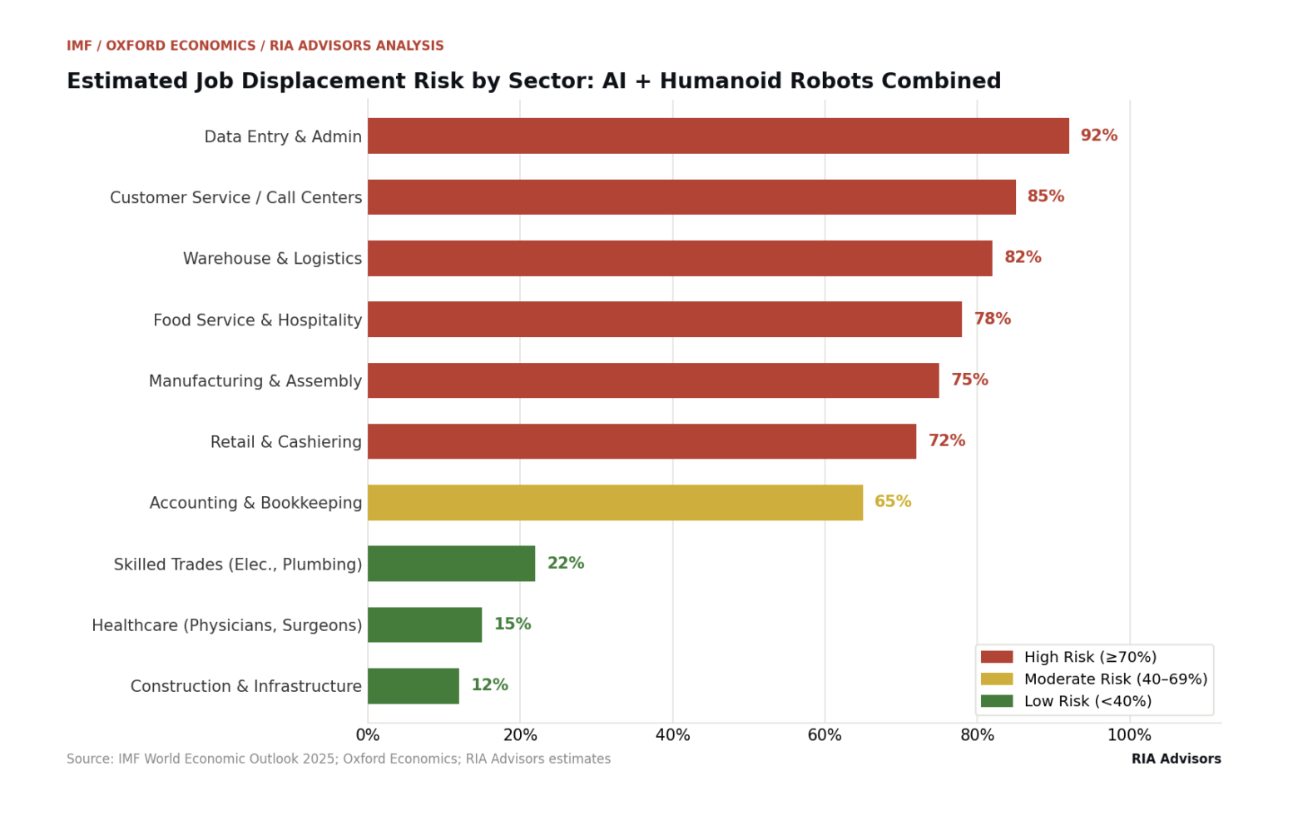
We already discussed the structural challenge in our January 2026 piece on AI Productivity, Employment, and UBI. The IMF estimates that AI could significantly affect nearly 40% of jobs worldwide. But the distribution of risk is deeply unequal. Entry-level roles, historically the on-ramp for younger workers without established skills, are exactly the jobs being automated first.
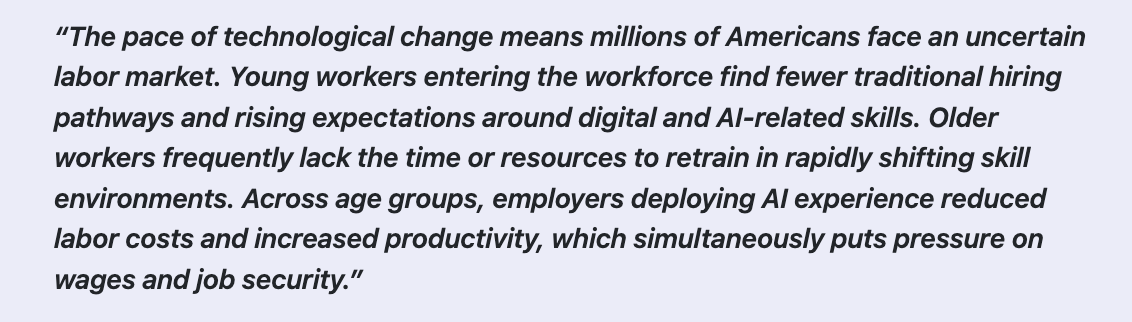
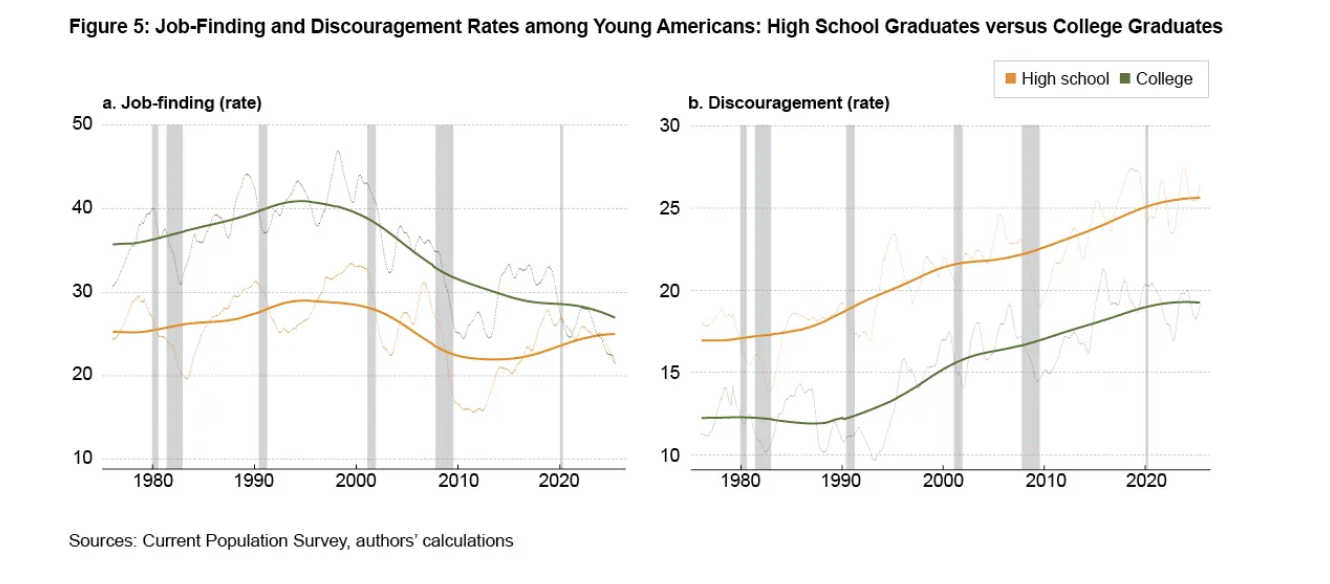
The problem already exists, and robots will likely only make things worse. For example, layoffs in 2025 ran more than 50% above the prior year, according to Challenger, Gray & Christmas. That displacement risk will grow further as robots enter the mainstream.
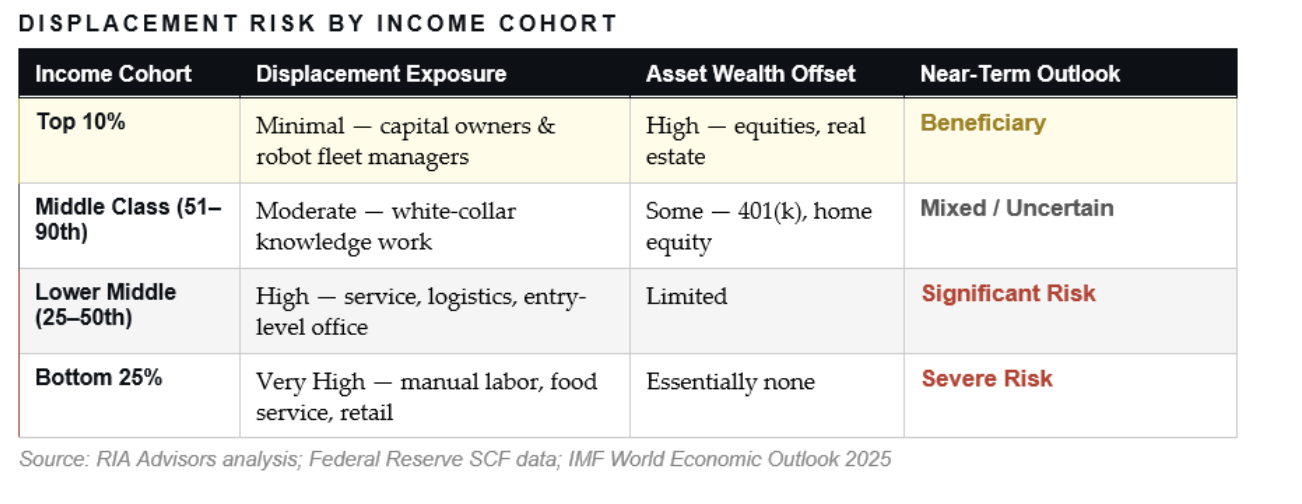
As we concluded in that previous article:
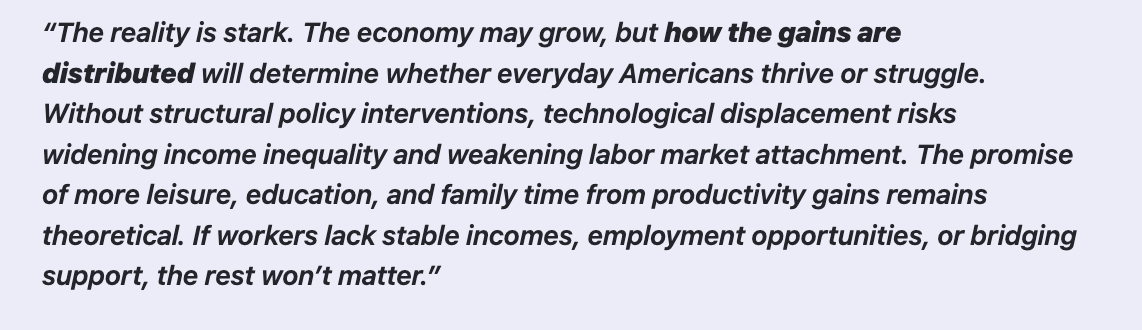
But, this is where the “cries for UBI” become most vocal.
The UBI Trap
When people confront this picture, the political reflex is predictable: send checks. Universal Basic Income has become the default policy proposal for managing automation-driven displacement, and it’s worth taking seriously, not because it works, but because understanding why it doesn’t tells you a great deal about what actually might.
We covered the evidence in detail in our earlier piece on UBI experiments. The real-world results were consistent: cash transfers increased short-term consumption and reduced reported stress. They did not raise employment. They did not meaningfully increase retraining, skill development, or entrepreneurship. The largest behavioral response was an uptick in what researchers categorized as “social and solo leisure activities.” Legendary investor Howard Marks framed the core problem plainly: financial support alone cannot replace the psychological and social benefits of employment. Work provides identity, structure, and purpose, not just income. A check replaces the wage. It replaces nothing else.
The structural flaw is deeper than behavioral. An economy cannot function on transfers alone. Production must precede consumption. When the government sends checks to households without a corresponding increase in productive output, the result is inflation, exactly what 2020–2022 demonstrated. Producers observe increased purchasing power and raise prices to capture it. The real value of the transfer evaporates. A national UBI program large enough to offset meaningful displacement would cost trillions annually, requiring higher taxes or debt expansion, each of which suppresses the private investment needed to create new roles.
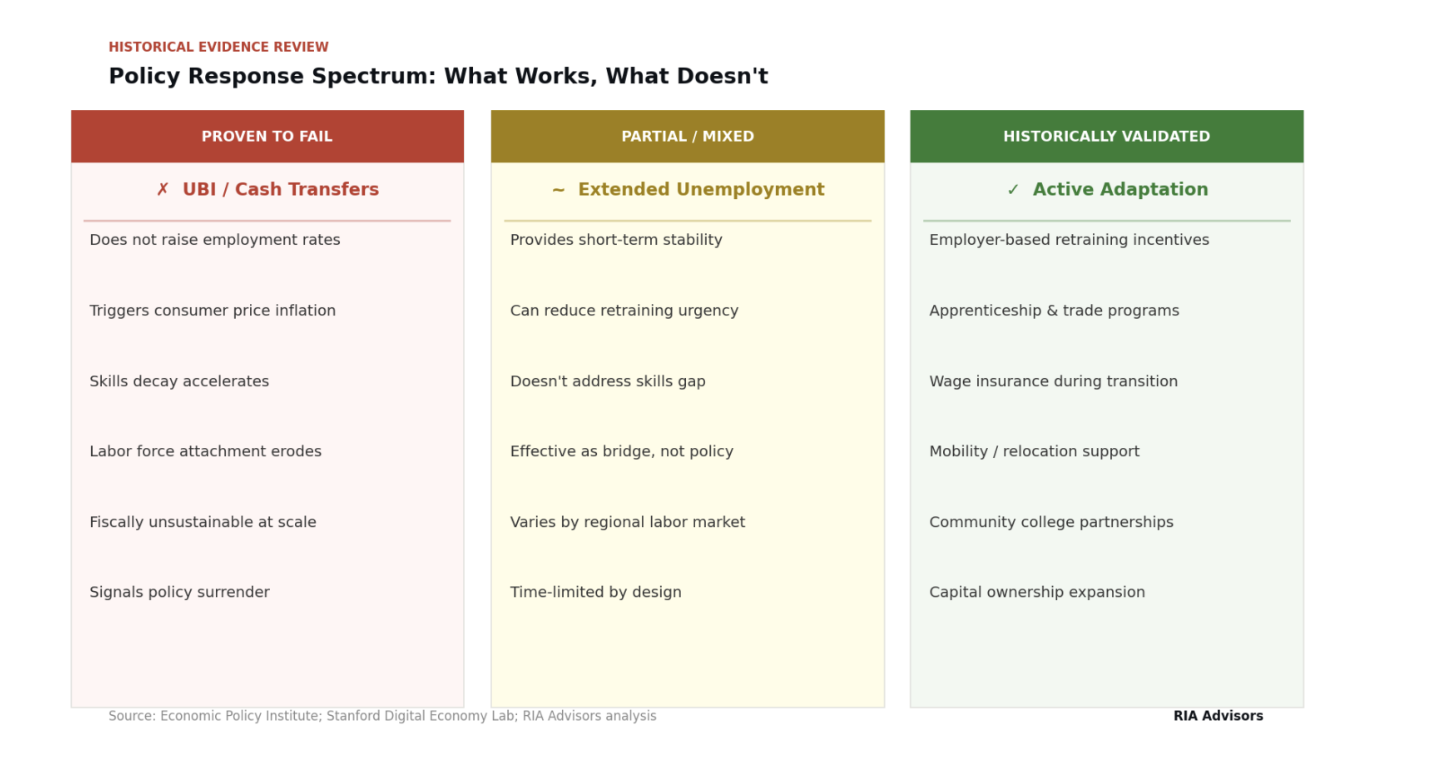
While that all seems bad, there is a more optimistic possibility, and why I want to push back on the dystopian framing. First, I don’t think the outcome is predetermined. The Industrial Revolution created enormous displacement: artisans lost work to mechanized production, and whole trades disappeared. But it also produced a century of rising living standards for people who successfully transitioned into new economic roles. The difference between that transition going well and going badly was not a UBI check. It was access to new skills, new institutions, and new markets.
The economy of humanoid robots creates real demand for roles that robots genuinely cannot fill. Trades requiring tactile judgment in unpredictable environments, such as master electricians, structural engineers, and experienced surgeons, aren’t going anywhere quickly. Secondly, AI and robotics are capital-intensive industries themselves, generating sustained demand for maintenance technicians, fleet managers, training data specialists, and deployment engineers. These aren’t science-fiction roles, but the downstream jobs for the infrastructure being built right now.
Lastly, there’s one lever that doesn’t get discussed enough: ownership. The K-shaped economy is, at its core, a problem of capital ownership. The households that benefit from automation are the ones that own the companies deploying it. Expanding the share of Americans with meaningful exposure to productive capital, whether through 401(k) reforms, Employee Stock Ownership Plans, or accessible investment platforms, does more for long-term inequality than any transfer payment. If a displaced warehouse worker owns shares in the company whose humanoid robots replaced her, the economics look very different than if she doesn’t.
What This Means for Investors Right Now
From a portfolio standpoint, the humanoid robots economy creates some of the most asymmetric opportunities I’ve seen in my career. However, the risk distribution is equally asymmetric, and most retail investors are positioned to capture the downside more than the upside.
The companies building the enabling infrastructure, robotics manufacturers, neural network chip designers, industrial automation software, and energy infrastructure to power the compute are the obvious beneficiaries. But valuations in that space already reflect extraordinary expectations. Morgan Stanley’s Global Investment Committee assigns roughly a 50/50 probability to AI-related capital expenditures meeting investor expectations, noting that implementation timelines frequently slip and productivity gains tend to concentrate in a handful of large firms. That’s not a reason to avoid the sector. It is a reason to size positions carefully and not chase narratives at elevated multiples.
The overlooked angle is the deflationary pressure on companies that rely heavily on service labor. Hospitality, food service, residential services, and logistics firms currently trade at labor cost structures that will look dramatically different in five to seven years. For some, that’s a margin expansion story. For others, it’s a demand destruction story. A significant portion of their customer base works in exactly the jobs being displaced. The companies that survive the transition are the ones that both reduce labor costs and retain the purchasing power of their customer base. That’s a genuinely difficult needle to thread.
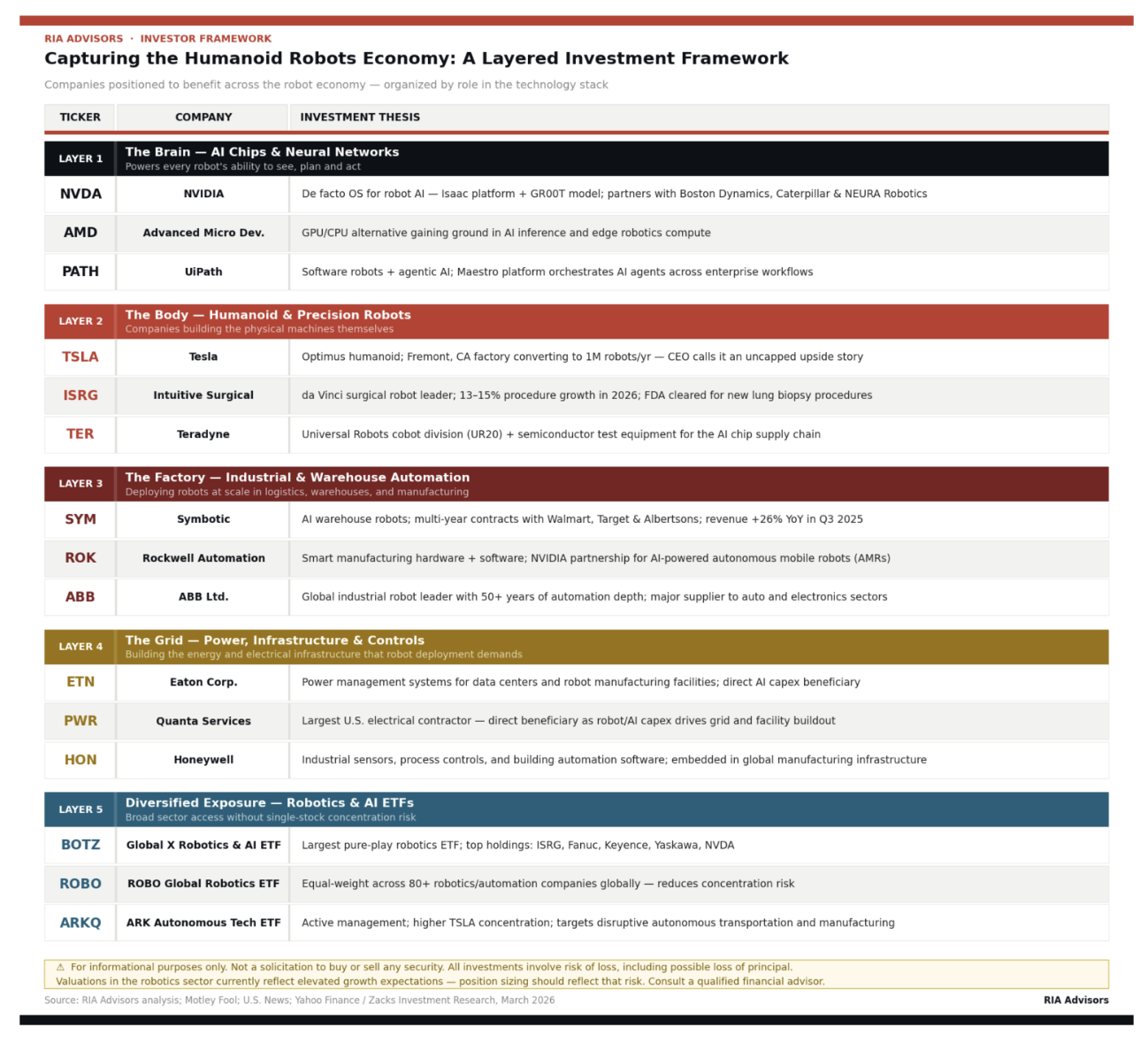
The investors who benefit most from the humanoid robots economy will be those who own the productive assets. Investing in equities, real estate, and capital-allocating businesses will far outpace depending solely on earned income. That pattern is not new. It’s the same dynamic that has driven the K-shaped divergence for the past 50 years. The robotics revolution amplifies it; it doesn’t invent it. Which means the single most important investment decision most Americans can make today has nothing to do with picking the right robotics stock. It’s making sure they own enough capital to participate in the upside that’s coming, whatever form it ultimately takes.
The age of abundance is coming. I genuinely believe that. But abundance distributed through ownership looks completely different from abundance distributed through government transfers. The first compounds. The second erodes. History has run this experiment repeatedly, and the result is not ambiguous. The question isn’t whether humanoid robots will transform the economy. They already are. The question is whether you’re positioned on the right side of the ledger when they do.
Lance Roberts is a Chief Portfolio Strategist/Economist for RIA Advisors. He is also the host of “The Lance Roberts Podcast” and Chief Editor of the “Real Investment Advice” website and author of “Real Investment Daily” blog and “Real Investment Report“. Follow Lance on Facebook, Twitter, Linked-In and YouTube Customer Relationship Summary (Form CRS)
Join RIA Advisors and elevate your career within a deeply experienced team focused on innovation. Our collaborative environment is built on a foundation of advanced technology and effective investment models, designed to enhance your ability to serve clients and grow your practice. Benefit from a supportive culture that encourages professional development and fosters a forward-thinking approach. By joining our team, you’ll be part of a group dedicated to excellence and continuous improvement, empowering you to focus on building meaningful client relationships and pursuing your business ambitions. Discover the advantages of working with our accomplished advisory team by starting your conversation today.
A message from Advisor Perspectives and VettaFi: Discover something new! Click here to register for our upcoming webcasts.
Membership required
Membership is now required to use this feature. To learn more:
View Membership BenefitsSponsored Content
Upcoming Virtual Events View All











