Automotive enthusiasts have coined the phrase malaise era to describe U.S. vehicles made from roughly 1973 to the early 1980s. New emissions and safety standards, plus high gasoline prices following the 1973 oil crisis, permanently reshaped the market. Automakers needed years to engineer more efficient vehicles. In the interim, they hurried out vehicles with detuned motors, lookalike bodies and poor build quality.
The cars of the 1970s were just one component of a regrettable interval. Nations subject to the oil embargo, including the U.S., U.K., Canada, Japan and the Netherlands, saw their unemployment rates roughly double from 1973 to 1975. Inflation rates spiked and struggled to calm down, with inflation in the U.K. exceeding 20%. The circumstances were summarized as stagflation: a combination of stagnant growth, uncontrollable inflation and elevated unemployment.
Worries of stagflation are on the rise again today. Oil prices are adding to the cost of living, while cooling job markets have put households on edge. The risks run globally: regions dependent on energy imports, especially Japan and Europe, are at high risk of an energy-driven inflation cycle. Memories of the 1970s malaise spring to mind, but we do not yet anticipate history to repeat.
Stagflation can be difficult to define. By the numbers, it’s not a recession: economic growth stays positive during these episodes, and the unemployment rate may even improve mildly, though from a higher starting point. To a typical person, however, it feels like a recession. Inflation makes most households feel they are falling behind, while persistent unemployment makes them feel they can’t get ahead. A simple measure that took hold in the 1970s was the misery index, the sum of the unemployment rate and the rate of inflation. The higher the index, the worse the malaise.
The trigger for a stagflation cycle is typically an inflationary supply shock. While it may prove temporary, stagflation takes hold if the shock meets already-elevated inflation, a slowing economy and a weak policy response. A wage-price spiral can then sustain the cycle: workers demand higher pay to meet the cost of living, which allows prices to rise further.
The 1973 oil embargo was a clear shock to global energy markets. It sparked stagflation because the decade had gotten off to a sluggish start, with many nations seeing an industrial slowdown and higher unemployment. In the U.S., a politically-swayed Federal Reserve could not achieve inflation below 3%, though government spending on the Vietnam War and Great Society did not make stable prices any easier to achieve.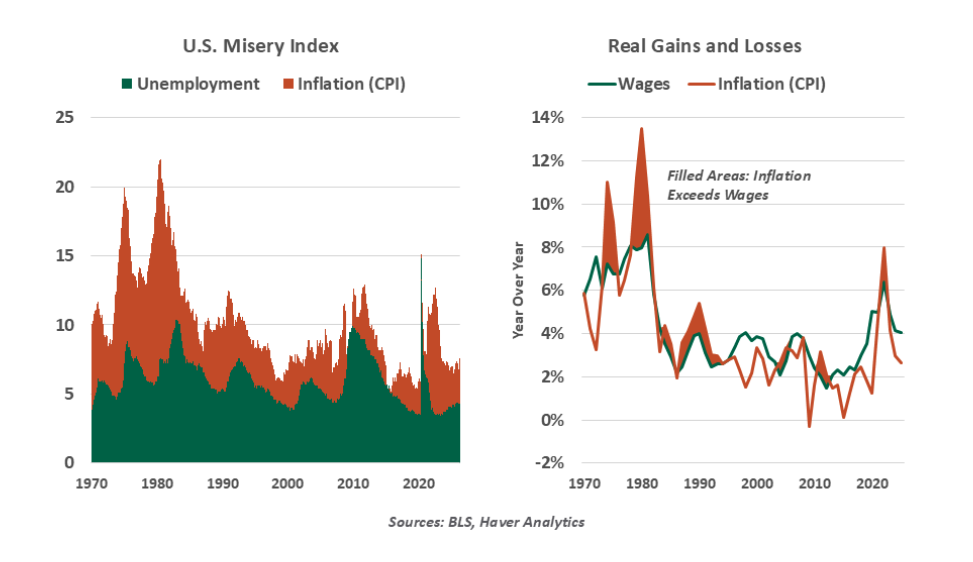
Stagflation cycles cannot be cured without some pain. A stimulative push for growth would risk adding to inflation. A recession can arrest inflation, allowing growth to reset sustainably. High interest rates and the recessions of the 1980s were the tough medicine needed to change course.











