In the current market, broad healthcare exposure means navigating relentless regulatory pressure and drug-pricing reform, a combination that can erode returns quickly. To find true value in this challenging macro environment, investors are increasingly turning to cash as the ultimate truth-teller, specifically, free cash flow (FCF).
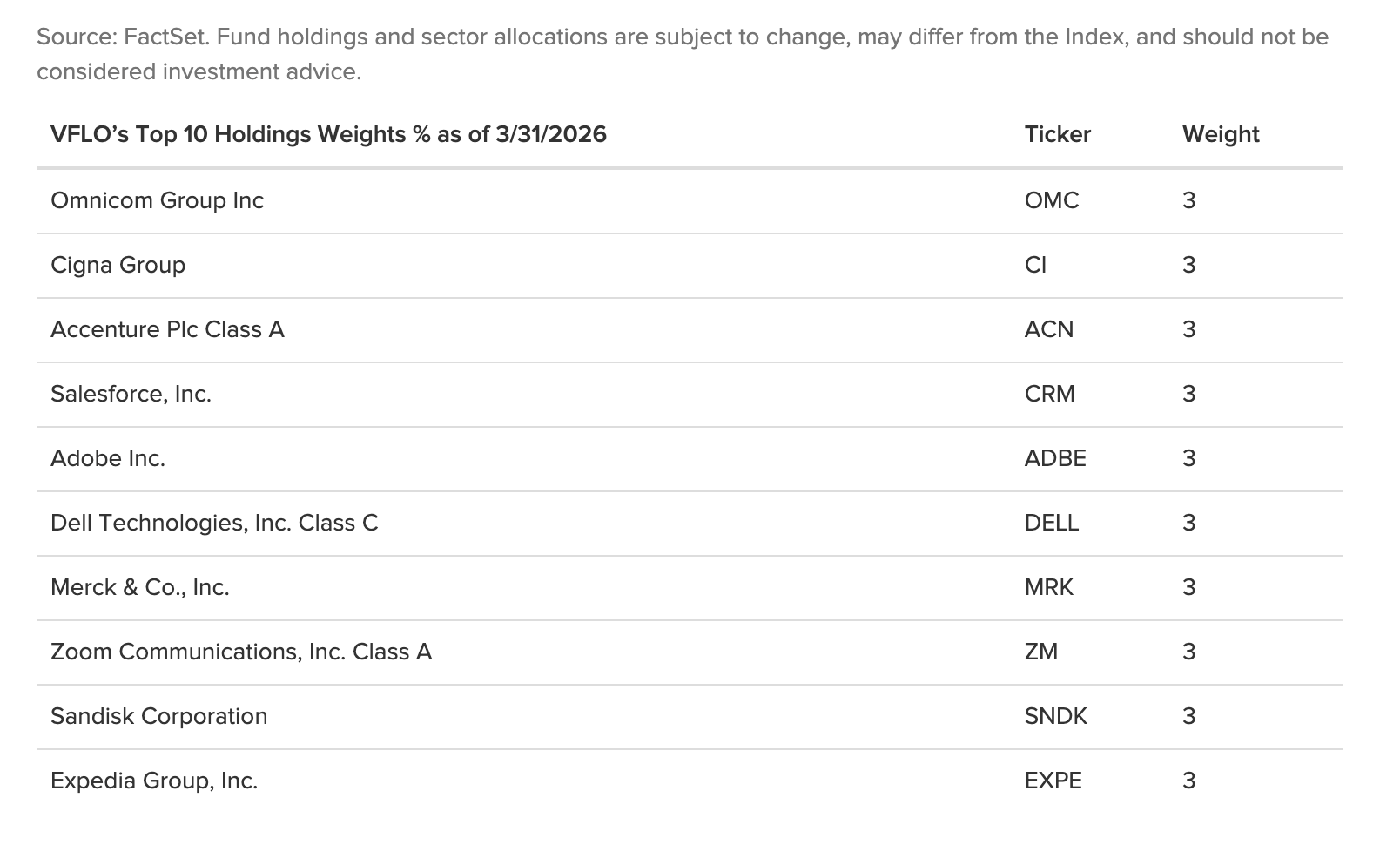
Merck (MRK) stands as a prime example of what FCF screening surfaces. A pharmaceutical giant recognized for consistent, high-volume free cash flow generation, Merck currently appears as a holding in the VictoryShares Free Cash Flow ETF (VFLO B+). As of March 31, 2026, VFLO held a 2.92% weight in MRK.
During VFLO’s most recent rebalance assessment on March 12, 2026, Merck’s expected FCF yield of 5.72%, the average of a 6.15% trailing yield and a 5.29% forward estimate, reflects a company generating durable, consistent cash flow rather than a one-period anomaly. That profile, combined with positive sales and EBITDA trends of 4.92% and 9.24%, respectively, positions Merck as a fundamentally sound holding within a rules-based, cash-flow-driven framework.
Muting the Healthcare Noise
In the healthcare sector, investor sentiment can shift rapidly. Clinical trial outcomes and legislative shifts can send a stock swinging wildly. When negative market sentiment clouds a company’s outlook, FCF can mute the noise.
By targeting companies with high FCF yields, VFLO identifies businesses built to weather industry volatility, supported by the cash reserves to prove it. For Merck specifically, consistent FCF generation provides a layer of protection that an earnings report alone might miss.
VFLO tracks the Victory U.S. Large Cap Free Cash Flow Index, which screens for companies with strong expected free cash flow, a forward-looking measure but not merely a trailing one. The result is a portfolio of companies positioned to grow their cash flow, not just companies that already have.
FCF Reveals the Truth
Merck’s market position is anchored by a high-margin oncology portfolio and a disciplined approach to R&D. While headlines about Merck may focus on topical issues such as patent cliffs or drug-pricing reform, the company’s FCF tells the true story.
“Merck generates a lot of free cash flow,” said VictoryShares Client Portfolio Manager Michael Mack in an interview with TMX VettaFi at ETF Exchange 2026. “When you have free cash flow, you have two things in your favor. Number one, you’re going to have a strong balance sheet. Number two, you can take that cash flow and reinvest in your business, often through acquisition. So Merck has been doing acquisitions to grow their pipeline and R&D.”
The firm has been making key acquisitions to scale its operations, including the acquisition of Cidara Therapeutics earlier this year.
Merck is a textbook example of how VFLO surfaces value in an industry under pressure. In an environment where elevated borrowing costs and stubborn inflation squeeze capital-dependent companies, Merck’s ability to self-finance is a meaningful competitive advantage.
As growth valuations look increasingly stretched, the discipline of free cash flow becomes more relevant. The VictoryShares Free Cash Flow ETF applies that discipline systematically, screening for companies whose cash flow is growing, not merely present, and whose scale and trajectory support that growth going forward. For investors who want that rigor embedded in a single, cost-efficient vehicle, VFLO delivers it at a net expense ratio of just 0.39% (gross expense ratio of 0.44%).
For more news, information, and analysis, visit the Free Cash Flow Content Hub
VettaFi LLC (“VettaFi”) is the index provider for VFLO, for which it receives an index licensing fee. However, VFLO is not issued, sponsored, endorsed, or sold by VettaFi, and VettaFi has no obligation or liability in connection with the issuance, administration, marketing, or trading of VFLO.

Disclosure Information
Carefully consider a fund’s investment objectives, risks, charges, and expenses before investing. To obtain a prospectus or summary prospectus containing this and other important information, visit http://www.vcm.com/prospectus. Read it carefully before investing.
All investing involves risk, including the potential loss of principal. The market prices of securities may go up or down, sometimes rapidly or unpredictably, due to general market conditions, such as real or perceived adverse economic, political, or regulatory conditions, recessions, inflation, or changes in interest or currency rates. VFLO has the same risks as the underlying securities traded on the exchange throughout the day. ETFs may trade at a premium or discount to their net asset value. Investing in companies with high free cash flows could lead to underperformance when such investments are unpopular or during periods of industry disruptions. The fund could also be affected by company-specific factors that could jeopardize the generation of free cash flow. Index Funds invest in securities included in, or representative of securities included in, the Index, regardless of their investment merits. The performance of the Fund may diverge from that of the Index. Large shareholders, including other funds advised by the Adviser, may own a substantial amount of the Fund’s shares. The actions of large shareholders, including large inflows or outflows of cash, may adversely affect other shareholders, including potentially increasing capital gains. Investments concentrated in an industry or group of industries may face more risks and exhibit higher volatility than investments that are more broadly diversified over industries or sectors. Investments in companies in the energy sector may be subject to substantial government regulation, as well as risks involving changes in energy prices, international political instability, and liability for environmental damage and accidents resulting in loss of life or property. The profitability of companies in the healthcare sector may be affected by government regulations and healthcare programs, fluctuations in the cost of, and demand for, medical products and services and product liability claims. Derivatives may not work as intended and may result in losses. The Fund may frequently change its holdings, resulting in higher fees, lower returns, and more capital gains. The value of your investment is also subject to geopolitical risks such as wars, terrorism, trade disputes, environmental disasters, and public health crises; the risk of technology malfunctions or disruptions; and the responses to such events by governments and/or individual companies.
The Victory U.S. Large Cap Free Cash Flow Index aims to select high quality companies from its starting universe by applying profitability screens. It then selects companies with the strongest free cash flow yield that exhibit higher growth. The Index is rebalanced and reconstituted quarterly. This Index calculates free cash flow yield by dividing expected free cash flow by enterprise value. Expected free cash flow is the average of trailing 12-month FCF and next 12-month forward free cash flow. Enterprise value (EV) measures a company’s total value, often used as a more comprehensive alternative to equity market capitalization.
VictoryShares ETFs distributed by Victory Capital Services, Inc. (VCS). VCS is not affiliated with VettaFi.
©2026 Victory Capital Management Inc. All Rights Reserved.
20260506-5444796
A message from Advisor Perspectives and VettaFi: Discover something new! Click here to register for our upcoming webcasts.
Read more commentaries by VettaFi