Investing in emerging markets (EM) used to be synonymous with getting exposure to China. It’s an ideal notion, given that it’s the second largest economy and thus commands a heavy weight in standard EM benchmarks. Challenging that narrative today is a changing geopolitical landscape, which continues as U.S. president Donald Trump visits China in a high-stakes meeting between the two economic superpowers.
In years past, tariff spats between the two nations have led to investors decoupling China exposure in ETFs. As both nations negotiate complex trade and security issues, the potential for sudden policy shifts reinforces investors’ need to exclude China from their portfolios to mitigate geopolitical risk in the short-term. Whatever happens in these latest negotiations, ETFs tailormade for ex-China exposure have that specific built-in risk mitigation.
Key Takeaways:
With President Trump’s high-stakes visit to China highlighting ongoing trade friction, investors increasingly use ex-China ETFs to isolate emerging market growth from the idiosyncratic risks of the world’s second-largest economy.
The MSCI Ex-China Index continues to outpace broad EM benchmarks in 2026, driven by growth engines in India, Taiwan, and Brazil. Meanwhile, specialized funds like FRDM and NSI add layers of “freedom” and national security screening.
The ex-China landscape has become highly competitive; investors can now choose between ultra-low-cost passive options like VEXC (7 bps) or surgical, actively managed portfolios like AVXC and EMM for professional oversight.
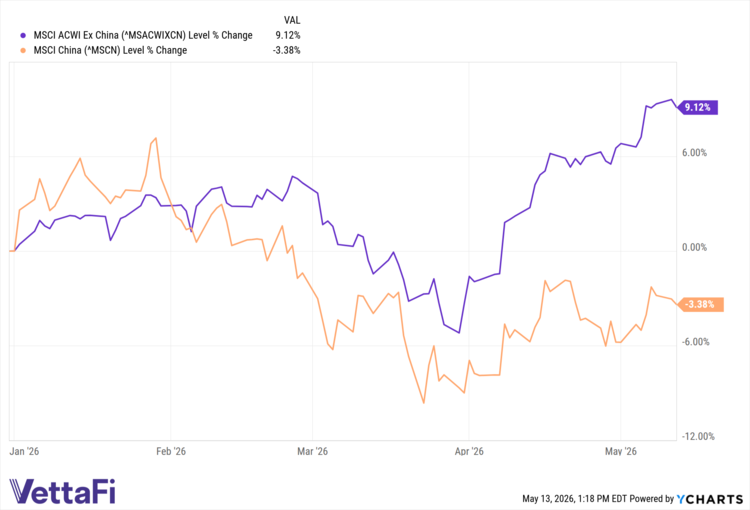
Why look at ex-China ETFs to begin with? Performance certainly plays a factor as the MSCI Ex-China Index has been outpacing the MSCI China Index so far this year. Ex-China ETFs offer investors easy ingress into EM exposure without the associated risk tied to China.
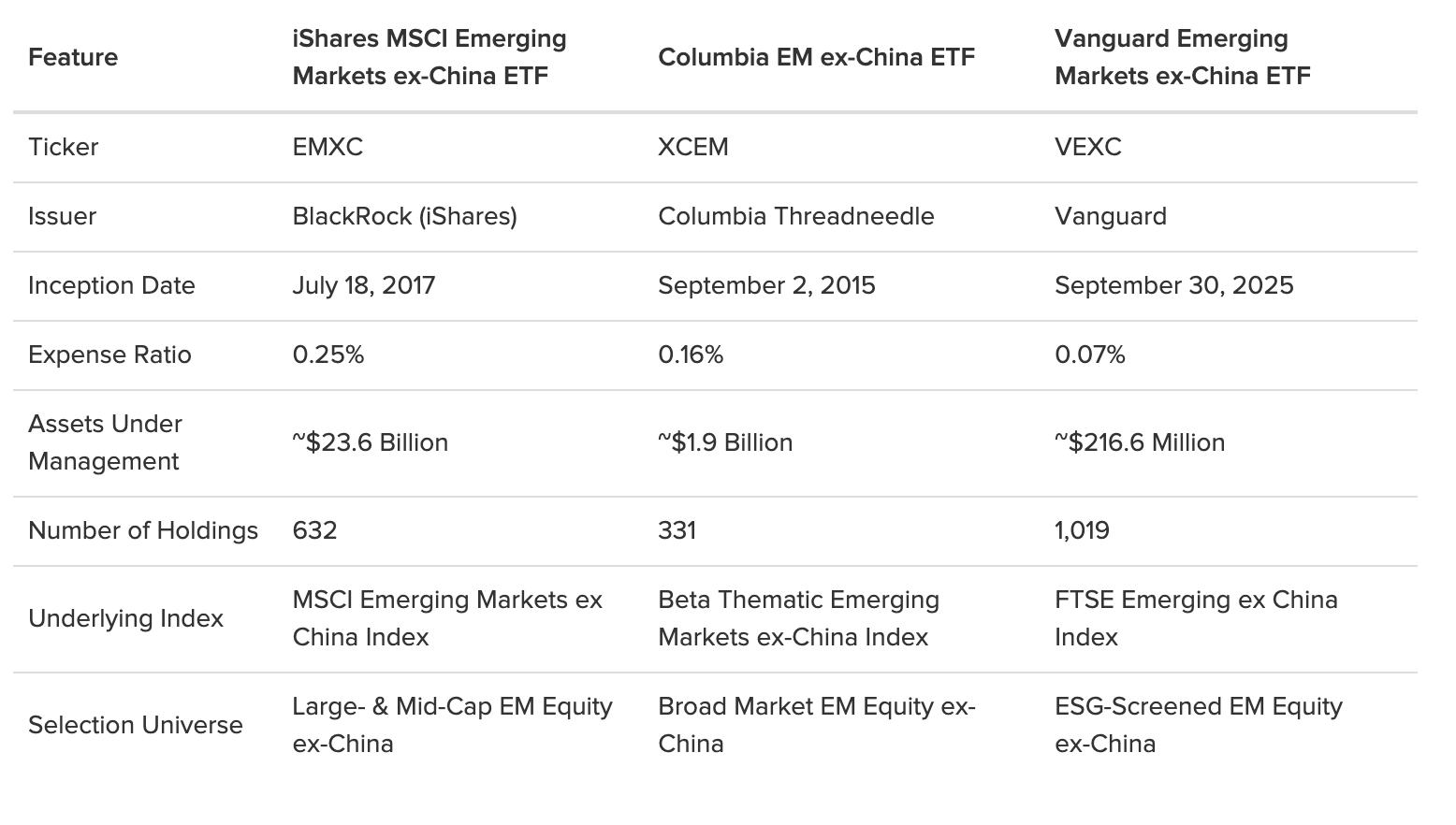
That said, a look at ex-China ETFs can begin with the biggest passive funds among this collective. With almost $24 billion in assets, the list starts with the iShares MSCI Emerging Markets ex China ETF (EMXCB+). Incepted in the summer of 2017, EMXC provides a broad, market-cap-weighted approach that re-allocates what would typically be reserved for China exposure to other growth engines like India, Taiwan, and Brazil.
At 16 basis points (bps) and almost $2 billion in assets, the Columbia EM Core ex-China ETF (XCEMB-) is another option. The fund tracks the Beta Thematic Emerging Markets ex-China Index, providing broad exposure to mostly large- and midcap companies across various emerging economies.
At over $220 million assets and counting, the Vanguard Emerging Markets Ex-China ETF (VEXC) just came onto the ex-China scene late last year. This fund meets the ex-China mandate by tracking the FTSE Emerging ex-China Index. In typical Vanguard fashion, it competes with its peers by outpricing the competition. At just seven bps, it will certainly draw more interest — and more importantly, more assets.
A side-by-side comparison of these ETFs with data from ETF Database:
Active Fund Options
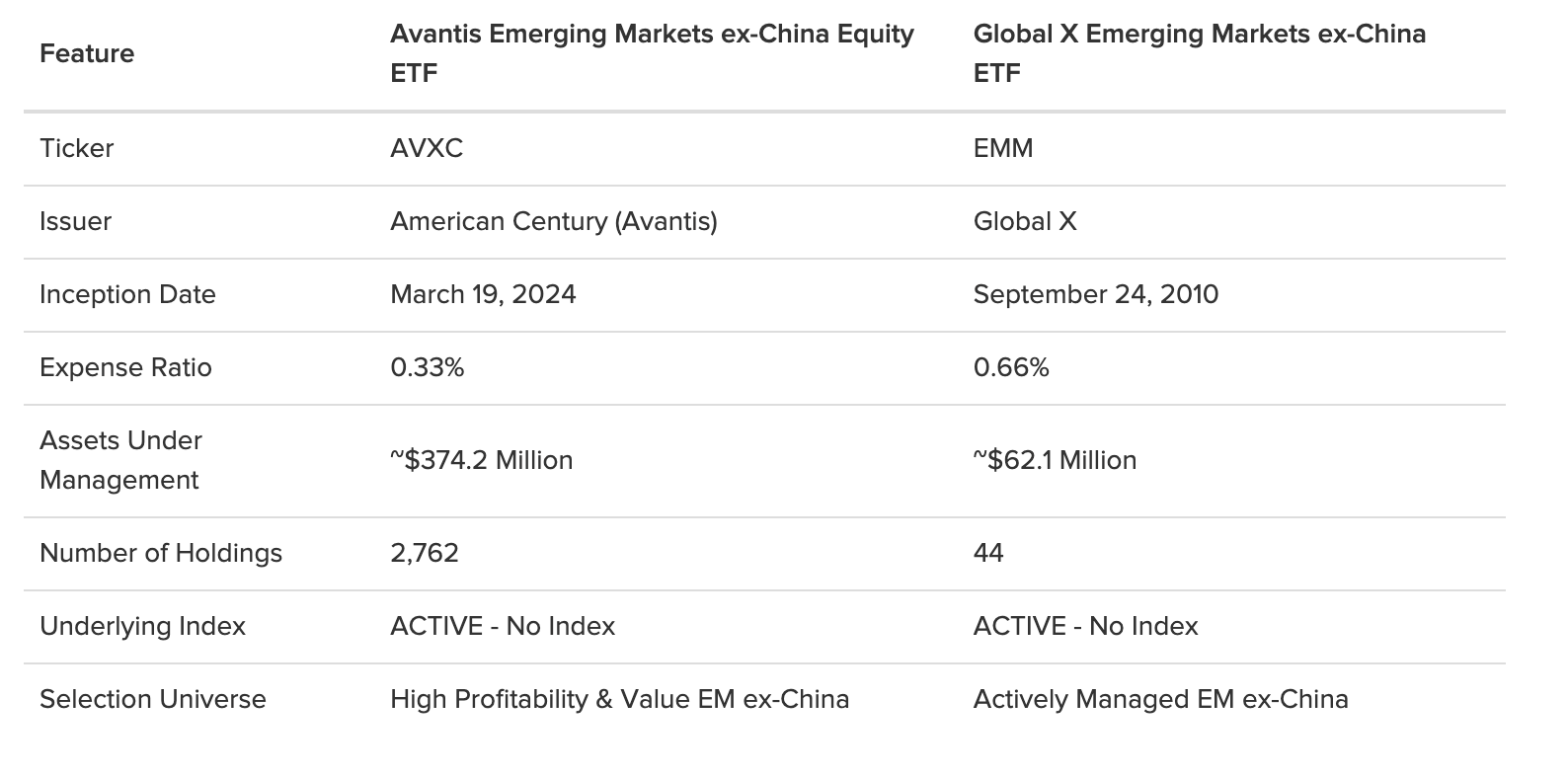
For those preferring an actively managed approach, the Avantis Emerging Markets ex-China Equity ETF (AVXCB+) is a compelling option with an expense ratio of 33 bps. Benchmarked to the MSCI Emerging Markets IMI Index, AVXC specifically targets companies of all cap sizes exhibiting high profitability and attractive valuations while avoiding the idiosyncratic risks tied to China equities.
To balance out the active options, the Global X Emerging Markets ex-China ETF (EMMC) is another alternative. Given its active management, the portfolio is highly curated compared to its peers, as evidenced by its only 44 holdings. With the complexities and nuanced nature of EM assets, having the portfolio actively managed by experts in the sector may give investors added peace of mind.
A side-by-side comparison of these ETFs with data from ETF Database:
Differentiated Ex-China ETFs
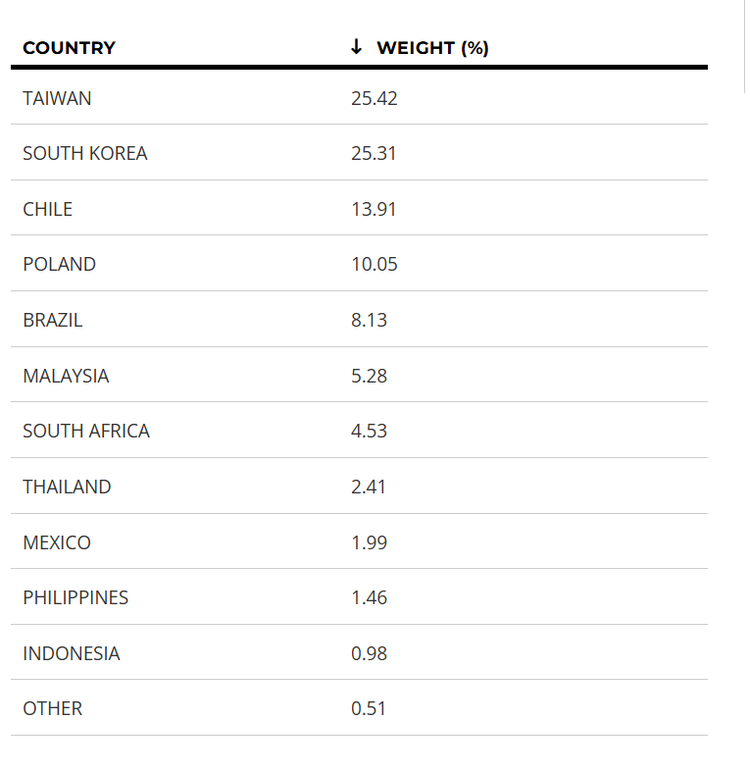
While ex-China ETFs specifically focus on geographic exclusion, other ETFs take a differentiated approach. For example, the Freedom 100 Emerging Markets ETF (FRDMC) uses a data-driven “Freedom Weighting” methodology as opposed to a typical market cap-weighted approach. By tracking the Life + Liberty Freedom 100 Emerging Markets Index, FRDM ranks countries based on indicators of civil, political, and economic freedom. In essence, the fund tilts towards exposure to more stable, rule-of-law-based economies. Note the exclusion of China in the fund’s top country weights (as of May 13).
Similarly, the National Security Emerging Markets Index ETF (NSIB+) offers a unique focus on national security and sovereignty for EM exposure. EM indexes may inadvertently include constituents that are subject to U.S. sanctions, involved in espionage, or linked to human rights abuses. To counter this, NSI employs a rigorous National Security Governance (NSG) process built upon the U.S. Intelligence Cycle. Given this discerning screener, the fund filters out companies that pose strategic threats or cybersecurity risks. By tracking the Alerian National Security Emerging Markets Index rather than the MSCI index, NSI essentially screens out bad actors that endanger national security interests.
Additionally, getting ex-China exposure isn’t relegated to just equities. Such is the case with the Sprott Rare Earths Ex-China ETF (REXC), which launched just last month. By tracking the Nasdaq Sprott Rare Earths Ex-China Index (the Index), REXC offers investors a targeted way to capitalize on reworking the global mineral supply chain by avoiding companies domiciled in China. Historically, China has held a controlling interest in rare earth mining as well as processing and refining capacity. This near-monopoly creates greater risk as trade friction or export restrictions from Western sanctions can disrupt global supply chains.