The rapid deployment of artificial intelligence (AI) is evident; 99% of CEOs say their companies are investing in the technology. Apparently, AI is also quick at garnering assets. Launched less than three months ago, the Pictet AI Enhanced US Equity ETF (PQUS) is already approaching the $100 million mark in assets under management (AUM).
Key Takeaways:
-
PQUS has approached the $100 million AUM mark in less than three months, underscoring strong investor demand for shifting artificial intelligence from a speculative theme into a core portfolio-building tool.
-
At a competitive 22 basis points, PQUS blends a transparent, factor-neutral AI model analyzing 250+ data features with human portfolio managers serving as vital institutional guardrails.
-
Investors can choose between PQUS’s diversified, factor-neutral broad market strategy or factor-focused alternatives like AIVL, which applies machine learning to extract specific value tilts.
AI No Longer a Theme
Needless to say, AI is no longer just a hot investment team, but a portfolio-building tool. Launched on February 25, PQUS has already garnered $88 million in assets.
What’s all the hype about? The fund has three Ps working in its favor—price, investors’ proclivity towards something new and interesting, and Pictet. The Geneva-based Pictet Asset Management has been around since 1805, but entered the U.S. ETF market last year with the debut of three funds: the Pictet AI Enhanced International Equity ETF (PQNT), Pictet Cleaner Planet ETF (PCLN), and Pictet AI & Automation ETF (PBOT).
The early success of PQUS underscores a growing appetite among certain investors looking beyond the rigid constraints of passive funds tracking market cap-weighted indices. They’re seeking highly disciplined, risk-managed AI-focused strategies to extract consistent outperformance.
Cost-Effective Quant 2.0
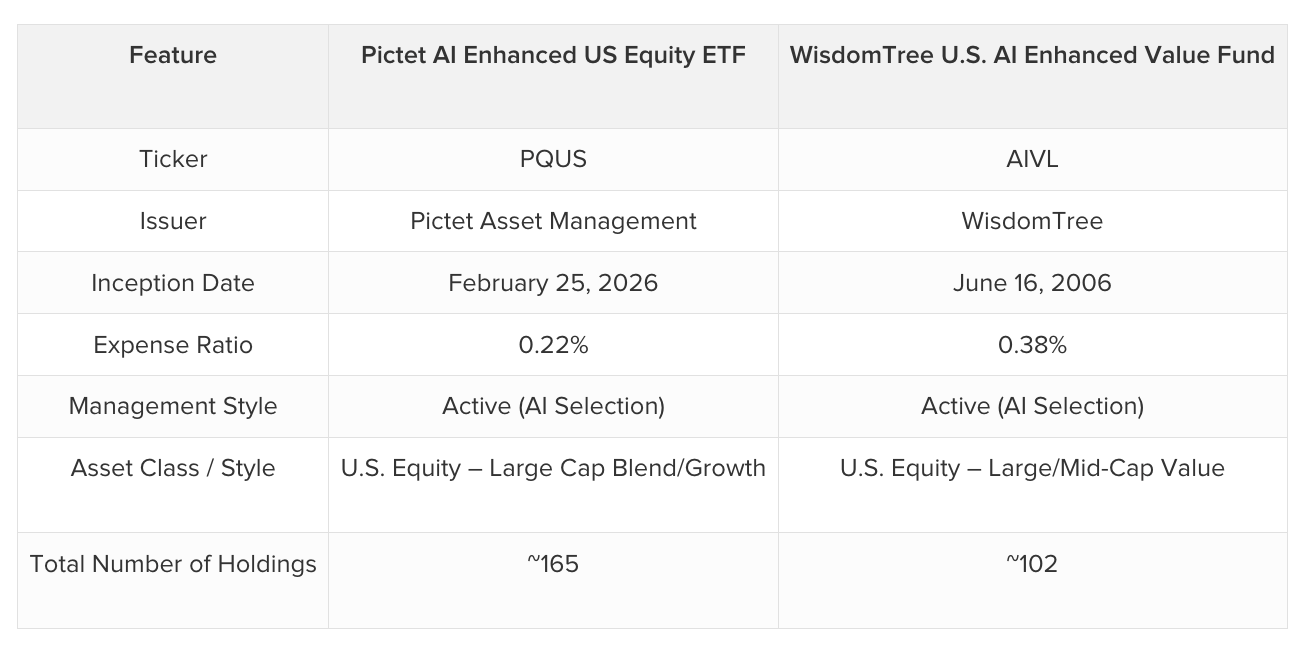
PQUS delivers its AI strategy at a competitively priced expense ratio of 22 basis points for an active fund. This is less than half the FactSet Segment Average. At a time when fee compression is paramount in a competitive ETF marketplace, the 0.22% expense ratio puts it on par with passive alternatives despite its active, tech-driven methodology.
What truly sets PQUS apart is its operational philosophy, dubbed “Quant 2.0.” The AI model is engineered to be fully transparent and factor-neutral. Per its prospectus, the model analyzes over 250+ data features such as fundamentals, sentiment, price activity, and short interest to make relative forecasts. A proprietary optimizer combines these predictions with risk constraints to generate buy and sell recommendations.
However, AI doesn’t get the final say. Portfolio managers review and approve the recommendations before becoming part of the portfolio. The fund operates under the direct oversight of a veteran investment team with 25 years of institutional experience in quantitative investing. Furthermore, Pictet’s team members are established thought leaders in Artificial Intelligence and Machine Learning (AI/ML) techniques. Before introducing this strategy to the U.S. market, the team successfully engineered and ran similar machine-learning strategies across their European fund lineups, bringing a battle-tested track record to PQUS.
Additionally, PQUS seeks to outperform the broad market with low tracking error. The algorithm targets a maximum of up to 2% tracking error relative to its benchmark index, which preserves broad-market beta.
A Value-Focused AI Option
With AI proliferating as a portfolio construction tool, there are other funds to consider in this burgeoning space that already have an established footprint in the U.S. market. While PQUS takes a factor-neutral approach, investors may be opting for factor tilts such as value. For example, the WisdomTree U.S. AI Enhanced Value Fund (AIVL), incepted in 2006, utilizes a proprietary, quantitative AI model developed by Voya Investment Management Co. to find value-oriented stocks.
Certain AI-driven investment strategies may lean into momentum or growth sectors to generate alpha. On the other hand, AIVL applies machine learning specifically to the large-cap U.S. value equity space. The algorithm evaluates companies based on standard value factors such as attractive valuations, cash flow characteristics, and quality metrics.
Like PQUS, AIVL is also actively managed though investors will need to pay 16 basis points more to get the value-focused tilt. AIVL typically limits its portfolio to around 100 high-conviction positions to establish a targeted allocation compared to the more diversified PQUS with its 165 holdings.
A New Era for Core Exposure
The rapid march of PQUS to $100 million in assets signals that AI-enhanced investing is quickly becoming part and parcel when it comes to portfolio construction. While established funds like AIVL prove that AI can effectively navigate the U.S. market to extract value, PQUS is demonstrating that Quant 2.0 can optimize core exposure.
For modern investors, PQUS offers a sophisticated mechanism to keep the market exposure they expect while letting AI capture the marginal alpha that passive indexing may overlook. At the same time, humans aren’t left out in the process with its established portfolio managers serving as the necessary guardrails for building the final portfolio.

For more news, information, and analysis, visit VettaFi | ETF Trends.
A message from Advisor Perspectives and VettaFi: Discover something new! Click here to register for our upcoming webcasts.
Read more commentaries by VettaFi